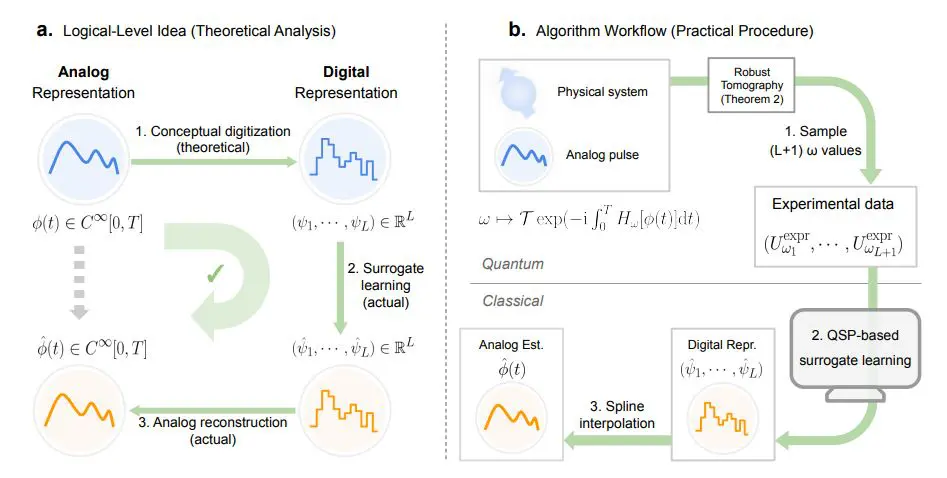
Analog quantum simulators hold immense promise for exploring complex physical phenomena, but achieving accurate results demands precise control of time-dependent pulses, a challenge that existing calibration methods struggle to address. Yulong Dong from University of Michigan, Christopher Kang from University of Chicago, and Murphy Yuezhen Niu from Google Quantum AI now present a novel characterization algorithm that directly learns these continuous pulse trajectories within the simulator itself. Their method extends a signal processing framework to analyse time-dependent pulses, reconstructing a smooth, accurate pulse from queries of the system’s evolution, and crucially, avoids the performance limitations of conventional approaches. This breakthrough delivers a lightweight and robust validation protocol for analog simulators, capable of detecting significant hardware faults and paving the way for more reliable exploration of complex quantum systems.
Existing calibration methods, developed for digital quantum computers, struggle with continuous pulse trajectories. This research introduces a novel characterisation algorithm that learns these trajectories in situ by extending the Quantum Signal Processing (QSP) framework to analyse time-dependent pulses, combining it with a logical-level analog-digital mapping for precise control and characterisation.
Robust Pulse Reconstruction From Noisy Measurements
This research addresses the challenge of accurately implementing quantum control pulses in real-world experiments where imperfections in hardware introduce errors. The team developed a robust method for reconstructing these control pulses from noisy measurements, accounting for realistic hardware limitations and focusing on improving the accuracy of the quantum operation applied to a qubit. The Pauli Transfer Matrix efficiently characterises this operation, providing a compact representation of the transformation, while a method for simulating realistic hardware imperfections in numerical simulations ensures the robustness of control methods. A key innovation is an algorithm that aligns the signs of the reconstructed transformations, ensuring correct phase and accurate control.
Analog Simulator Validation Via Pulse Reconstruction
This research presents a novel method for accurately characterising and validating analog quantum simulators. The team extended the Signal Processing (QSP) framework to learn and reconstruct the precise time-dependent pulses necessary for controlling these simulators, overcoming limitations of existing calibration techniques. By analysing the time-ordered propagator, the method establishes a smooth pulse trajectory without requiring complex mid-circuit measurements or extensive computational resources, demonstrably achieving high accuracy and robustness against common errors such as state preparation and measurement (SPAM) errors and depolarizing noise. Importantly, the method avoids performance degradation associated with segmenting the simulation, maintaining accuracy even as complexity increases, and provides a lightweight validation protocol for identifying major hardware faults. Future work could focus on applying this technique to more complex quantum systems and exploring its potential for optimizing pulse sequences to further enhance simulation accuracy.
👉 More information
🗞 In Situ Quantum Analog Pulse Characterization via Structured Signal Processing
🧠 ArXiv: https://arxiv.org/abs/2512.03193