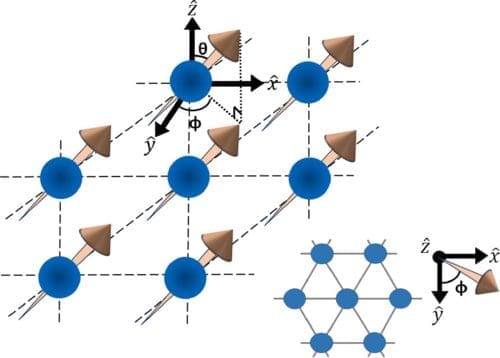
A team of researchers from various institutions has made significant contributions to the field of quantum physics by studying the programmable order by disorder effect and the dipolar bosonic model in quantum simulators. The study, led by HuanKuang Wu from the University of Maryland, provides valuable insights into the behavior of quantum systems and the potential applications of quantum simulators. The research, which was published in the Physical Review Research journal, could lead to the development of more efficient and powerful quantum computers and further our understanding of complex systems.
What is the Programmable Order by Disorder Effect in Quantum Simulators?
The programmable order by disorder effect is a phenomenon observed in quantum simulators, which are devices that use quantum mechanics to simulate complex systems. This effect is characterized by the presence of subextensive degenerate ground states in the classical limit of a system, which are composed of continuous strings with a high degree of freedom in their configuration. In this study, the researchers focused on two configurations: the stripe up and down spins aligning straightly and the kinked up and down spins forming zigzag spin chains patterns.
The researchers used real space perturbation theory to estimate the leading order energy correction when the nearest-neighbor spin exchange coupling, denoted as J, is considered. The overall model becomes an effective XXZ model with a spatial anisotropy. Their calculations demonstrated a lifting of the degeneracy, favoring the stripe configuration. When J becomes larger, the researchers adopted the infinite projected entangled-pair state (iPEPS) and numerically checked the effect of degeneracy lifting. The iPEPS results showed that even when the spin exchange coupling is strong, the stripe pattern is still favored.
The programmable order by disorder effect was studied in a quantum simulator composed of circular Rydberg atoms in a triangular optical lattice with a controllable diagonal anisotropy. This system, known as the S12 system, can be programmed in the quantum simulator. The researchers’ findings provide valuable knowledge about the quantum order by disorder effect of the S12 system.
How Can the Dipolar Bosonic Model be Realized in Quantum Simulators?
The researchers also studied the dipolar bosonic model with a tilted polar angle, which can be realized through a quantum simulator composed of cold atomic gas with dipole-dipole interaction in an optical lattice. By placing the atoms in a triangular lattice and tilting the polar angle, the diagonal anisotropy can also be realized in the bosonic system.
The researchers used cluster mean-field theory calculation to provide various phase diagrams for the bosonic system. These diagrams are useful for understanding the behavior of the system under different conditions. The researchers’ work on the dipolar bosonic model contributes to the understanding of how quantum simulators can be used to simulate complex systems.
The study of the dipolar bosonic model and the programmable order by disorder effect in quantum simulators is a significant contribution to the field of quantum physics. The researchers’ findings provide valuable insights into the behavior of quantum systems and the potential applications of quantum simulators.
Who are the Researchers Behind this Study?
The study was conducted by a team of researchers from various institutions. HuanKuang Wu from the Department of Physics, Condensed Matter Theory Center, and Joint Quantum Institute at the University of Maryland led the research. Takafumi Suzuki from the Graduate School of Engineering at the University of Hyogo, Naoki Kawashima from the Institute for Solid State Physics at the University of Tokyo and the Transscale Quantum Science Institute at the University of Tokyo, and WeiLin Tu from the Faculty of Science and Technology at Keio University were also part of the research team.
The researchers’ diverse backgrounds and expertise contributed to the depth and breadth of the study. Their collaborative effort resulted in a comprehensive study that provides valuable insights into the programmable order by disorder effect and the dipolar bosonic model in quantum simulators.
The research was received on 11 October 2023, accepted on 21 May 2024, and published on 20 June 2024 in the Physical Review Research journal. The publication of the research in a reputable journal attests to the quality and significance of the researchers’ work.
What are the Implications of this Research?
The researchers’ study on the programmable order by disorder effect and the dipolar bosonic model in quantum simulators has significant implications for the field of quantum physics. Their findings provide valuable insights into the behavior of quantum systems and the potential applications of quantum simulators.
The programmable order by disorder effect, in particular, is a phenomenon that has potential applications in quantum computing. Understanding this effect could lead to the development of more efficient and powerful quantum computers. The researchers’ findings on the dipolar bosonic model also contribute to the understanding of how quantum simulators can be used to simulate complex systems.
The researchers’ work contributes to the advancement of knowledge in the field of quantum physics. Their findings could potentially lead to the development of new technologies and applications in quantum computing and other areas.
What are the Future Directions of this Research?
The researchers’ study provides a solid foundation for future research in the field of quantum physics. Their findings on the programmable order by disorder effect and the dipolar bosonic model in quantum simulators open up new avenues for exploration.
Future research could focus on exploring other configurations of the programmable order by disorder effect. Understanding the behavior of these configurations could provide further insights into the phenomenon and its potential applications. Future research could also focus on exploring other models that can be realized in quantum simulators.
The researchers’ work also raises interesting questions about the behavior of quantum systems. Future research could focus on exploring these questions and further advancing our understanding of quantum physics. The potential applications of the researchers’ findings in quantum computing and other areas also present exciting opportunities for future research.
Conclusion
The researchers’ study on the programmable order by disorder effect and the dipolar bosonic model in quantum simulators is a significant contribution to the field of quantum physics. Their findings provide valuable insights into the behavior of quantum systems and the potential applications of quantum simulators. The research opens up new avenues for exploration and raises interesting questions about the behavior of quantum systems. The potential applications of the researchers’ findings in quantum computing and other areas present exciting opportunities for future research.
Publication details: “Programmable order by disorder effect and underlying phases through dipolar quantum simulators”
Publication Date: 2024-06-20
Authors: Huan-Kuang Wu, T. Suzuki, Naoki Kawashima, Wei-Lin Tu, et al.
Source: Physical review research
DOI: https://doi.org/10.1103/physrevresearch.6.023297