The challenge of controlling light flow in nanoscale devices receives a significant boost from new research into carbon nanostructures, as Álvaro Rodríguez Echarri from the Max-Born-Institut and NWO Institute AMOLF, along with F. Javier García de Abajo from ICFO-Institut de Ciencies Fotoniques and Joel D. Cox from the University of Southern Denmark, demonstrate a pathway to overcome limitations imposed by conventional materials. This team investigates how applying an electrical current to nanoscale ribbons and tubes made of carbon alters the way light propagates within them, achieving a nonreciprocal response previously difficult to obtain. The research reveals that even a moderate electrical bias dramatically breaks reciprocity for light travelling through these structures, effectively allowing active control over light flow and enabling interactions between multiple light sources. These findings establish carbon nanostructures as a highly promising platform for developing atomically thin devices for advanced nanophotonics.
Chiral Carbon Nanostructures Enable Nonreciprocal Plasmons
Researchers are investigating how one-dimensional carbon nanostructures can create nonreciprocal plasmon propagation, allowing light to travel more easily in one direction than another. They developed a theoretical framework and simulations to model light interacting with chiral carbon nanostructures, demonstrating that nonreciprocal plasmon propagation is achievable under specific conditions, with implications for new optical devices. This work focuses on exploiting the unique properties of these materials to confine and manipulate light at the nanoscale. This research demonstrates strong nonreciprocity in plasmonic modes, achieving a performance level sufficient for practical applications in optical isolation and other nonreciprocal photonic components. The study reveals that the nonreciprocal response can be tuned by modifying the geometry and material properties of the carbon nanostructure, offering a pathway for designing customized optical devices.
Drift Current Controls Plasmons in Nanocarbons
This research investigates the non-reciprocal optical response of graphene nanoribbons and carbon nanotubes when subjected to an electric field, creating a drift current. Theoretical calculations and simulations explore how this drift current affects plasmon propagation and enables directional light propagation. Results show that the dissymmetry factor, quantifying non-reciprocal behavior, is strongly dependent on applied bias and doping. Analysis of the local density of states demonstrates how the applied bias can create directional plasmon propagation. The research reveals that the applied electric field breaks the symmetry of the graphene system, leading to non-reciprocal plasmon propagation, and that the edge termination of the graphene nanoribbon significantly affects the plasmonic properties.
Electrical Bias Controls Nanoscale Light Flow
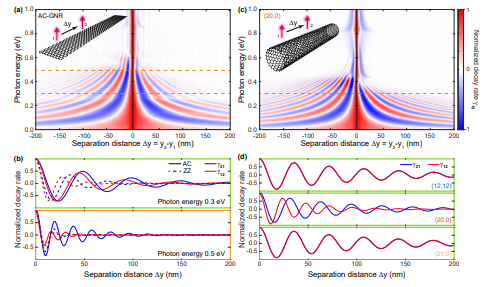
This research demonstrates that electrical bias can break reciprocity in plasmonic waveguides constructed from carbon nanotubes and graphene nanoribbons, offering a pathway towards actively controlling light propagation at the nanoscale. Atomistic simulations revealed that a moderate electrical current significantly alters how light propagates within these materials, enabling directional control of plasmon modes. This ability stems from the unique electronic properties of these nanostructures and their response to applied electrical fields. The team demonstrated that this nonreciprocal behavior extends to interactions between multiple light emitters, such as quantum dots, where the decay rate of one emitter is influenced by the presence and position of another, exhibiting directional dependence determined by the applied current. This suggests the potential for creating complex optical circuits where light-matter interactions can be actively tuned and controlled, with graphene nanoribbons exhibiting stronger light-matter interactions and a wider range of nonreciprocal behavior compared to carbon nanotubes. This research establishes a foundation for developing novel nanophotonic devices with advanced functionalities, paving the way for applications in optical communication, sensing, and quantum information processing.
🗞 Nonreciprocal plasmons in one-dimensional carbon nanostructures
🧠 ArXiv: https://arxiv.org/abs/2509.16109