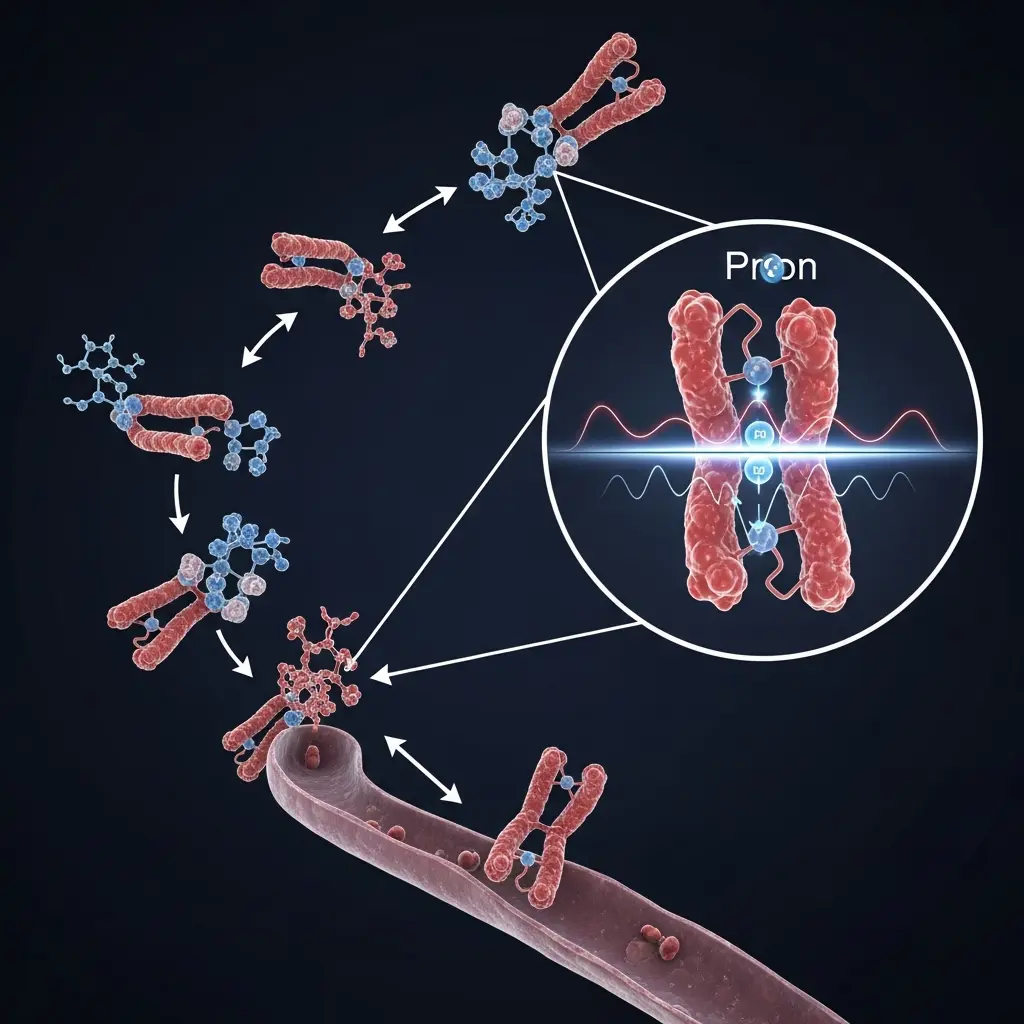
Scientists are tackling the long-standing problem of predicting disease severity from genetic mutations, focusing on how tiny structural changes can have dramatic consequences. Biraja Ghoshal from the Institute of Ophthalmology, University College London, and colleagues, alongside et al., have now revealed a critical quantum mechanism governing the function of RPE65, an enzyme vital for vision, and mutations of which cause Leber Congenital Amaurosis. Their research demonstrates that RPE65 function is governed by a “Quantum Cliff” , a threshold where even sub-Angstrom changes in structure drastically reduce the probability of proton tunneling, a quantum process essential for the enzyme’s activity. This breakthrough establishes a direct link between atomic structure, quantum mechanics, and clinical phenotype, offering a novel framework for understanding and potentially predicting the severity of RPE65-mediated retinal diseases , and potentially other enzyme deficiencies too.
This breakthrough research establishes a hybrid quantum-classical pipeline, combining AlphaFold structure prediction with \textit{ab initio} quantum simulation using the Variational Quantum Eigensolver (VQE), to analyse minimal proton-coupled electron transfer crucial to the visual cycle. The team achieved a detailed understanding of how seemingly minor structural changes can dramatically reduce the quantum probability of proton tunneling, revealing that many pathogenic mutations do not simply block the active site, but fundamentally disrupt this quantum process. Experiments show a sharp, non-linear effect, termed the “Quantum Cliff”, where structural alterations below 0.1 Å can decrease the reaction rate by multiple orders of magnitude, highlighting the enzyme’s extreme sensitivity.
Quantifying Activity: The Relative Quantum Activity Score
The study unveils a dimensionless Relative Quantum Activity Score (RQAS) that effectively isolates the geometry-controlled exponential sensitivity of the reaction rate, successfully differentiating between mild and severe patient phenotypes. Researchers observed that RPE65 operates near a quantum-critical point, meaning even sub-Angstrom structural perturbations can induce catastrophic loss of function, explaining why mutations distant from the active site can have devastating effects. Analysis of AlphaFold2-predicted structures revealed that pathogenic mutations consistently increase the donor-acceptor distance within the active site, subtly distorting the geometry and impacting quantum tunneling. The team reconstructed the active site geometry and computed the proton potential energy surface using VQE, demonstrating that the wild-type enzyme confines the proton within a narrow potential well, while mutations like R91W significantly widen the barrier, hindering proton transfer.
This work establishes quantum tunneling as a predictive mechanistic link between atomic structure and clinical phenotype, proposing a general framework for quantum-structural disease modeling. The discovery of the “Quantum Cliff” explains the extreme sensitivity of RPE65 to mutation and the discrete nature of its clinical phenotypes, offering a novel perspective on genotype-phenotype correlations. Specifically, the research demonstrates that a mere 0.1 Å increase in active site distance can lead to orders-of-magnitude loss of enzymatic activity, a phenomenon not captured by classical simulations. Table 1 details structural and quantum parameters for various RPE65 variants, showing how changes in donor-acceptor distance (dOO) correlate with barrier height (V0), effective barrier width (a), tunneling probability (Ptunnel), and ultimately, biological activity measured in vitro.
Furthermore, the findings suggest that standard classical simulations are inadequate for understanding quantum-sensitive enzymes like RPE65, emphasizing the need for quantum mechanical approaches to accurately predict the functional impact of genetic mutations. By combining computational modelling with experimental data, the researchers have not only elucidated the underlying mechanism of RPE65 dysfunction but also paved the way for developing more effective therapeutic strategies for LCA and related retinal diseases. This innovative approach could potentially be extended to other enzymes where quantum effects play a critical role in function, opening new avenues for precision medicine and drug discovery.
RPE65: Connecting Quantum Mechanics to Retinal Function
RPE65 Structure and Quantum Parameterisation reveal critical insights
Scientists pioneered a hybrid quantum-classical pipeline to dissect the molecular origins of blindness caused by mutations in the \textit{RPE65} isomerohydrolase, revealing a quantum-mechanical threshold effect governing enzyme function. The study established a novel link between sub-atomic-scale geometry and clinical phenotype, demonstrating that seemingly minor structural changes can dramatically reduce enzymatic activity. Researchers began by leveraging the AlphaFold prediction algorithm to obtain high-confidence atomic coordinates of the RPE65 active site, specifically utilising Model AF-Q16518-F1 as a baseline. This initial structure was then meticulously parameterized with a donor-acceptor distance of 2.70 Å, mirroring optimal hydrogen bond lengths observed in crystallographic data.
Computational Modeling of Mutant Active Site Geometries
To model pathogenic variants, the team engineered a Structural Perturbation Model, informed by principles from structural bioinformatics tools like ColabFold, to define mutant active site geometries. Geometric shifts (∆d) were calculated based on the steric volume difference and electrostatic disruption potential of substituted side chains, generating a VARIANT_DATABASE with oxygen-oxygen distances ranging from 2.78 Å to 3.35 Å. These parameterized coordinates then served as crucial input for subsequent quantum mechanical Hamiltonian scans, enabling precise exploration of the energy landscape. Crucially, the research employed a (4e, 4o) active-space model mapped onto 8 qubits using the PennyLane framework, coupled with the PySCF backend, to perform Variational Quantum Eigensolver (VQE) simulations.
Experiments harnessed a STO-3G minimal basis set and a simplified [O-H-O]− system to represent the proton transfer coordinate, allowing for computationally feasible analysis of electron correlation. The fermionic Hamiltonian was transformed into qubit representation via the Jordan-Wigner transformation, paving the way for quantum circuit optimization. Unlike traditional coupled-cluster approximations, the ansatz |ψ(θ)⟩ was constructed using a Hardware-Efficient Ansatz (HEA), designed for Near-Term Intermediate Scale Quantum (NISQ) devices, consisting of layers of parameterized single-qubit rotations and entangling CNOT gates. Optimization was carried out using the Adam Optimizer (η = 0.4) for 25 iterations per geometry step, accelerated by NVIDIA cuQuantum via lightning. gpu, ensuring rapid convergence across the potential energy surface.
Determining Ground State Energies and Kinetic Barriers
The team computed ground state energies E0(z) by scanning the proton position linearly along the internuclear axis, generating 25 equidistant points between varying O, O boundaries. Kinetic parameters, including Barrier Height V0 and Width w (derived from oxygen, oxygen separation as w = dOO −1.9Å), were extracted directly from the computed surface. This data informed the development of the Relative Quantum Activity Score (RQAS), defined as the ratio of mutant to wild-type total transmission probability, successfully distinguishing between mild and severe patient phenotypes. The total transmission probability was calculated as the sum of quantum tunneling probability (using the WKB approximation) and classical thermal probability, establishing a mechanistic link between atomic structure and clinical phenotype.
RPE65 Mutations Impair Quantum Proton Tunneling, reducing visual
Scientists have demonstrated that mutations impacting the human enzyme RPE65, responsible for visual isomerase activity, are governed by a quantum-mechanical threshold effect stemming from proton tunneling within its active site. Researchers established a computational pipeline integrating AlphaFold structure prediction with ab initio quantum simulation, utilising the Variational Quantum Eigensolver, to analyse proton-coupled electron transfer crucial to the visual cycle. Their analysis reveals that many disease-causing mutations don’t simply block the active site, but significantly diminish the quantum probability of proton tunneling, leading to functional impairment. A key finding is the identification of a “Quantum Cliff,” whereby even minute structural alterations, less than 0.1 Å, can reduce the reaction rate by several orders of magnitude, highlighting the enzyme’s sensitivity to geometric precision.
The team introduced a dimensionless Relative Quantum Activity Score (RQAS) which effectively differentiates between mild and severe patient phenotypes by isolating the geometry-controlled exponential sensitivity of the reaction rate. These results suggest RPE65 functions near a quantum-critical point, where minor structural changes induce substantial functional loss, establishing quantum tunneling as a predictive link between atomic structure and clinical presentation. The study establishes a computational framework for predicting clinical severity in genetic enzymopathies, demonstrating that ab initio quantum simulation can connect atomic structure to macroscopic phenotype. Importantly, the authors acknowledge the absence of in vitro experimentation, with all insights derived from high-throughput quantum mechanical modelling. The research highlights a “Quantum Cliff” effect, where the probability of proton tunneling collapses exponentially with small structural perturbations, a finding that challenges conventional structure-function relationships by showing that severe disease can arise from seemingly negligible geometric distortions. By combining AlphaFold-derived structural information with VQE-based quantum simulation, a novel, quantum computing-based metric (RQAS) was developed for predicting disease severity, offering a broadly applicable template for investigating quantum-sensitive enzymes in human disease.
🗞 The Quantum Cliff: A Critical Proton Tunneling Threshold Determines Clinical Severity in RPE65-Mediated Retinal Disease
🧠 ArXiv: https://arxiv.org/abs/2601.18435