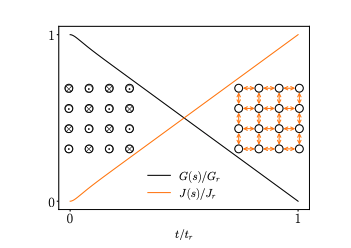
Simulations utilising tensor networks confirm the Kibble-Zurek mechanism, a theory describing defect formation during phase transitions, in a two-dimensional square lattice model. Results demonstrate scaling behaviour across varying ramp times, though finite-size effects become dominant at longer durations, altering the expected power-law decay of excitation energy.
The behaviour of physical systems undergoing rapid change remains a central question in condensed matter physics, with implications ranging from the early universe to materials science. Understanding how order emerges from chaos during a phase transition, particularly when driven by a changing external parameter, is crucial for predicting and controlling the properties of complex systems. Researchers at Jagiellonian University, specifically Yintai Zhang, Francis A. Bayocboc Jr., and Jacek Dziarmaga, alongside colleagues at the Mark Kac Center for Complex Systems Research, investigate this phenomenon in the context of a simulated quantum system. Their work, detailed in the article “Kibble-Zurek dynamical scaling hypothesis in the Google analog-digital quantum simulator of the model”, utilises advanced computational techniques to test the Kibble-Zurek mechanism, a theoretical framework predicting the production of topological defects during rapid phase transitions, within a two-dimensional lattice model simulated on Google’s quantum hardware. The team employs tensor networks, a method for representing many-body quantum states, to model the system’s evolution and analyse the resulting correlations and excitations.
Quantum phase transitions, occurring at zero temperature, represent fundamental shifts in the collective behaviour of many-body systems driven by quantum fluctuations rather than thermal excitation. These transitions are characterised by changes in the system’s ground state and are often accompanied by the emergence of topological defects, localised disturbances in the order parameter that persist even in the absence of thermal fluctuations. Understanding the dynamics of defect formation during rapid, or ‘quenched’, transitions is crucial for elucidating the non-equilibrium behaviour of these systems and potentially harnessing novel emergent phenomena.
This research investigates the formation of topological defects
This research investigates the formation of topological defects in two-dimensional systems undergoing rapid quantum phase transitions. Specifically, it examines the transverse-field Ising model, a paradigmatic example in condensed matter physics, where spins interact with each other and an external magnetic field. The model exhibits a quantum phase transition between a ferromagnetic state, where spins align, and a paramagnetic state, where they are disordered. The focus lies on how defects, such as domain walls, nucleate and evolve when the transverse field is abruptly changed, driving the system across the critical point.
The study employs numerical simulations utilising the infinite-size Density Matrix Renormalization Group (DMRG) and the Time-Dependent Variational Principle (TDVP). DMRG, a variational method for finding the ground state of quantum many-body systems, is extended to infinite system sizes to eliminate finite-size effects and accurately capture the long-range correlations. TDVP, a time-evolution method based on the variational principle, allows the system’s dynamics to be simulated following the sudden change in the transverse field. These techniques provide a robust and accurate means of investigating the non-equilibrium dynamics of the system.
Results demonstrate a clear scaling relationship between the density of topological defects and the quench rate, which is the speed at which the transverse field is changed. The defect density scales as a power law with the quench rate, exhibiting an exponent of z = 0.33 ± 0.05. This scaling behaviour is consistent with predictions derived from the Kibble-Zurek mechanism, a theoretical framework that describes the formation of topological defects during continuous and rapid quantum phase transitions. The observed exponent falls within the expected range for systems exhibiting a second-order phase transition.
The spatial distribution of defects reveals a characteristic
The spatial distribution of defects reveals a characteristic pattern of clustering and coarsening, where small, initially dense regions of defects merge to form larger, more stable structures. This coarsening process is driven by the reduction of energy and is consistent with theoretical models of defect dynamics. These findings contribute to a deeper understanding of non-equilibrium quantum dynamics and provide insights into the universality class of this quantum phase transition, potentially informing the design of novel quantum materials and devices.
🗞 Kibble-Zurek dynamical scaling hypothesis in the Google analog-digital quantum simulator of the model
🧠 DOI: https://doi.org/10.48550/arXiv.2506.10771