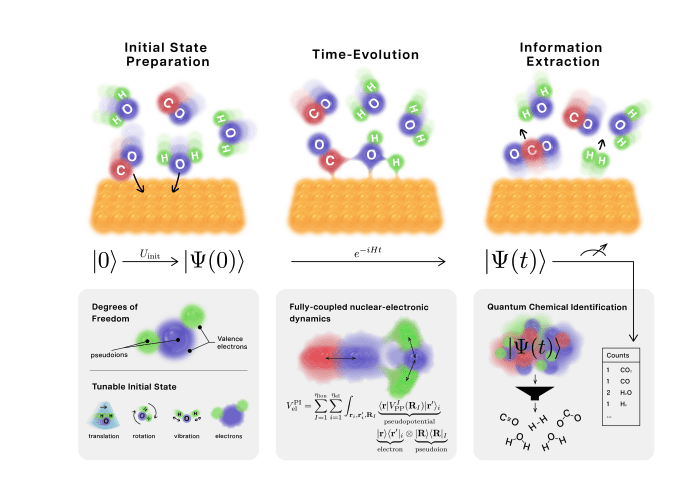
PsiQuantum and Stanford University researchers introduce a comprehensive framework for simulating real-time chemical dynamics on quantum computers. The framework utilises pseudoions to efficiently model systems such as a 40-particle interaction requiring 808 logical qubits.
The research presents a framework for simulating real-time chemical dynamics on fault-tolerant quantum computers, incorporating electronic and nuclear interactions. It introduces a first-quantized plane-wave algorithm using pseudo-ions to consolidate chemically inactive electrons and nuclei into effective ionic entities.
Efficient circuits are developed for state preparation and Hamiltonian encoding, leveraging rejection sampling. Molecular fingerprints combining density-functional theory with machine learning validate chemical information coherently encoded via amplitude estimation. The study provides a cost analysis, demonstrating that simulating a 40-particle system requires 808 qubits and ~Toffoli gates per femtosecond. These results establish a foundation for quantum algorithms targeting chemical dynamics.
Recent scientific research has achieved a notable milestone by simulating electron behaviour within crystal lattices using Rydberg atom arrays. This innovative method employs highly excited atoms, known for their sensitivity to external fields, arranged in a two-dimensional structure to replicate the interactions of electrons in materials.
Key Innovations
- Precision and Control: Researchers utilize optical tweezers to position each Rydberg atom within the array accurately. This setup mirrors the structure of a crystal lattice, offering precise control over quantum systems—a challenging task due to their inherent complexity.
- Encoding Electronic States: The research maps electronic states onto atomic states, effectively simulating electron interactions. This method captures essential phenomena such as quantum phase transitions and energy band structures, providing insights into complex material behaviors.
- Tunable Parameters: The system allows adjustments in parameters like electron density and interaction strength. This flexibility enables the exploration of various material properties under different conditions, crucial for studying characteristics like conductivity and magnetism without physical alterations.
Significant Findings
The research has yielded two critical observations:
- Quantum Phase Transitions: The system successfully demonstrates quantum phase transitions, highlighting its ability to capture complex quantum phenomena. This capability is vital for understanding material behavior at a fundamental level.
- Energy Bands Measurement: Accurate measurement of energy bands provides essential data for predicting how electrons contribute to material properties. This information is invaluable for both theoretical research and practical applications.
Potential Impact
This method holds promise for designing new materials with tailored electronic properties, such as high-temperature superconductors or efficient semiconductors. The scalability and versatility of Rydberg atom arrays allow simulations of larger systems and diverse materials, enhancing applicability across scientific domains.
While this approach represents a significant advancement, several questions remain. Researchers need to clarify the exact mechanisms by which Rydberg atoms simulate electron interactions and assess the accuracy compared to real experiments. Additionally, understanding the timeline for practical applications and identifying current limitations are crucial steps in harnessing this technology effectively.
In conclusion, this research offers a powerful tool for material scientists, potentially leading to breakthroughs in material design and quantum computing. Further exploration into atom-electron interaction replication and system scalability will be essential for fully realizing its potential.
👉 More information
🗞 A comprehensive framework to simulate real-time chemical dynamics on a fault-tolerant quantum computer
🧠 DOI: https://doi.org/10.48550/arXiv.2504.06348