

Researchers demonstrate a novel gauge protection scheme utilising alkaline-earth-like atoms to simulate non-Abelian lattice gauge theories, crucial for modelling particle physics. This approach, leveraging Zeeman shifts and superexchange interactions, enables scalable, hybrid digital-analog quantum simulations of these complex systems with dynamical fermionic matter.
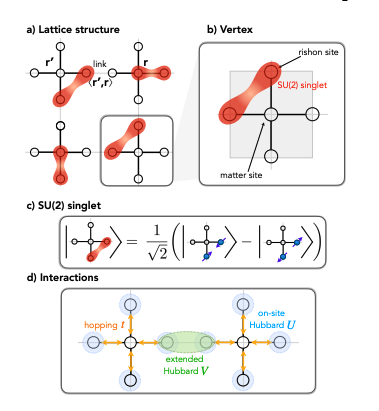
The simulation of quantum field theories represents a significant challenge at the intersection of theoretical physics and experimental realisation. Recent research focuses on utilising controlled quantum systems to model these complex phenomena, particularly lattice gauge theories (LGTs), which underpin our understanding of fundamental particles and forces. Maintaining gauge invariance – a principle ensuring physical predictions remain unchanged under certain transformations – is crucial in these simulations, yet increasingly difficult as system size grows. A team led by researchers at Ludwig-Maximilians-Universität München and the Max Planck Institute of Quantum Optics, comprising Gaia De Paciani, Lukas Homeier, Jad C. Halimeh, Monika Aidelsburger, and Fabian Grusdt, now present a novel approach to address this challenge. Their work, entitled “Quantum simulation of fermionic non-Abelian lattice gauge theories in D with built-in gauge protection”, details a scheme utilising alkaline-earth-like atoms (AELAs) and Rydberg interactions to construct and simulate models of non-Abelian LGTs, incorporating a mechanism to preserve gauge symmetry even at larger scales.
Recent advances in quantum simulation offer increasingly sophisticated methods for investigating complex phenomena in particle physics, notably through accurate modelling of lattice gauge theories (LGTs). LGTs are a discretised formulation of quantum field theories, allowing calculations that are otherwise intractable using conventional computational methods. A central challenge lies in maintaining gauge invariance within these simulations, a fundamental requirement for faithfully representing the behaviour of fundamental particles and forces, particularly when incorporating dynamical matter, which refers to the inclusion of particles that can be created and destroyed during the simulation.
This research details a viable pathway towards simulating
This research details a viable pathway towards simulating non-Abelian LGTs, crucial models for understanding the strong nuclear force, one of the four fundamental forces of nature, and the behaviour of quarks and gluons, the fundamental constituents of matter that experience this force. The approach utilises alkaline-earth-like atoms (AELAs) as the primary platform for quantum computation. AELAs, such as strontium or barium, possess properties that make them well-suited for trapping and manipulating individual atoms, forming the basis of a quantum computer.
A novel gauge protection scheme forms the core of this work, offering a robust solution to the persistent challenge of maintaining gauge invariance. This innovative approach leverages native interactions within AELAs, specifically a Zeeman shift, a change in energy levels due to an external magnetic field, combined with superexchange interactions, an indirect exchange of interactions between atoms mediated by a third atom. This combination effectively shields the simulation from unwanted symmetry breaking, simplifying experimental implementation and enabling seamless integration with existing rishon-based protocols. Rishons are quasi-particles representing excitations within the AELA system, used to encode and manipulate quantum information.
The team successfully extends this approach to a fully scalable, hybrid digital-analog quantum simulation. Digital quantum computation relies on precisely controlled quantum gates, while analog quantum computation exploits the natural dynamics of a quantum system. Combining these strengths achieves unprecedented levels of control and accuracy. This hybrid approach utilises Rydberg AELAs, atoms excited to a high energy level, with a variable number of rishons, offering increased flexibility and control over the system. The number of rishons can be adjusted to represent different physical parameters within the simulation.
This research directly addresses the need for more
This research directly addresses the need for more accurate and efficient methods for simulating quantum field theories, essential for understanding the fundamental laws of nature. By developing a robust and scalable approach to gauge protection, researchers enable the exploration of a wider range of physical phenomena and accelerate the pace of discovery in particle physics. The proposed general mechanism for gauge protection represents a significant step forward, providing a promising route toward realising the long-sought-after simulation of non-Abelian LGTs relevant to understanding fundamental particle physics.
This work not only advances the field of quantum simulation but also has the potential to impact other areas of physics, such as condensed matter physics and cosmology. The techniques developed could be applied to simulate a wide range of physical systems, providing new insights into the behaviour of matter under extreme conditions. The research team intends to continue developing and refining this approach, exploring new ways to improve the accuracy and scalability of quantum simulations of LGTs, and investigating the possibility of applying these techniques to simulate other complex physical systems, such as high-temperature superconductors and black holes.
🗞 Quantum simulation of fermionic non-Abelian lattice gauge theories in D with built-in gauge protection
🧠 DOI: https://doi.org/10.48550/arXiv.2506.14747


