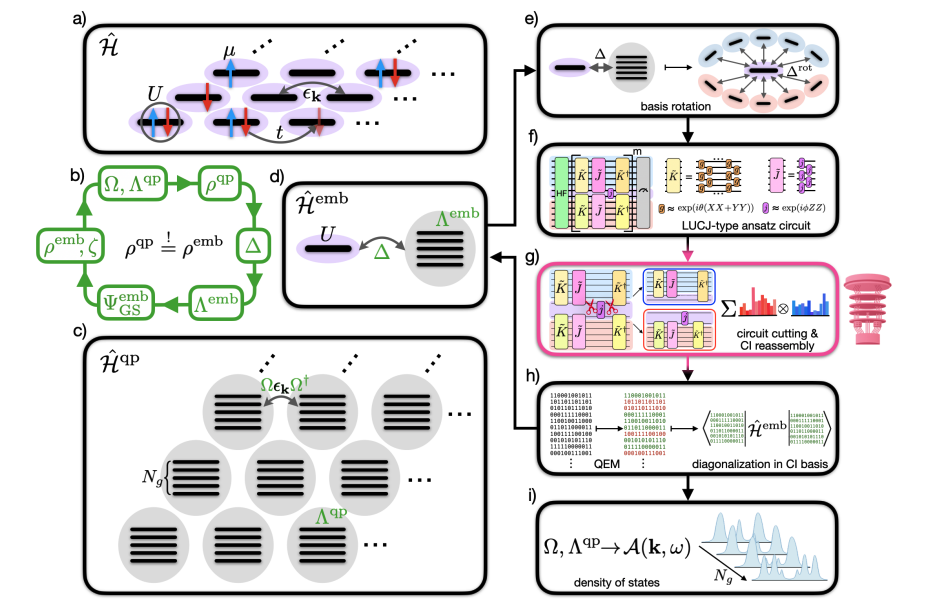
Simulating the behaviour of complex quantum materials presents a significant computational challenge, often requiring approximations to render calculations tractable. Researchers continually seek methods that balance accuracy with efficiency, and a promising avenue involves embedding techniques which reduce the complexity of many-body problems. A new study by Sriluckshmy, Jamet, and Šimkovic, all from IQM in Munich, details an advancement in this field, specifically a hybrid classical-quantum approach to the ghost Gutzwiller ansatz (gGut). Their work, entitled ‘Quantum Assisted Ghost Gutzwiller Ansatz’, demonstrates the application of a sample-based selected configuration interaction (QSCI) algorithm, executed on IQM’s quantum hardware, to accelerate gGut calculations and accurately model the metal-to-insulator transition in the Fermi-Hubbard model.
The team’s findings suggest that leveraging quantum computation can substantially reduce the computational cost associated with determining the density matrix, a critical step in embedding calculations, paving the way for more detailed simulations of correlated electron systems.
The successful application of a hybrid classical-quantum computational approach, utilising the ghost Gutzwiller ansatz (gGut), efficiently calculates ground state properties of complex quantum many-body systems. The gGut method addresses strongly correlated materials, systems where electron interactions significantly influence material behaviour, and traditionally presents a substantial computational challenge. Results demonstrate that gGut achieves accuracy comparable to dynamical mean-field theory, a widely used technique for studying these systems, but with a significantly reduced computational demand. This reduction addresses a key limitation of conventional methods, opening avenues for simulating larger and more complex materials.
The investigation establishes that increasing the number of ‘ghost orbitals’ – auxiliary mathematical constructs used within the gGut framework – leads to increasingly sparse ground states within the configuration interaction (CI) basis. The CI basis represents all possible electronic configurations of the system, and its size grows exponentially with the number of electrons and orbitals. Sparsity, meaning many CI states have negligible contributions, is crucial in reducing computational cost. This allows for the effective use of sample-based selected configuration interaction (QSCI) algorithms. QSCI leverages both classical computation and quantum hardware to determine ground state properties with improved efficiency. Specifically, the study employs QSCI in conjunction with local unitary cluster Jastrow (LUCJ) variational states – trial wavefunctions designed to approximate the true ground state – and a circuit cutting technique, executed on IQM hardware, for systems containing up to eleven ghost orbitals, equivalent to twenty-four qubits.
Analysis reveals that the accuracy of the LUCJ
Analysis reveals that the accuracy of the LUCJ ansatz improves with increasing layers, though this improvement plateaus. Deeper circuits, meaning more complex quantum computations, are necessary for higher interaction strengths, indicating a trade-off between computational cost and accuracy. Crucially, the rate of CI weight decay remains consistent regardless of the number of layers, suggesting the ansatz may not fully capture the system’s inherent complexity, prompting further investigation into more expressive variational forms. Despite this limitation, the research successfully demonstrates converged gGut calculations capable of accurately predicting the metal-to-insulator phase transition in the Fermi-Hubbard model on the Bethe lattice. The Fermi-Hubbard model is a fundamental model in condensed matter physics used to understand electron behaviour in solids, and the Bethe lattice is a mathematical representation of a disordered solid. The calculations utilise samples to construct an SCI basis containing only a small fraction of the total CI basis states, further demonstrating computational efficiency.
The robustness of QSCI to noise present in quantum hardware is confirmed, although the implementation of error mitigation techniques remains essential for optimal performance and reliable results. Simulations and hardware experiments yield differing numbers of CIs for the same cutoff, indicating that simulations may underestimate the complexity of the system. This highlights the value of utilising quantum hardware for more accurate representation of quantum states. Future work should focus on extending these calculations to larger system sizes and exploring more sophisticated error mitigation strategies for quantum hardware, ultimately pushing the boundaries of what is computationally feasible.
👉 More information🗞Quantum Assisted Ghost Gutzwiller Ansatz🧠 DOI:https://doi
🗞 Quantum Assisted Ghost Gutzwiller Ansatz
🧠 DOI: https://doi.org/10.48550/arXiv.2506.21431