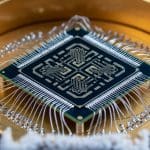
Quantum sensing, an emerging technology that enables extremely precise measurements at the atomic level, is poised to revolutionize various industries. This innovative field offers significant advantages over traditional sensors in terms of accuracy, consistency, and measurement frequency. With potential applications spanning life sciences, energy, communications, logistics, and microelectronics, quantum sensing is expected to have a moderate market impact by 2030, with potential for significant acceleration thereafter.
Companies like Airbus, Atomionics, Chipiron, ColdQuanta, EuQlid, Infleqtion, Mesa Quantum, MuQuans, NVision, Q-CTRL, Qnami, and Quantum Systems are at the forefront of this technology. Investment in quantum sensing is growing, with over 80% coming from venture capital and corporate investors. The five most funded startups have received over 80% of total funding, leaving room for new entrants to join the ecosystem. As researchers continue to overcome challenges like shielding sensors from environmental noise, the potential for quantum sensing to transform industries becomes increasingly promising.
Quantum Sensing: A Revolutionary Technology for Precise Measurements
Quantum sensing is an emerging technology that enables extremely precise measurements at the atomic level. This technology offers significant advantages over traditional sensors in terms of accuracy, consistency, and measurement frequency. The market impact of quantum sensing is expected to grow moderately approaching 2030, with potential for significant acceleration thereafter.
Principles of Quantum Sensing
Quantum sensing leverages the principles of quantum superposition and entanglement to achieve unprecedented levels of sensitivity and precision. In a classical system, a particle can exist in one of two states, whereas in a quantum system, it can exist in multiple states simultaneously. This property allows quantum sensors to detect tiny changes in their environment that would be impossible for classical sensors.
Applications of Quantum Sensing
Quantum sensing has far-reaching applications across various industries, including healthcare, defense, information technology, environmental monitoring, oil and gas, transportation, and finance.
In healthcare, quantum sensors can be used for early disease detection, drug discovery, and biosensing. For instance, quantum magnetometers can detect biomarkers for diseases such as Alzheimer’s at an early stage, enabling timely intervention and treatment.
In defense, quantum sensing can enhance navigation systems, underwater detection, and communication systems. Quantum inertial measurement units can provide GPS-independent navigation, while quantum gravity gradiometers can be used for underwater mapping.
Competitive Landscape
The competitive landscape of the quantum sensing market is characterized by a mix of established companies and startups. Companies profiled in this report include Airbus, Atomionics, Bosch Quantum Sensing, Chipiron, ColdQuanta, EuQlid, Infleqtion, Mesa Quantum, MuQuans, NVision, Q-CTRL, Qnami, Quantum Systems, and many others.
Technology Trends and Innovations
Several technology trends and innovations are driving the development of quantum sensing. These include miniaturization of quantum sensors, room temperature quantum sensors, hybrid quantum-classical systems, quantum networks and distributed sensing, AI and machine learning integration, and quantum-enhanced metrology.
Miniaturization of quantum sensors is crucial for their widespread adoption in various industries. Room temperature quantum sensors can operate without the need for complex cooling systems, making them more practical for real-world applications.
Market Forecast and Future Outlook
The market forecast for quantum sensing is promising, with emerging applications and use cases expected to drive growth. These include quantum sensors in brain-computer interfaces, anti-aging research, personalized medicine, virtual and augmented reality systems, and hybrid quantum-photonic sensors.
Potential disruptive technologies such as topological quantum sensors and quantum sensors based on exotic states of matter are also being explored. The investment landscape for quantum sensing is characterized by significant investments from governments, venture capital firms, and strategic investors.
Case Studies
Several case studies demonstrate the potential impact of quantum sensing in various industries. For instance, quantum magnetometers can be used for early disease detection in healthcare, while quantum inertial measurement units can enhance navigation systems in defense. Quantum gravity sensors can be used to measure ice mass changes in environmental monitoring, and quantum timing systems can improve performance in high-frequency trading platforms.
In conclusion, quantum sensing is a revolutionary technology with far-reaching applications across various industries. As the market continues to grow, we can expect significant innovations and advancements in the development of quantum sensors, driving widespread adoption and transformational impact.
External Link: Click Here For More