

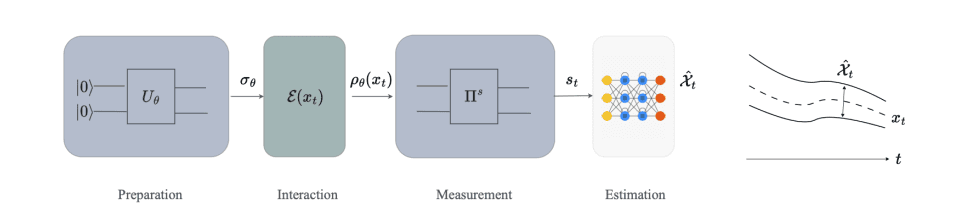
Variational quantum sensing benefits from a new online control framework which dynamically updates parameters and provides deterministic error estimates. Experiments utilising magnetometry demonstrate maintained reliability and precision over time, establishing the practical advantages of combining variational algorithms with online conformal inference on noisy intermediate-scale quantum devices.
Quantum sensors promise enhanced precision in measurements across diverse fields, from detecting gravitational waves to characterising materials at the nanoscale. However, realising this potential with current quantum hardware presents challenges due to inherent noise and limitations in the number of measurements obtainable. Researchers at Eindhoven University of Technology and King’s College London, led by Ivana Nikoloska, Hamdi Joudeh, Ruud van Sloun, and Osvaldo Simeone, address this issue in their paper, ‘Dynamic Estimation Loss Control in Variational Quantum Sensing via Online Conformal Inference’. Their work details a novel control framework for variational quantum sensing (VQS) that dynamically adjusts parameters and provides quantifiable error margins, ensuring reliable estimations even with imperfect quantum devices.
Enhanced Reliability for Quantum Sensors Through Dynamic Control and Statistical Inference
Quantum sensors offer the potential for increased precision in measurement across a range of disciplines, including gravitational wave detection and nanoscale material characterisation. A recent study by researchers at Eindhoven University of Technology and King’s College London addresses a critical limitation in realising this potential: the susceptibility of current quantum sensors to noise and the constraints of utilising noisy intermediate-scale quantum (NISQ) devices.
Quantum sensing leverages quantum mechanical phenomena – such as superposition and entanglement – to achieve measurement precision beyond the capabilities of classical instruments. However, NISQ devices, characterised by a limited number of qubits and high error rates, introduce significant challenges to practical implementation. These errors accumulate during measurement, degrading performance and hindering reliable data acquisition.
The researchers present a dynamic variational quantum sensing (VQS) framework that actively mitigates these issues. VQS is a hybrid quantum-classical algorithm where a quantum computer performs measurements guided by parameters optimised using classical computation. The innovation lies in the continuous, online updating of these variational parameters during the sensing process. This contrasts with traditional VQS where parameters are optimised beforehand and remain fixed.
Crucially, the framework integrates online conformal inference. Conformal inference is a statistical technique that provides guaranteed error bounds on predictions, without requiring strong assumptions about the underlying data distribution. By applying this technique during the sensing process, the system generates sequential estimation sets, each accompanied by a quantifiable level of confidence. This allows the sensor to maintain a pre-defined long-term risk level for its measurements – essentially, a guaranteed probability of the estimate being correct.
The dynamic nature of the control loop is significant. It enables the framework to adapt to changing environmental conditions and actively counteract the effects of noise accumulation, improving the robustness of the sensor.
To demonstrate the efficacy of their approach, the researchers conducted experiments focused on magnetometry – the measurement of magnetic fields. Results showed that the dynamic VQS framework, combined with online conformal inference, successfully maintained the required reliability level over time while achieving precise estimates of the magnetic field. This suggests a viable pathway towards building dependable quantum sensors capable of operating effectively on currently available NISQ hardware. The method offers a robust solution for mitigating the impact of noise and ensuring the trustworthiness of quantum measurements in challenging environments.
👉 More information
🗞 Dynamic Estimation Loss Control in Variational Quantum Sensing via Online Conformal Inference
🧠 DOI: https://doi.org/10.48550/arXiv.2505.23389


