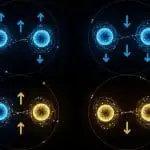
Quantum sensing promises to revolutionise measurement science, offering precision beyond the limits of classical devices, and researchers are continually seeking ways to amplify this capability. Hao, at Delft University of Technology, and colleagues, demonstrate a new approach to enhance quantum sensing using superconducting qubits. The team unifies concepts of criticality and non-equilibrium dynamics within a Stark-Wannier localization platform, creating a highly sensitive probe that operates effectively across a broad range of conditions. This innovative method achieves near-optimal precision using only standard measurements, and significantly outperforms existing techniques in certain regimes, establishing Stark-Wannier systems as a promising foundation for future sensing technologies.
Double-Excitation Probes for Potential Gradient Sensing
This research investigates using double-excitation probes to sense and characterize a quantum system, focusing on achieving high-fidelity quantum walks and precisely determining the gradient of a linear potential. The team combines experimental results with theoretical simulations to validate their approach and demonstrate its sensitivity, paying close attention to the effects of decoherence on the quantum walks. The study analyzes how the probes move through the system under varying potential gradients to understand the system’s behavior and optimize sensing capabilities. Researchers identified a transition point between localized and extended phases within the quantum system, crucial for optimizing sensing.
They observed that in the extended phase, the probe rapidly propagates throughout the system, while in the localized phase, excitation remains confined. Near the transition point, Bloch oscillations appeared, indicating a change in the system’s dynamics. These observations provide insights into the system’s behavior and its potential for sensing applications. The team confirmed the accuracy of their experimental quantum walks by comparing them to theoretical predictions, achieving high fidelity for both single and double excitations. The study also investigated the impact of decoherence, demonstrating that it degrades the fidelity of the quantum walks and reduces the scaling of the Fisher information.
Understanding and mitigating decoherence is therefore critical for maintaining sensing accuracy. Researchers successfully demonstrated the ability to accurately estimate the potential gradient using Bayesian estimation, closely matching the true value with their measurements. Combining measurements taken at different times further improved the estimation accuracy. This demonstrates the potential of this approach for precise parameter estimation in quantum systems.
Quantum Sensor Exceeds Classical Precision Limits
Researchers have developed a new quantum sensor capable of exceptionally precise measurements, surpassing the limits achievable with classical devices. This sensor utilizes a superconducting quantum circuit, specifically a nine-qubit system, to estimate the strength of external gradient fields with unprecedented accuracy. The device leverages both quantum criticality and non-equilibrium dynamics, combining the benefits of both approaches to enhance sensing capabilities across a broad range of conditions. The team’s approach centers on a Stark-Wannier system, where a carefully tuned electric field competes with the natural tendency of particles to tunnel between locations, creating a highly sensitive environment.
By manipulating this competition, the researchers achieved sensing precision approaching the so-called Heisenberg limit, a fundamental boundary in measurement accuracy. Remarkably, this high level of performance was attained using relatively simple measurements, avoiding the need for complex experimental setups often required in quantum sensing. The sensor’s performance was evaluated across three distinct phases, revealing a significant advantage in the extended phase. Measurements in this phase consistently outperformed those taken in the localized phase, demonstrating the power of criticality in enhancing sensing capabilities. This suggests that the system offers a versatile platform for quantum sensing, capable of maintaining high precision even in the presence of imperfections and noise common in real-world quantum devices. This advancement represents a significant step towards practical quantum sensing technologies.
Stark-Wannier Localization Enables Enhanced Quantum Sensing
This research demonstrates a new approach to quantum-enhanced sensing using Stark-Wannier localization, a platform that combines criticality and non-equilibrium dynamics. The team successfully implemented this probe on a superconducting device, achieving precision in parameter estimation that surpasses the limits of classical methods. By carefully controlling the competition between a linear gradient field and particle tunneling, they created a system sensitive to external parameters across a broad range of conditions. The key finding is that this Stark-Wannier system offers enhanced sensitivity, particularly in the extended phase where error bars were significantly smaller than in the localized regime.
Furthermore, the researchers achieved near-Heisenberg-limited precision by combining measurements taken at different points in time, using only readily implementable computational basis measurements. This combination of features makes the architecture promising for practical applications, potentially extending to other quantum platforms like cold atoms and ion traps for sensing gravity, electric fields, and magnetic fields. The authors acknowledge that estimation accuracy is limited in the localized phase, and error bars are relatively large. They also note that dephasing represents a major limitation, especially for longer duration dynamics. Future work will likely focus on mitigating these limitations and exploring the full potential of Stark-Wannier localization in diverse sensing applications.
🗞 Non-Equilibrium Criticality-Enhanced Quantum Sensing with Superconducting Qubits
🧠 ArXiv: https://arxiv.org/abs/2508.14409