
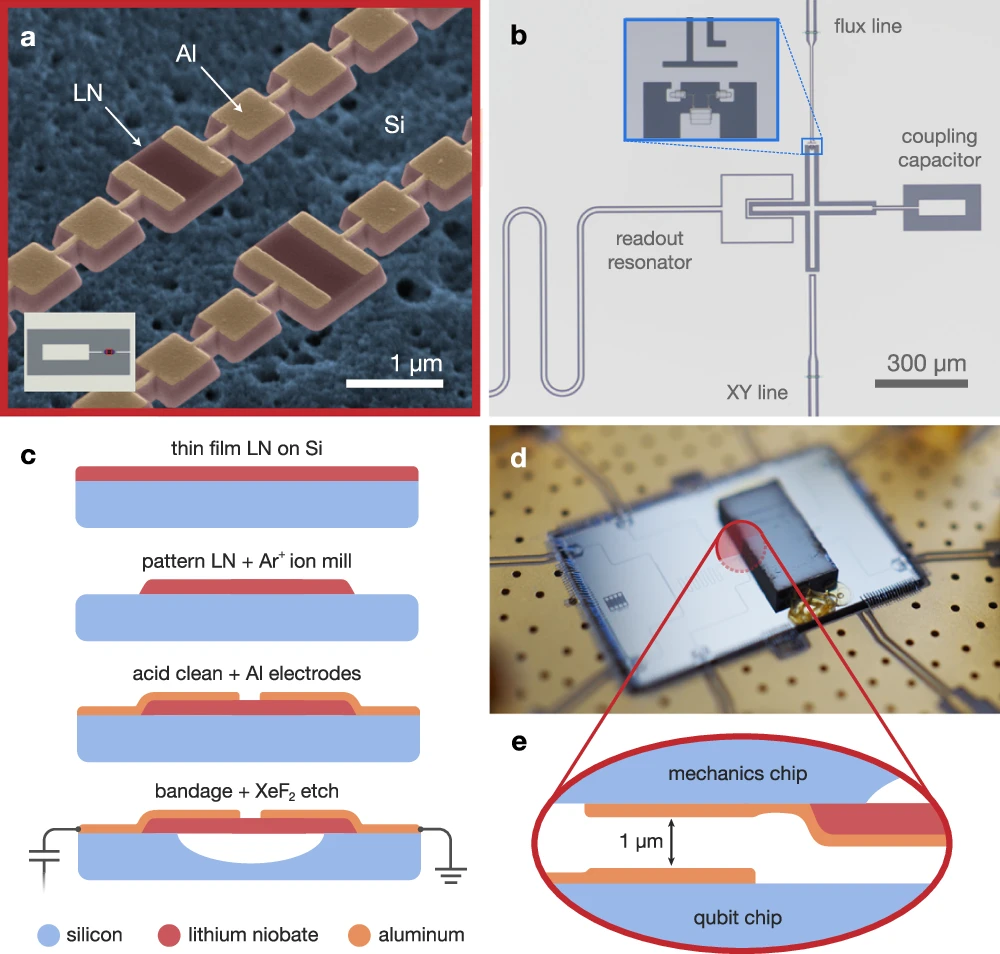
The study of phonon coherence using quantum sensors is a rapidly evolving field in quantum technology. Phonon coherence refers to the collective behavior of phonons, quantum mechanical descriptions of vibrations in a crystal lattice. This study is crucial for understanding quantum systems and developing quantum technologies. Nanomechanical oscillators, which generate nanoscale vibrations, are potential long-lived memories for computation, transducers for communication, and high-precision quantum sensors. However, understanding the decoherence processes affecting these oscillators is vital. The study used a superconducting qubit as a quantum sensor to examine mechanical dissipation and dephasing in coherent states, providing valuable insights for quantum technology development.
What is the Significance of Studying Phonon Coherence with a Quantum Sensor?
The field of quantum technology is rapidly evolving, and one of the key areas of focus is the study of phonon coherence using quantum sensors. Phonon coherence refers to the collective behavior of phonons, which are quantum mechanical descriptions of vibrations in a rigid crystal lattice. The study of phonon coherence is crucial in understanding the behavior of quantum systems and has significant implications for the development of quantum technologies.
Nanomechanical oscillators, which are devices that generate mechanical vibrations at the nanoscale, offer numerous advantages for quantum technologies. These devices are compact, have long lifetimes, and can detect force and motion. They hold the potential to serve as long-lived memories for computation, transducers for communication, and high-precision quantum sensors. Their ability to interact with superconducting qubits, which are the basic units of quantum information, through the piezoelectric effect has allowed mechanical systems to be brought into the quantum regime.
However, to fully realize the potential of this hybrid platform, it is crucial to understand the decoherence processes affecting mechanical oscillators in the quantum limit. Decoherence refers to the loss of quantum behavior of a system, which is a major challenge in the development of quantum technologies. For mechanical states with large numbers of phonons, the established work has followed semi-classical spectroscopic methods to detect time-averaged energy loss and frequency noise in the resonator.
How Does Two-Level System (TLS) Defects Affect Nanomechanical Systems?
One important loss channel affecting nanomechanical systems is two-level system (TLS) defects. These defects are similar to those which exist in amorphous glasses and imperfect crystalline materials. TLS can couple to the mechanical oscillator and cause energy loss and frequency noise, leading to decoherence of the mechanical state.
In the study, the researchers used a superconducting qubit as a quantum sensor to perform phonon number-resolved measurements on a piezoelectrically coupled phononic crystal cavity. This approach enabled a high-resolution study of mechanical dissipation and dephasing in coherent states of variable size. The researchers observed non-exponential relaxation and state size-dependent reduction of the dephasing rate, which they attributed to TLS.
Using a numerical model, the researchers were able to reproduce the dissipation signatures and, to a lesser extent, the dephasing signatures via emission into a small ensemble of rapidly dephasing TLS. These findings comprise a detailed examination of TLS-induced phonon decoherence in the quantum regime.
What are the Implications of this Study for Quantum Technologies?
The findings of this study have significant implications for the development of quantum technologies. By providing a detailed examination of TLS-induced phonon decoherence in the quantum regime, the study contributes to our understanding of the decoherence processes affecting mechanical oscillators in the quantum limit. This understanding is crucial for the development of quantum technologies that rely on the coherent behavior of mechanical oscillators, such as quantum computers and quantum sensors.
Furthermore, the use of a superconducting qubit as a quantum sensor to perform phonon number-resolved measurements represents a novel approach to studying mechanical dissipation and dephasing in coherent states. This approach could potentially be applied to other quantum systems, opening up new avenues for research in quantum technology.
In conclusion, the study of phonon coherence with a quantum sensor is a promising area of research in quantum technology. The findings of this study not only contribute to our understanding of the decoherence processes affecting mechanical oscillators in the quantum limit but also demonstrate the potential of using superconducting qubits as quantum sensors for high-resolution studies of mechanical dissipation and dephasing. As the field of quantum technology continues to evolve, such research will play a crucial role in driving the development of new quantum technologies.
Publication details: “Studying phonon coherence with a quantum sensor”
Publication Date: 2024-06-11
Authors: Agnetta Y. Cleland, E. Alex Wollack and Amir H. Safavi-Naeini
Source: Nature communications
DOI: https://doi.org/10.1038/s41467-024-48306-0