

The search for dark matter has expanded to consider ultraheavy particles, but current detection strategies largely assume these are point-like entities, a limitation given that particles at such extreme masses must, in fact, possess internal structure. Dorian W. P. Amaral from Rice University, Erqian Cai from Stony Brook University, and Andrew J. Long, along with colleagues, investigate how quantum sensor arrays could directly detect this composite, ultraheavy dark matter. Their work demonstrates that these arrays offer a unique opportunity to probe the internal structure of dark matter, specifically by searching for signals arising from both standard interactions and a newly considered Yukawa force. By modelling various dark matter density profiles and accounting for realistic noise levels, the team projects the sensitivity of future accelerometer arrays, offering a pathway to determine the mass and size of these elusive composite particles and distinguish between competing theoretical models.
Levitated Sensors Detect Dark Matter Interactions
Scientists are developing innovative experiments to detect dark matter using networks of highly sensitive quantum sensors. These sensors, which can be levitated to minimize external disturbances, aim to detect the tiny forces exerted by dark matter particles. The research focuses on several dark matter candidates, including axions, dark photons, and ultralight dark matter, as well as potential signals arising from the diffusion of spacetime itself. Isolating the sensors and employing techniques to reduce quantum and thermal noise are crucial for maximizing detection potential. The sensitivity of these sensors depends on factors such as the sensor’s mass, the stability of levitation, and the reduction of quantum noise through techniques like squeezing.
Calculating the expected detection rate requires understanding the local density of dark matter and the strength of its interaction with the sensor material. A thorough analysis of all noise sources, including seismic vibrations, gravity fluctuations, and electronic noise, is crucial for distinguishing a genuine signal from background interference. Sophisticated data analysis techniques will be needed to extract a signal from the noise and accurately characterize any potential dark matter interactions.
Extended Dark Matter Detection with Sensor Arrays
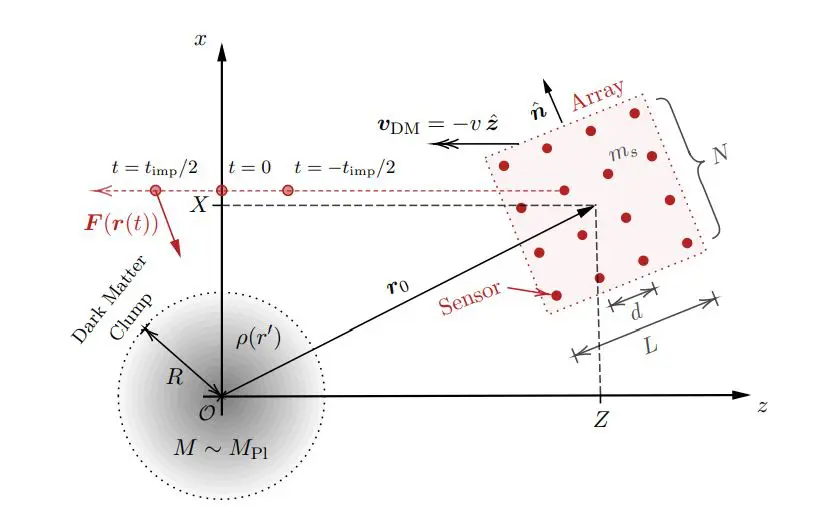
Scientists are investigating the possibility that ultraheavy dark matter may not be point-like, but rather composed of smaller constituents with a finite size. This research focuses on how sensor arrays could detect these extended dark matter candidates, particularly those interacting through both gravity and a novel force beyond the standard gravitational interaction. The study explores how the sensitivity of these arrays depends on the characteristics of the dark matter clumps, such as their mass density and size, and contrasts these scenarios with the traditional assumption of point-like dark matter. Researchers performed detailed simulations to project the sensitivity of future sensor arrays, considering the interplay between the dark matter clump’s size, the spacing between sensors, and the strength of the additional force.
The results demonstrate that sensitivity is optimized when these length scales align, but decreases as the dark matter clump becomes larger than the sensor array. The team modeled dark matter clumps with masses comparable to the Planck mass and radii potentially as small as 10 meters. The research details how the additional force allows for contributions from mass beyond a given radial position, deviating from the inverse-square law of gravity. The findings establish a framework for interpreting signals from future accelerometer arrays, enabling scientists to characterize the mass and size of composite ultraheavy dark matter and differentiate between various theoretical models.
Sensor Arrays Detect Composite Ultraheavy Dark Matter
This work investigates the potential for detecting ultraheavy dark matter, focusing on the scenario where dark matter is not an elementary particle but a composite object with a finite size. Researchers demonstrate that sensor arrays offer a promising platform for directly detecting these extended dark matter candidates, which are expected to have masses around the Planck scale. The study establishes that the sensitivity of these sensor arrays depends critically on the characteristics of the dark matter itself, specifically its size and mass. Through detailed simulations, scientists projected the achievable sensitivity of a future accelerometer array, highlighting its potential to constrain the properties of composite ultraheavy dark matter. Future work should focus on exploring a wider range of theoretical models and refining the understanding of the forces governing interactions between dark matter and detectors, ultimately improving the prospects for directly detecting this elusive substance.
🗞 Towards the Direct Detection of Composite Ultraheavy Dark Matter in Quantum Sensor Arrays
🧠 ArXiv: https://arxiv.org/abs/2512.10124


