
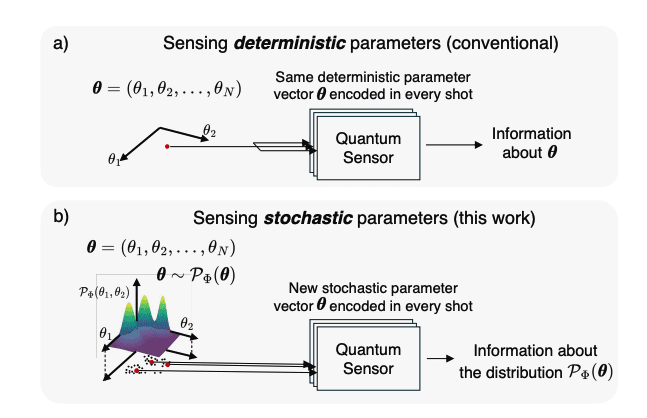
An article by Sridhar Prabhu et al., published on April 30, 2025, reveals how quantum sensing leverages entanglement to achieve an exponential advantage in estimating correlated stochastic parameters, demonstrating a significant leap over classical methods.
The research shifts from deterministic to stochastic parameters in sensing, where each protocol shot involves random parameter draws. It demonstrates entanglement’s benefits across three examples: a two-parameter classification task with low-shot advantages; an -parameter estimation and its classification variant requiring constant shots versus classical methods needing exponentially more; and magnetization classification of fluctuating spins in thermal equilibrium. A theoretical framework assesses the advantage of entangled protocols over unentangled ones, revealing potential exponential benefits for quantum sensing compared to classical methods.
In an era where precision is paramount, quantum sensors are emerging as transformative tools, offering unparalleled accuracy across various scientific and technological domains. These devices harness the principles of quantum mechanics to achieve measurement capabilities that classical systems cannot match. By leveraging phenomena such as entanglement and superposition, quantum sensors are paving the way for advancements in medical imaging and environmental monitoring.
At the heart of quantum sensing lies a fundamental shift in processing information. Unlike classical sensors, which require multiple measurements to estimate joint correlations, quantum sensors can evaluate characteristic functions at multiple points simultaneously. This capability stems from multi-qubit encoding, where parameters are distributed across entangled qubits. This approach not only enhances the sensor’s ability to distinguish between different distributions but also significantly reduces the number of measurements needed to achieve a given level of accuracy.
The efficiency of quantum sensors is further amplified by their ability to evaluate non-vanishing points in characteristic functions. These points, often undetectable by classical systems, allow quantum sensors to identify subtle differences that are critical in many applications. This enhanced sensitivity is particularly valuable in scenarios where minute variations can have significant consequences, such as in the early detection of diseases or the monitoring of environmental changes.
The development of quantum sensors relies on two key frameworks: multi-qubit encoding and dual qubit action. Multi-qubit encoding distributes parameters across multiple entangled qubits, enabling simultaneous evaluation of characteristic functions at various points. This method maximises information extraction from each measurement, thereby improving the sensor’s discriminative power.
Dual qubit action involves each parameter acting on two sets of qubits, allowing for the evaluation of additional non-vanishing points. By strategically selecting specific patterns for these qubits, quantum sensors can access information that is otherwise unattainable. This approach not only enhances sensitivity but also opens new possibilities for detecting changes that classical systems might miss.
The exponential advantage of quantum sensors translates into tangible benefits across a wide range of applications. In medical imaging, these devices have the potential to detect diseases at an earlier stage by identifying subtle variations in tissue properties. Similarly, in environmental monitoring, quantum sensors can provide more accurate measurements of pollutants, enabling timely interventions to mitigate their impact.
The ability to evaluate non-vanishing points in characteristic functions is particularly valuable in scenarios where classical systems fall short. For instance, in the field of telecommunications, quantum sensors can detect minute signal distortions that are critical for maintaining data integrity. This capability not only improves the reliability of communication networks but also paves the way for future advancements in quantum computing and cryptography.
Quantum sensors represent a significant leap forward in precision measurement, offering capabilities that were previously unimaginable. By harnessing the principles of quantum mechanics, these devices are unlocking new possibilities across various scientific and technological domains. As research continues to advance, the potential applications of quantum sensors are expected to expand further, revolutionising industries and improving our ability to understand and interact with the world around us.
👉 More information
🗞 Exponential advantage in quantum sensing of correlated parameters
🧠 DOI: https://doi.org/10.48550/arXiv.2504.21745