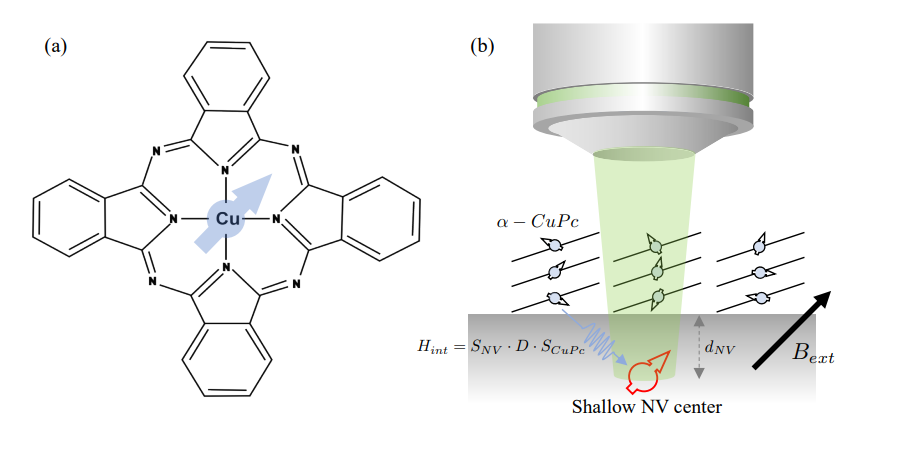
Molecular spin systems hold considerable promise for future technologies, including nanoscale information processing, but characterising these systems at room temperature presents a significant challenge due to the rapid loss of spin information. Boning Li, Xufan Li, and Yifan Quan from the Massachusetts Institute of Technology, alongside Avetik R Harutyunyan from Honda Research Institute USA, Inc., and Paola Cappellaro, now demonstrate a new method for probing these molecular spins using nitrogen-vacancy (NV) centres in diamond. Their work unequivocally identifies interactions between NV centres and copper-phthalocyanine (CuPc) molecules, and crucially, extracts detailed parameters of the CuPc spin ensemble, including its correlation time and local orientation, that are inaccessible using conventional techniques. This achievement establishes NV centres as powerful tools for investigating molecular spin systems, offering new avenues for developing molecular qubits, engineering spin baths, and creating advanced hybrid materials with potential applications in molecular-scale processors and spin-based networks.
NV-CuPc Interaction Impacts Diamond Coherence
Scientists engineered a hybrid quantum system by probing the interaction between nitrogen-vacancy (NV) centers in diamond and the electron spins of copper phthalocyanine (CuPc) molecules at room temperature, utilizing a 27 ±0. 8nm thin film of pure CuPc deposited onto the diamond substrate. The study employed T1 relaxometry experiments to quantitatively demonstrate this interaction, enabling the extraction of key properties of the CuPc spin system, inaccessible through conventional bulk electron paramagnetic resonance techniques. Scientists analyzed the hyperfine spectrum, a crucial step towards harnessing the long-lived nuclear spins within the CuPc molecules for potential quantum applications, and the model explicitly defines the interaction strength between the NV center and the CuPc spins. Fitting this model to the experimental data revealed critical properties of the CuPc, including the spin bath correlation time and nanoscale variations in the thin film lattice orientation, providing insights beyond the capabilities of bulk material analysis. Furthermore, the analysis confirmed that electron-electron interactions dominate the decoherence dynamics of the CuPc electronic spin at room temperature, and the team proposed a novel method for measuring the depth of shallow NV centers with approximately 1nm precision, leveraging their quantitative understanding of the interaction strength. This innovative approach establishes NV centers as powerful probes for molecular spin systems, offering a pathway towards molecular-scale quantum processors and spin-based quantum networks.
NV Centers Probe Molecular Spin Interactions
Scientists have demonstrated a novel method for probing molecular spin systems using nitrogen-vacancy (NV) centers in diamond, achieving detailed characterization of copper phthalocyanine (CuPc) thin films at room temperature. The work establishes NV centers as powerful tools for investigating molecular qubits and engineering spin baths for quantum materials. Experiments involved depositing a 27 ±0. 8nm thick CuPc thin film onto a diamond surface and utilizing T1 relaxometry to probe the interaction between NV centers and the CuPc electron spins. The team unequivocally identified the NV-CuPc interaction through analysis of the hyperfine spectrum, a crucial step towards harnessing the potential of long-lived nuclear spins for quantum applications.
Detailed modeling of the experimental data revealed key properties of the CuPc spin ensemble, including the spin bath correlation time and nanoscale variations in the thin film lattice orientation, parameters inaccessible through conventional bulk electron resonance experiments. Measurements confirm that electron-electron interactions dominate the decoherence dynamics of CuPc at room temperature, providing insight into the mechanisms limiting spin coherence. Furthermore, scientists developed a new technique for estimating the depth of shallow NV centers with approximately 1nm precision, offering an improvement over existing methods. The research quantitatively demonstrates the interaction strength between the NV center and CuPc, enabling accurate extraction of CuPc properties from experimental results. These findings pave the way for exploring molecular-scale quantum processors and spin-based quantum networks, leveraging the unique capabilities of NV centers to control and characterize molecular spin systems.
CuPc Spin Bath Characterized by NV Centers
This research demonstrates the successful probing of molecular spin systems using shallow nitrogen-vacancy (NV) centers in diamond, offering new insights into the behaviour of these systems at room temperature. Scientists utilized relaxometry to investigate the interaction between NV centers and an ensemble of electron spins within a copper phthalocyanine (CuPc) thin film, accurately determining key properties of the CuPc spin bath, including its correlation time and local lattice orientation, parameters difficult to measure with traditional bulk techniques. The analysis confirms that electron-electron interactions primarily govern the decoherence observed in CuPc at room temperature, furthering understanding of spin dynamics within these materials. Furthermore, this work introduces a novel method for precisely determining the depth of NV centers using T1 relaxometry, achieving nanometer-level precision without requiring prior knowledge of the CuPc lattice orientation or individual calibration of each NV center.
The extracted NV depths align closely with measurements obtained through conventional proton resonance techniques, validating the accuracy of this new approach. Future work could extend this protocol to investigate other molecular spin systems and hybrid quantum materials, potentially paving the way for advancements in molecular qubits, spin bath engineering, and scalable entangled networks with fast, local control.
🗞 Quantum Sensing of Copper-Phthalocyanine Electron Spins via NV Relaxometry
🧠 ArXiv: https://arxiv.org/abs/2511.03200