The increasing threat to current encryption methods drives research into future-proof security systems, and a promising approach combines the strengths of quantum key distribution (QKD) with post-quantum cryptography (PQC). Aman Gupta, Ravi Singh Adhikari, and Anju Rani, all from the School of Electrical Engineering and Telecommunications at the University of New South Wales, alongside Xiaoyu Ai and Robert Malaney, significantly advance this field by addressing critical limitations in existing hybrid designs. Their work integrates realistic finite-key effects into QKD key rates and establishes a method for maintaining security even when both QKD and PQC systems are vulnerable to side-channel attacks. This research delivers a hybrid system employing a uniquely secure instruction sequence, guaranteeing message confidentiality and achieving a processing time that scales efficiently with increasing secret instruction size, representing a substantial step towards practical, deployable quantum-enhanced security networks.
Rigorous QKD Performance and Security Analysis
This research details a comprehensive analysis of a Quantum Key Distribution (QKD) system, focusing on maximizing the secure key rate while protecting against eavesdropping. The work precisely calculates error rates inherent in quantum transmission, accounting for noise and potential attacks, and establishes methods to bound the probability of incorrect decisions. By optimizing system parameters, such as key length and privacy amplification, the team developed algorithms for practical implementation within a QKD system. The analysis rigorously estimates the Quantum Bit Error Rate (QBER), a key indicator of potential eavesdropping or channel noise, using statistical techniques like Serfling’s bound, and defines relationships between key parameters to accurately calculate privacy amplification needed to protect against eavesdroppers.
Hybrid QKD and Post-Quantum Key Sharing
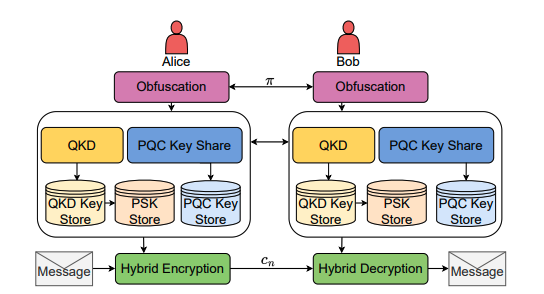
Researchers engineered a hybrid quantum key distribution (QKD) and post-quantum cryptography (PQC) system, termed HOQS+, to address vulnerabilities in existing hybrid schemes and improve scalability. This system establishes secure communication by combining QKD, based on the BBM92 protocol, with the Crystals-Kyber PQC scheme, and employs information-theoretically secure instruction sequences (ISs) to protect message confidentiality. A key innovation lies in the implementation of tight finite-key security bounds for the QKD component, deployed within a functioning QKD system for the first time, ensuring robust key rates even with limited data. The HOQS+ system operates in cycles, encrypting an IS by combining it with a subset of a pre-shared key (PSK) before transmission, and then configures QKD post-processing, PQC key sharing, and hybrid encryption, providing obfuscation.
Tight Finite-Key Security for Hybrid QKD Systems
This work presents a significant advancement in hybrid quantum key distribution (QKD) and post-quantum cryptography (PQC) systems, delivering improved scalability and security against sophisticated attacks. Researchers developed a modified system, termed HOQS+, building upon a previous design, to address limitations in processing time and security robustness. The core achievement lies in integrating tight finite-key security into the QKD component and refining the design of the hybrid system’s primitives. The team implemented the tightest finite-key security to date for the BBM92 protocol, bolstering the system’s resilience even with limited key lengths, and modifications to the hybrid system’s primitives enable processing times that scale linearly with the size of secret instructions, a substantial improvement over previous iterations.
HOQS+ Achieves Tightest Finite-Key Security
This work presents significant advances in hybrid quantum-post-quantum cryptography, specifically through the development of an improved system, termed HOQS+. Researchers addressed limitations in existing hybrid designs by integrating rigorous finite-key security analysis into the quantum key distribution component and enhancing the system’s scalability. The HOQS+ system employs a novel information-theoretically secure instruction sequence that governs the configuration of cryptographic primitives, ensuring message confidentiality even if both the quantum and post-quantum components are compromised, and the design improvements ensure that processing time scales linearly with the size of secret instructions, a critical factor for real-world deployment.
🗞 Combined Quantum and Post-Quantum Security Performance Under Finite Keys
🧠 ArXiv: https://arxiv.org/abs/2512.04429