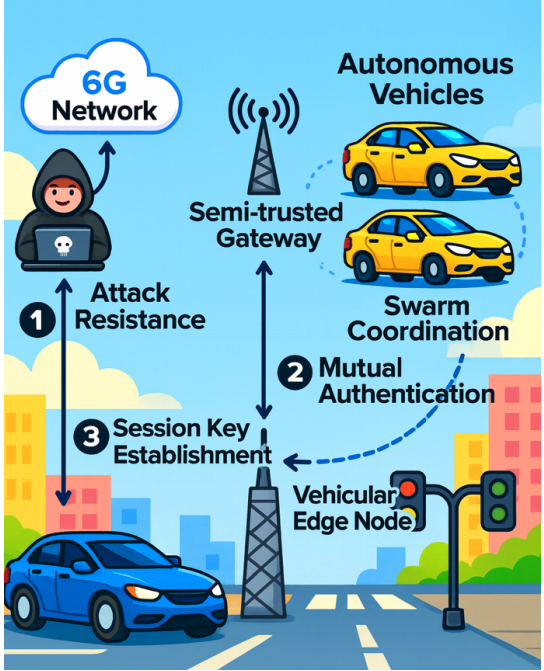
The increasing sophistication of connected and autonomous vehicles demands exceptionally secure communication protocols, yet many existing systems remain vulnerable to increasingly powerful attacks. Shakil Ahmed, Amika Tabassum, and Ibrahim Almazyad, alongside colleagues at Iowa State University and Al-Qassim University, address this critical need with QSAFE-V, a novel authentication framework designed specifically for the challenging environment of tactile wireless networks. This research introduces a quantum-enhanced approach to vehicle authentication, offering significantly stronger security guarantees than traditional methods while maintaining comparable communication and computational costs. By leveraging the principles of quantum key distribution, QSAFE-V establishes robust protection against both conventional and advanced attacks, ensuring the safety and reliability of future intelligent transportation systems and paving the way for truly secure vehicle-to-vehicle communication.
Tactile Internet Security and Haptic Data Protection
This research explores the security challenges inherent in the tactile internet, a network enabling real-time, bi-directional transfer of data and haptic feedback for applications like remote surgery and immersive telepresence. The team addresses the need for robust security measures, recognizing that traditional methods often fall short due to latency requirements and the limited resources of edge devices. A key focus is the development of solutions resistant to attacks from future quantum computers, necessitating the adoption of post-quantum cryptography. The research presents a novel security architecture, combining multiple techniques for enhanced defense.
This approach integrates Quantum Key Distribution (QKD) to establish secure keys between critical nodes, leveraging the theoretically unbreakable nature of quantum key exchange. Physically Unclonable Functions (PUFs) generate unique device identities based on inherent manufacturing variations, making device cloning difficult. Security functions are strategically placed at the network edge to minimize latency and improve scalability, while lightweight cryptographic algorithms are employed to suit resource-constrained devices. The system also incorporates machine learning for anomaly detection and formal verification techniques to ensure security and correctness.
Quantum Identity Tokens for Vehicle Authentication
Researchers engineered QSAFE-V, a novel authentication framework for vehicles operating within the Tactile Internet and vehicular edge computing environments. This system addresses critical security vulnerabilities in existing methods by employing a Quantum Identity Token (QIT), a security primitive leveraging quantum mechanics to create uniquely identifiable and unforgeable credentials. The team generates QITs using principles of quantum information theory, exploiting the quantum no-cloning theorem to prevent replication and impersonation attacks. To achieve robust security, the study combines Quantum Key Distribution (QKD) with hash-based verification techniques, providing mutual authentication and forward secrecy against both conventional and quantum attacks.
QSAFE-V is designed to operate effectively within the constraints of vehicular edge computing, prioritizing low latency and high reliability. Unlike conventional quantum protocols, QSAFE-V adopts lightweight communication primitives to minimize quantum overhead, enabling deployment on resource-constrained edge nodes and facilitating scalability. Extensive analytical evaluations confirm the protocol’s resistance to common attack vectors, demonstrating improvements in handshake latency and entropy strength compared to existing classical schemes.
Quantum Authentication Secures Edge Vehicle Networks
The research team developed QSAFE-V, a novel authentication framework for edge-enabled vehicles operating within the Tactile Internet. This system addresses critical vulnerabilities in existing authentication schemes when faced with advanced adversarial models and the demands of ultra-low latency communication. QSAFE-V integrates quantum and classical cryptographic techniques to achieve a lightweight and scalable solution suitable for resource-constrained vehicular networks. Experiments reveal that QSAFE-V leverages quantum information theory, specifically quantum unclonability and measurement-driven uniqueness, to provide strong resistance against replication and impersonation attacks.
Each Quantum Internet Token (QIT) is defined by a quantum challenge and its expected response, governed by quantum measurement principles, ensuring a secure identification process for Autonomous Vehicles. The framework utilizes lattice-based cryptography, relying on the hardness of the Shortest Vector Problem and the Learning With Errors problem, to provide security against both classical and quantum attacks. Detailed analysis shows that QSAFE-V achieves comparable communication and computation costs to classical schemes while offering significantly stronger guarantees under wireless conditions. The system model incorporates Autonomous Vehicles, Vehicular Edge Nodes, Gateways, and Trusted Authorities, working in concert to provide secure authentication and coordination. Vehicular Edge Nodes perform context-aware behavioral analysis and manage reauthentication during high-mobility conditions. Measurements confirm that the framework supports secure key exchanges and relays entangled authentication tokens when needed, ensuring secure communication across the network.
QSAFE-V Secures Vehicles Against Quantum Attacks
The research team developed QSAFE-V, a novel authentication framework designed to secure edge-enabled vehicles within the emerging Tactile Internet. This system addresses critical vulnerabilities in existing authentication schemes when faced with advanced computing threats, particularly those leveraging quantum capabilities. QSAFE-V achieves robust protection against both conventional and contextual attacks by employing a lightweight, adaptable design suitable for the dynamic environment of vehicular networks. Formal security proofs demonstrate that QSAFE-V’s advantage in compromising session key security is bounded by the number of hash oracle queries and the difficulty of solving the Learning With Errors problem, a well-established lattice-based cryptographic challenge.
Through a series of analytical games, the researchers rigorously evaluated potential attack paths, confirming the system’s resilience even when an adversary gains access to various levels of information. Performance analysis indicates that QSAFE-V achieves comparable communication and computation costs to classical schemes, while simultaneously offering significantly stronger security guarantees under the demanding conditions of wireless Tactile Internet applications. Future work may focus on exploring alternative cryptographic primitives and refining the framework to minimize computational overhead, particularly for resource-constrained vehicles.
🗞 QSAFE-V: Quantum-Enhanced Lightweight Authentication Protocol Design for Vehicular Tactile Wireless Networks
🧠 ArXiv: https://arxiv.org/abs/2511.03850