Researchers have demonstrated a novel approach to manipulating light-matter interactions using electromagnetically induced transparency in a four-level atomic system. Sheng-Xian Xiao and Tao Wang, both from Chongqing University, alongside their colleagues, detail how frequency mixing within this ‘ladder’ configuration dramatically alters transparency spectra, revealing a secondary splitting of the Autler-Townes effect. This significant finding, achieved through a combination of multi-mode Floquet theory and periodic driving, allows for continuous tuning of resonant frequencies and the coexistence of distinct interference effects , interference between Floquet channels and loop interference from coherent pathways. Crucially, these effects are independently readable from transmission spectra, offering a new method for precise AC field phase extraction and paving the way for advanced coherent control in complex quantum systems.
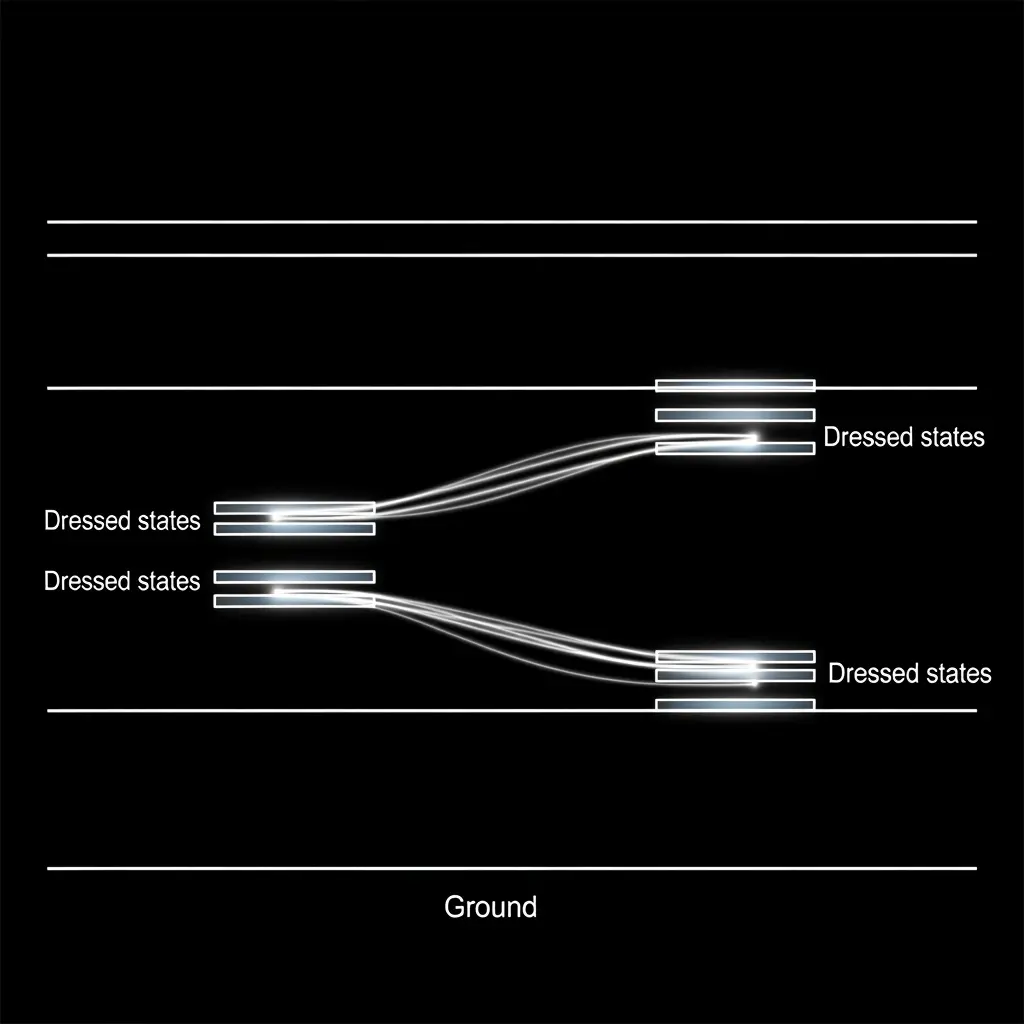
The research establishes that both interference effects can be independently read out from the transmission spectra, offering enhanced control and measurement capabilities. Specifically, the team utilized a ladder four-level system, comprising a ground state |1⟩, an excited state |2⟩, and two metastable upper states |3⟩ and |4⟩, as depicted in their schematic diagram. A probe laser with a Rabi frequency of Ωp/(2π) = 2 was resonant with the |1⟩←→|2⟩ transition, while a control laser with Rabi frequency Ωc and detuning ∆c was coupled to the |2⟩←→|3⟩ transition.
Quantum Frequency Mixing in a Four-Level Atomic System
The study pioneered a method for achieving continuous tunability of resonant frequencies between upper levels, facilitating broadband AC field operation and enabling novel coherent control mechanisms. Researchers constructed the system using a ground state |1⟩, an excited state |2⟩, and two metastable upper states |3⟩ and |4⟩, as depicted in their schematic diagram. A probe laser with a Rabi frequency of Ωp/(2π) = 2, resonant with the |1⟩←→|2⟩ transition, was employed alongside a control laser with Rabi frequency Ωc and detuning ∆c coupled to |2⟩←→|3⟩. Within the rotating-wave approximation, the team derived a system Hamiltonian to model the atomic interactions.
This Hamiltonian accounted for the probe, control, and LO fields, as well as the far-detuned fields driving the transition between the upper states. The strong LO field induced the formation of two dressed states, |d3⟩ and |d4⟩, with an energy gap of ħΩL, effectively extending the system’s resonant response to far-detuning signal fields without requiring additional energy levels. Scientists then incorporated periodic driving on the LO field, resulting in a dual-Floquet-driven Hamiltonian in the dressed-state picture. To further refine their analysis, the research team derived an effective Hamiltonian in the dressed-state picture, detailed in Appendix A of their work. This Hamiltonian, incorporating the QFM theory for the far-detuning fields, revealed that the two detuned fields generate an effective field aligned along the z-axis, driving transitions between the dressed states. By resonating this effective field with the dressed states (ωM = ΩL), the study demonstrated a new paradigm for coherent control in multi-level systems, offering avenues for quantum sensing and manipulation.
Double Autler-Townes Splitting via Frequency Mixing
Experiments confirmed that the team successfully implemented quantum frequency mixing, leading to this novel spectral feature. Specifically, when g = 3.83, with Ωk M and δj M approximately 0, Floquet-channel interference was turned off, and the double-ATS peak spacing remained constant. Further measurements revealed that when g = 4, both types of interference existed simultaneously. Both the peak spacing and the linewidth asymmetry of the double-ATS underwent complex periodic modulation with the drive phase φ, showcasing the interplay of the two mechanisms. Tests prove that this dual-Floquet drive provides two independent “knobs”, one tuning the peak separation via Floquet-channel interference, and the other tuning the linewidth symmetry via loop interference, both addressable through the phase of an external periodic drive.
The team recorded that the linewidth asymmetry varied periodically with φ when Floquet-channel interference was off, demonstrating precise control over spectral characteristics. Results demonstrate that loop interference, arising from the artificially created closed coherent pathway, provides a robust tool for controlling the lineshape of spectral features and sensing the phase of microwave electric fields without relying on specific atomic natural energy level transitions. The Floquet-channel interference governs the effective coupling strength and thus the peak splitting distance, allowing for precise, phase-coherent tuning of the sensor’s spectral resolution. Crucially, both interference effects are phase-tunable via a common external driving field, yet their occurrence can be independently selected through the driving strength, establishing a versatile coherent control platform.
Dual Modulation Unlocks Broad Spectrum Sensing capabilities
Furthermore, researchers introduced a periodic driving force, achieving dual-Floquet modulation and uncovering two independently tunable quantum interference mechanisms. One mechanism, arising from interference among Floquet channels, governs the effective coupling strength and peak splitting distance, allowing for precise tuning of spectral resolution. The other, loop interference, originates from a closed coherent pathway and provides a robust tool for controlling lineshape and sensing the phase of microwave electric fields, independent of specific atomic transitions. Both mechanisms are phase-tunable via a common external driving field, establishing a versatile platform for coherent control. The authors acknowledge that the current work focuses on theoretical modelling and simulation, and experimental verification would be crucial to confirm the predicted effects. Future research will explore time-varying driving waveforms for dynamic sensing protocols and extend this framework to more complex quantum networks, potentially enhancing quantum sensing capabilities.
👉 More information
🗞 Electromagnetically Induced Transparency Spectra of Ladder Four-Level System with Quantum Frequency Mixing
🧠 ArXiv: https://arxiv.org/abs/2601.20296