

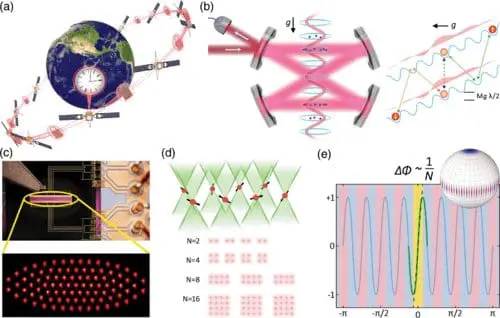
Atomic, molecular, and optical (AMO) physics have played a crucial role in the development of quantum science, paving the way for modern technology. Researchers Jun Ye and Peter Zoller argue that the rapid advancement of quantum information science could redefine the boundaries of measurement physics, potentially leading to significant discoveries. They anticipate that quantum technologies, such as fault-tolerant quantum computing and entangled quantum sensor networks, could unlock new areas of basic science. The authors also highlight the importance of quantum technologies demonstrating scalability and superior performance in areas where classical approaches are limited.
What is the Role of Atomic, Molecular, and Optical Physics in Quantum Science?
Atomic, molecular, and optical (AMO) physics has been instrumental in the development of quantum science, laying the foundation for modern technology. The growing capabilities of quantum control of many atoms for engineered many-body states and quantum entanglement have raised a key question: what critical impact will the second quantum revolution, with ubiquitous applications of entanglement, bring to bear on fundamental physics?
In this essay, Jun Ye from the JILA National Institute of Standards and Technology and Department of Physics, University of Colorado Boulder, and Peter Zoller from the Institute for Theoretical Physics, University of Innsbruck, and Institute for Quantum Optics and Quantum Information, Austrian Academy of Sciences, argue that a compelling long-term vision for fundamental physics and novel applications is to harness the rapid development of quantum information science to define and advance the frontiers of measurement physics with strong potential for fundamental discoveries.
As quantum technologies such as fault-tolerant quantum computing and entangled quantum sensor networks become much more advanced than today’s realization, we wonder what doors of basic science can these tools unlock. The authors anticipate that some of the most intriguing and challenging problems such as quantum aspects of gravity, fundamental symmetries, or new physics beyond the minimal standard model will be tackled at the emerging quantum measurement frontier.
How is Quantum Computing Shaping AMO Science?
The study of individual atoms, real or artificial, has brought us a tremendous understanding of fundamental physics such as the vacuum mode structure of electromagnetic fields and has given birth to powerful tools such as lasers and nuclear magnetic resonance (NMR). The tantalizing possibility of assembling and controlling thousands to millions of atoms as precisely as a single atom, bringing them together for engineered many-body states and quantum entanglement, is guaranteed to provide technological breakthroughs in information collection, processing, and communication.
While quantum computing is still in a very early stage of development, the implication on how quantum systems collect, process, and distribute information for sensing and communication is already fundamentally shaping the scope and impact of AMO science well beyond its traditional boundary. AMO platforms feature both spin qubits and qudits and bosonic and fermionic particles as basic constituents, and their functionality can be tailored to specific measurement goals.
Atoms and molecules can now be individually addressed and measured with high fidelity, then interconnected into small systems decoupled from the environment. The development of increasingly large-sized and programmable quantum systems with a mesoscopic number of particles will require both creative scientific ideas and innovative technology development.
What are the Applications of Quantum Sensing and Quantum Simulation?
Quantum simulation and quantum sensing are inextricably linked. Simulating many-body quantum systems provides fundamental insights into dynamical phases of matter, and this knowledge can be leveraged to design a new generation of quantum sensors with engineered many-body states and collective quantum measurements.
The goal is to develop sensors that supersede the current state of the art for targeted applications that are specifically motivated by the need to probe fundamental physics. It is through such applications that current intermediate-scale quantum technologies can have a great impact on both fundamental science and disruptive technology.
To realize a meaningful quantum advantage, quantum technologies must demonstrate scalability and superior performance in regimes where classical approaches reach their limit, and it is necessary to characterize and verify quantum devices in the classically inaccessible regime. Demonstrations of quantum advantage on problems that have practical applications, such as entanglement-enhanced quantum sensors, will help expand the deployment of quantum technologies.
How are Quantum Systems Advancing?
Chains of trapped ions were among the first systems to realize digital quantum computing that features high-gate fidelity. With enhanced connectivity, they have recently been used to run quantum circuits implementing quantum algorithms, as well as digital and analog quantum simulations of complex Hamiltonians.
Neutral atoms are rapidly rising to realize medium-scale quantum processors, including scaling to tens of thousands of atoms with local addressing and atom storage and reloading. The increasingly higher fidelity and programmability for one and two-qubit gates, along with effective mid-circuit readout and flexibility in spatial reconfiguration and entanglement distribution in a network of qubits, are leading to the production of encoded and error-corrected logical qubits permitting the systems to make fault-tolerant production of logical GHZ states that can be used to measure certain parameters at an enhanced rate.
Indeed, the development of quantum systems is a complex process that requires both creative scientific ideas and innovative technology development. The identification of near-term applications based on these machines will fuel the exploration of new physics beyond the current reach.
What is the Future of Quantum Physics?
The authors anticipate that some of the most intriguing and challenging problems such as quantum aspects of gravity, fundamental symmetries, or new physics beyond the minimal standard model will be tackled at the emerging quantum measurement frontier.
The rapid development of quantum information science is expected to define and advance the frontiers of measurement physics with strong potential for fundamental discoveries. As quantum technologies such as fault-tolerant quantum computing and entangled quantum sensor networks become much more advanced than today’s realization, we wonder what doors of basic science can these tools unlock.
The future of quantum physics is indeed promising, with the potential to unlock new doors of basic science and make fundamental discoveries. The second quantum revolution, with ubiquitous applications of entanglement, is expected to have a critical impact on fundamental physics.
How will Quantum Technologies Impact Fundamental Science and Technology?
To realize a meaningful quantum advantage, quantum technologies must demonstrate scalability and superior performance in regimes where classical approaches reach their limit. It is necessary to characterize and verify quantum devices in the classically inaccessible regime.
Demonstrations of quantum advantage on problems that have practical applications, such as entanglement-enhanced quantum sensors, will help expand the deployment of quantum technologies. It is through such applications that current intermediate-scale quantum technologies can have a great impact on both fundamental science and disruptive technology.
Indeed, the development and deployment of quantum technologies are expected to have a profound impact on both fundamental science and disruptive technology. The authors argue that a compelling long-term vision for fundamental physics and novel applications is to harness the rapid development of quantum information science to define and advance the frontiers of measurement physics with strong potential for fundamental discoveries.
Conclusion: The Quantum Revolution and its Impact on Fundamental Physics
The second quantum revolution, with ubiquitous applications of entanglement, is expected to have a critical impact on fundamental physics. The rapid development of quantum information science is expected to define and advance the frontiers of measurement physics with strong potential for fundamental discoveries.
As quantum technologies such as fault-tolerant quantum computing and entangled quantum sensor networks become much more advanced than today’s realization, we wonder what doors of basic science can these tools unlock. The authors anticipate that some of the most intriguing and challenging problems such as quantum aspects of gravity, fundamental symmetries, or new physics beyond the minimal standard model will be tackled at the emerging quantum measurement frontier.
In conclusion, the future of quantum physics is indeed promising, with the potential to unlock new doors of basic science and make fundamental discoveries. The second quantum revolution, with ubiquitous applications of entanglement, is expected to have a critical impact on fundamental physics.
Publication Date: 2024-05-07
Authors: Jun Ye and Peter Zoller
Source: Physical review letters
DOI: https://doi.org/10.1103/physrevlett.132.190001


