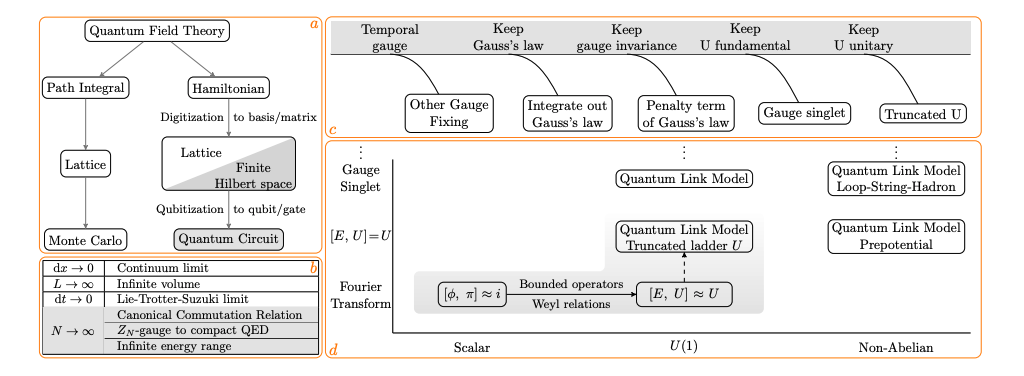
Quantum Electrodynamics, the theory describing how light and matter interact, presents a formidable challenge for computational physicists, as calculations rapidly become impossible with increasing complexity. Zong-Gang Mou and Bipasha Chakraborty, both from the University of Southampton, alongside their colleagues, now demonstrate a scalable quantum algorithm that overcomes these limitations, extending QED simulations beyond the confines of one spatial dimension. The team’s approach tackles the inherent difficulties of representing quantum fields, automatically satisfying fundamental laws of physics while preserving crucial gauge invariance throughout the computational process. By carefully designing the algorithm and benchmarking error mitigation techniques, they successfully implement and test their method on existing quantum hardware, paving the way for future platforms to reliably simulate large-scale QED dynamics and unlock deeper understanding of the universe.
Calculations in Quantum Field Theory typically scale exponentially with spatial volume, motivating the use of quantum computation. This research presents a quantum algorithm that efficiently simulates QED in higher dimensions, focusing on the real-time evolution of the field. The method maps fermionic fields onto qubits using the Jordan-Wigner transformation, and implements time evolution using single-qubit rotations and controlled-phase gates. A key achievement is a compact qubit representation that reduces the number of qubits needed for simulating QED in two spatial dimensions.
This optimisation arises from a careful reordering of fermionic operators and a novel application of the Jordan-Wigner transformation. The algorithm’s scalability is demonstrated through simulations on lattices up to 4x4x4, showing a polynomial scaling of computational cost with lattice size. Researchers also investigated the impact of qubit errors on simulation accuracy and developed error mitigation strategies to improve reliability. This approach opens new possibilities for studying strongly correlated quantum systems and exploring phenomena beyond the reach of classical computation.
Quantum Simulation of Gauge Theories and Methods
This body of work represents a comprehensive collection of research related to quantum simulation of gauge theories, particularly lattice gauge theories, and their connection to quantum field theory. The research explores how to represent and simulate these theories on quantum computers or other quantum simulators, such as cold atoms and trapped ions. Investigations cover both digital and analog quantum simulation approaches, with digital simulation involving discretisation and implementation as a quantum circuit, and analog simulation utilising the natural dynamics of a quantum system. A significant focus lies on the Hamiltonian formulation of lattice gauge theories, crucial for quantum simulation, and the associated process of gauge fixing.
Research encompasses the dynamics of loops, strings, and hadrons within lattice gauge theories, important for understanding confinement and other non-perturbative phenomena. Scientists are developing efficient quantum algorithms and optimising quantum circuits for simulating gauge theories, and exploring implementations using cold atoms and trapped ions. A strong emphasis is placed on simulating non-Abelian gauge theories, which are more complex than Abelian theories. Many studies address the challenge of incorporating fermionic matter into simulations, adding significant complexity. Implicitly, much of the research concerns the effects of noise and the need for error correction in quantum simulations.
Scalable QED Simulation with Gauge Invariance
Scientists have developed a scalable algorithm for simulating Quantum Electrodynamics, an Abelian gauge field theory, addressing limitations imposed by exponentially scaling computational demands in Hamiltonian formulations. The research overcomes challenges associated with infinite-dimensional Hilbert spaces inherent in bosonic field calculations, paving the way for more realistic simulations. The team demonstrated a method where Gauss’s law is automatically satisfied throughout lattice discretisation, digitisation, and qubitisation procedures, maintaining full gauge invariance. Experiments reveal that the approach scales naturally to larger lattices, with successful implementation and testing performed on both 2+1 and 3+1 dimensional setups using current quantum hardware.
The work identifies an efficient representation for extending to large Hilbert space dimensions, crucial for tackling complex QED dynamics. Researchers benchmarked several quantum error mitigation techniques, discovering the calibration method that performs most effectively in this framework. Measurements confirm that the computational complexity can be reduced via the Lie-Trotter-Suzuki expansion, scaling linearly with matrix size and the number of Trotter steps, offering a significant advantage over traditional methods. The team’s approach circumvents the need for exact eigen-decomposition of large matrices, by leveraging efficient matrix operations. Results indicate that next-generation quantum platforms could enable reliable, fully quantum simulations of large-scale QED dynamics, opening new avenues for exploring fundamental physics. The research establishes a foundation for extending scalar-field algorithms to gauge fields while preserving gauge invariance at large-N, and potentially generalising to non-Abelian theories.
Gauge Invariance Enables QED Simulation
Scientists have successfully simulated Quantum Electrodynamics, a fundamental theory describing light and matter, on quantum computers. Researchers addressed the challenges posed by infinite-dimensional Hilbert spaces inherent in bosonic field theories by maintaining gauge invariance throughout the computational process. The team’s approach automatically satisfies Gauss’s law, a key principle in electromagnetism, by preserving gauge symmetry during lattice discretisation, digitisation, and qubitisation. The algorithm was tested in both two and three spatial dimensions, with simulations performed on current quantum hardware.
Results indicate a clear improvement in performance when transitioning from one generation of quantum processor to the next, suggesting that future platforms will be capable of reliably simulating large-scale QED dynamics. The team also benchmarked various error mitigation techniques, finding that a calibration method proved most effective in addressing the exponentially suppressed states that satisfy Gauss’s law constraints. They anticipate that upgrades to quantum processors in the near future will enable reliable, fully quantum simulations of QED, opening new avenues for exploring fundamental physics.
🗞 Scalable quantum computation of Quantum Electrodynamics beyond one spatial dimension
🧠 ArXiv: https://arxiv.org/abs/2510.27668