Researchers are developing innovative methods to efficiently convert between different frequencies of light, a crucial step for advancing technologies that utilise terahertz radiation. Jonas von Milczewski, Kelly Werker Smith, and Susanne F. Yelin, all from Harvard University, demonstrate a new approach using carefully designed arrays of atoms that interact with light in a unique way. Their work establishes a highly directional and efficient method for converting terahertz signals into more easily detectable frequencies, and vice versa, by harnessing the collective behaviour of these atomic arrays. This breakthrough combines the flexibility of free-space optics with the precision of engineered materials, potentially enabling significant advances in areas such as astronomical observation, sparse-aperture imaging, and sensitive sensing applications that require coherent terahertz technology.
Light Scattering from Plasmonic Nanoparticle Arrays
This research investigates how light interacts with meticulously designed structures composed of metallic nanoparticles. Scientists explored the scattering of light by these periodic arrangements, aiming to understand and control the way these structures respond to illumination. This control has potential applications in creating novel materials, manipulating light at the nanoscale, developing highly sensitive sensors, and building advanced optical computing devices. The study focuses on plasmonic metamaterials, which exhibit unique optical properties due to the collective oscillation of electrons at their surface.
The research utilizes sophisticated computational techniques to model the behavior of light as it interacts with the nanoparticle arrays. These methods include the Green’s function and the dyadic Green’s function, which account for materials with direction-dependent properties. To simplify calculations, the team employed the rotating wave approximation, demonstrating its minimal impact on the overall results. The team validated the accuracy of both the finite element method and the boundary element method. The results demonstrate that the geometry and arrangement of the metallic nanoparticles significantly influence how light is scattered. By carefully designing these structures, scientists can control the direction of scattered light and create regions of enhanced electromagnetic fields, useful for sensing applications and nonlinear optics. The research provides a detailed understanding of light scattering from plasmonic metamaterials, paving the way for innovative applications in materials science and photonics.
Rydberg Array Enables Photon Frequency Conversion
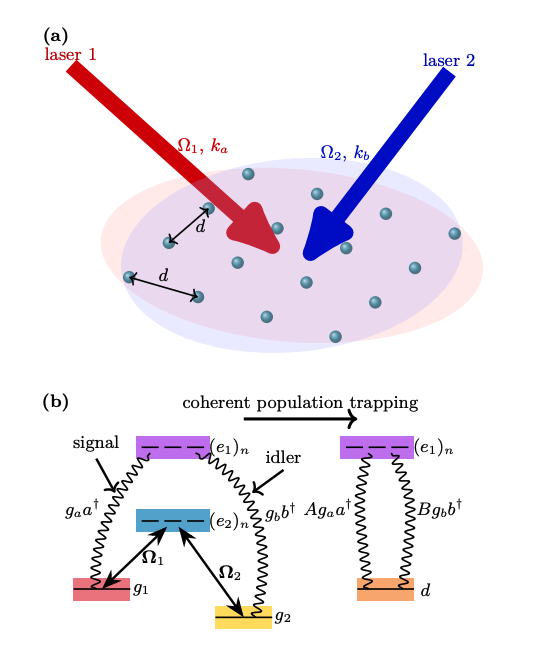
Scientists have developed a technique for converting single photons between different frequencies using a carefully arranged array of Rydberg atoms. This method leverages four-wave mixing and scattering processes to efficiently transform photons, potentially bridging the terahertz and optical ranges. The system utilizes two lasers to precisely prepare the atomic array, coherently coupling a signal transition to an idler transition, enabling the transduction process. To model this transduction process, the team developed a scattering operator formalism, detailing how an initial photon state evolves over time.
This operator describes the probabilities of scattering into various outgoing states, allowing scientists to accurately predict the characteristics of the resulting photons. They connected this quantum mechanical treatment to classical solutions of Maxwell’s equations, establishing a powerful link between quantum and classical descriptions. To facilitate simulations for realistic, finite-sized arrays, the team explored a semi-classical approach. This method offers a practical pathway for modeling experimental scenarios, simplifying calculations without sacrificing essential physics. Solving a self-consistent system of equations allowed them to accurately predict the characteristics of the output signal, including its directionality and efficiency, opening doors for applications in astronomical spectroscopy and networked imaging.
Superradiant Terahertz-to-Optical Photon Transduction Achieved
Scientists have achieved highly efficient and directional single-photon transduction using a novel approach involving four-wave mixing within planar arrays of interacting Rydberg atoms. This method enables the conversion of signals between terahertz and optical frequencies. The system utilizes two lasers to coherently trap the atoms in a specific ground state, effectively coupling an incoming terahertz signal to an idler photon in the optical regime. Under specific conditions, the team discovered that the admixture of the signal photon into dipolar idler modes results in a superradiant idler mode, which decays into a highly directional photon propagating within the plane of the array.
Measurements confirm that this scheme predicts transduction efficiencies of up to 50% into specific spatial directions, with potentially even higher overall efficiencies. Analysis of finite arrays reveals that the output beam becomes increasingly focused as the number of atoms increases, demonstrating improved beam control. This system combines the broadband acceptance of free-space four-wave mixing with the efficiency, directionality, and tunability of cooperative metasurfaces. The research establishes a strong connection between the collective dipole modes and the resulting photon modes, showing that cooperativity limits the photonic modes a dipolar mode can couple to, increasing overlap with individual photonic modes. This breakthrough paves the way for coherent terahertz detection and processing, with potential applications in astronomical spectroscopy, networked sparse-aperture imaging, and advanced sensing technologies.
Terahertz to Microwave Conversion via Atomic Arrays
This research demonstrates a new method for efficiently converting signals between terahertz and microwave frequencies using a specially designed system of interacting atoms arranged in a planar array. By employing a technique called four-wave mixing, the team achieved highly directional transduction, meaning the converted signal is emitted in a focused beam. The process relies on creating collective excitations within the array, effectively coupling an incoming terahertz signal to a microwave photon, and then directing that photon outwards. The team predicts that, under specific conditions, this system can achieve transduction efficiencies of up to 50% in targeted directions, with potentially higher overall efficiency.
Analysis of finite-sized arrays reveals that the output beam becomes increasingly focused as the array expands. This combination of broadband acceptance and precise control over signal direction offers promising applications in areas such as astronomical spectroscopy, sparse-aperture imaging, and advanced sensing technologies. The efficiency of this process is highly dependent on the degree of “cooperativity” within the atomic array, meaning the collective behavior of the atoms is crucial. Future research will likely focus on optimizing these parameters and exploring the scalability of this approach for more complex applications.
🗞 Directional quantum scattering transducer in cooperative Rydberg metasurfaces
🧠 ArXiv: https://arxiv.org/abs/2510.27654