

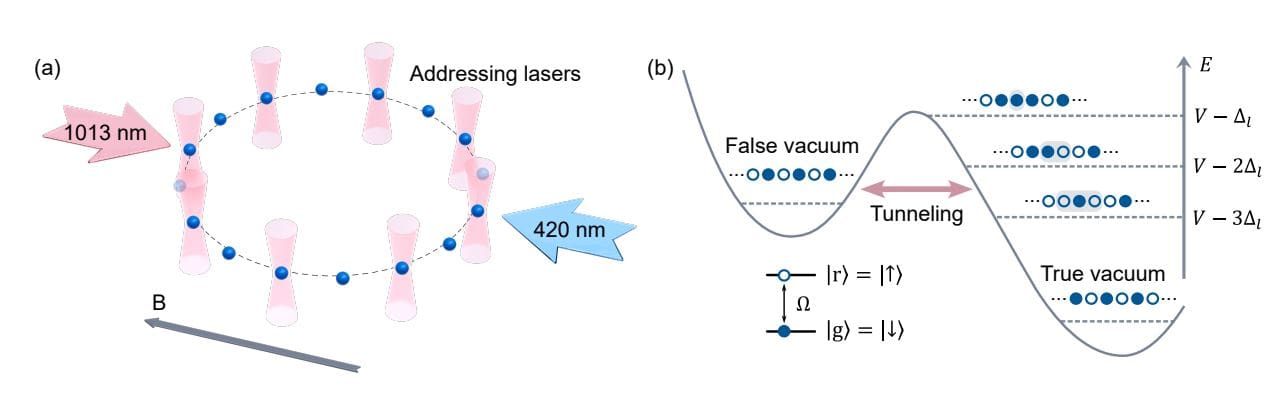
The fundamental concept of a vacuum in physics extends beyond empty space, representing instead the lowest-energy state of a field, and recent research explores the possibility of ‘false’ vacuums, temporary, unstable states that can decay towards a true, stable ground state. Yu-Xin Chao, Peiyun Ge, and Zhen-Xing Hua, alongside colleagues at their respective institutions, investigate this phenomenon using a unique platform of Rydberg atoms arranged in a ring. This approach allows the team to observe the decay of a false vacuum and the formation of bubbles of true vacuum, mirroring predictions from quantum field theory, and revealing how the decay rate changes with external influences. Importantly, the research demonstrates that even small imperfections in the initial state can dramatically alter expected behaviour, and the team’s observations of resonant bubble nucleation, a feature specific to systems with discrete energy levels, establish a new pathway for exploring vacuum decay in more complex scenarios.
Rydberg Atoms Simulate False Vacuum Decay
This work investigates the dynamics of false vacuum decay, a fundamental process in quantum field theory, using a programmable two-dimensional array of Rydberg atoms. The research focuses on simulating the nucleation of bubbles, representing transitions from an unstable false vacuum to a true ground state, and experimentally observing the associated decay process. By carefully controlling atomic interactions and observing the resulting dynamics, researchers aim to gain insights into non-equilibrium processes relevant to cosmology and particle physics. The approach maps the problem of vacuum decay onto the dynamics of a spin system, where atomic states represent different vacuum configurations.
Researchers engineer a potential energy landscape with a barrier separating the false vacuum from the true vacuum, and monitor the probability of bubble nucleation as a function of system parameters. The team utilises the high degree of control afforded by Rydberg atom arrays to precisely tune interactions between atoms, creating a controllable quantum simulator for studying vacuum decay. Through careful measurements, they track the formation and growth of bubbles, providing experimental validation of theoretical predictions. In quantum field theory, the “vacuum” represents the lowest-energy state of a quantum field. If the energy landscape possesses multiple local minima, these constitute the false vacuum, which can tunnel towards the global ground state, known as the true vacuum. Here, researchers study false vacuum decay and bubble nucleation within a Rydberg atom ring, exploiting long-range van-der-Waals interactions and individual-site addressability to explore physics beyond the standard Ising model.
Quench Dynamics via Perturbative Expansion
This document provides a detailed mathematical justification for results presented in related research, focusing on the dynamics of a quantum system after a sudden change in its parameters, known as a quench. The authors utilise the Baker-Campbell-Hausdorff (BCH) expansion to approximate how the system evolves over time, allowing them to calculate the expectation values of observable properties, such as magnetization, in different initial states. The goal is to understand how the system relaxes to equilibrium and how the initial state influences this process, focusing on a transverse-field Ising model. The BCH expansion is used within a perturbative framework, treating the change in the system’s energy due to the quench as a small perturbation.
This allows the authors to approximate the time evolution of the system using a series expansion, calculating the expectation value of magnetization order by order in the perturbation expansion. Detailed calculations reveal that different initial states lead to different short-time dynamics, and that expectation values decay slowly for small perturbations, suggesting long-time correlations. The document provides a valuable resource for researchers working in quantum dynamics and many-body physics, offering a detailed mathematical understanding of the system’s response to a quench.
Rydberg Array Simulates Vacuum Decay Processes
This research demonstrates the successful simulation of false vacuum decay and bubble nucleation using a programmable Rydberg atom array, effectively realising a one-dimensional system beyond the standard Ising model. By exploiting the individual addressability of atoms, scientists observed an exponential decay of antiferromagnetic order, mirroring predictions from field theory regarding the decay of false vacuums. A key finding is the significant dependence of this decay on the initial state of the system; a properly prepared metastable state exhibits a more stable decay rate, aligning with theoretical expectations. Extending beyond short-term dynamics, the team also investigated resonant bubble nucleation, a process unique to discrete systems, and achieved a high-bubble-density regime where interactions between bubbles become important. This work establishes a foundation for investigating more complex many-body tunneling phenomena on Rydberg platforms, including systems with multiple true and false vacuums and complex lattice geometries. Related research is ongoing in a separate two-dimensional Rydberg array, suggesting a growing interest in this area of quantum simulation.
👉 More information
🗞 Probing false vacuum decay and bubble nucleation in a Rydberg atom array
🧠 ArXiv: https://arxiv.org/abs/2512.04637


