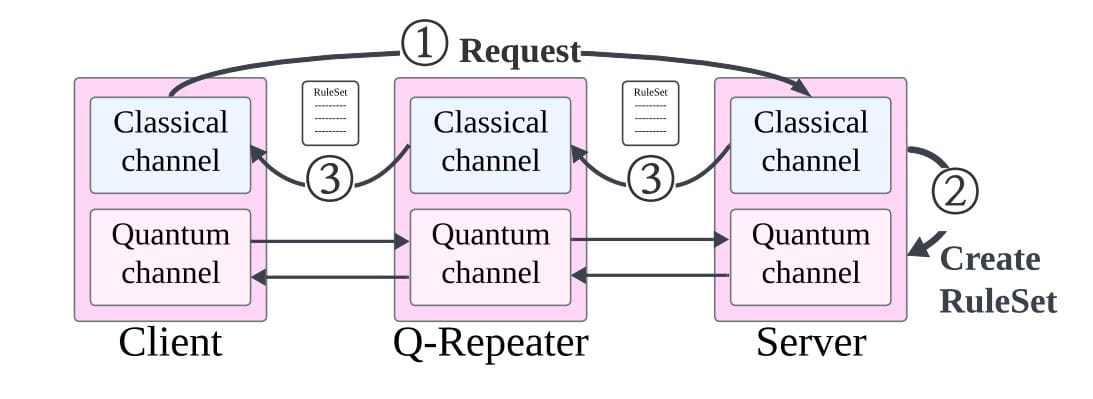
The development of a functional quantum internet demands more than just advances in quantum communication, it requires a complete network architecture capable of handling complex applications. Rei Kawano, Shin Nishio, and Hideaki Kawaguchi from Keio University, alongside Shota Nagayama and Takahiko Satoh, address this critical need by introducing a novel framework for integrating application-level requests into the layered structure of a quantum internet. Their work establishes a RuleSet-based protocol that translates user instructions into executable network operations, clarifying procedures and organising information for seamless application execution. By embedding application specifications into these RuleSets and constructing corresponding state machines, the team demonstrates a transparent integration from the application layer down to the physical layer, significantly lowering the barriers to deploying new applications and paving the way for a truly versatile quantum network.
Quantum Internet Architecture And Simulation Challenges
This research presents a comprehensive overview of quantum internet architecture, protocols, and simulation, addressing the significant challenges in building a functional quantum network beyond simple quantum key distribution. Scientists aim to create a network capable of distributed quantum computation, secure communication, and access to quantum resources, but face hurdles including quantum signal loss, the fragility of quantum states due to decoherence, and the difficulty of scaling these systems. The team argues that a layered architecture, similar to the classical internet, is essential for building a practical quantum internet, requiring clearly defined protocols and interfaces at different levels. Quantum repeaters are crucial for extending the range of quantum communication, overcoming signal loss by creating entanglement between distant nodes.
Efficient and reliable entanglement distribution is a primary focus, alongside the need for quantum memory to store quantum states and quantum error correction techniques to protect quantum information from noise. The authors advocate for a layered protocol stack, promoting modularity, interoperability, and easier development, and introduce a novel ruleset-based communication approach. This ruleset approach offers a declarative way to specify network behavior, defining what the network should do rather than how to do it, simplifying verification and management. Rulesets promote modularity and flexibility, allowing adaptation to different network configurations and applications, and are implemented through a dedicated programming language called RULA.
A key contribution of this work is QuISP, a quantum internet simulation package designed to model network behavior, supporting the modeling of network nodes and links, simulation of communication protocols, evaluation of network architectures, and ruleset-based specification of behavior. QuISP allows for dynamic simulation, enabling the network to evolve over time. The research draws a strong analogy between the quantum internet and the classical internet, highlighting the benefits of layered architecture and standardized protocols. The team acknowledges other quantum networking efforts but emphasizes the unique benefits of the ruleset-based approach and the QuISP simulation package. Future work will focus on improving the scalability of the simulation package, integrating it with real quantum hardware, developing new quantum communication protocols, and working towards standardization of quantum networking protocols and interfaces. In essence, this work presents a comprehensive vision for a practical quantum internet, based on a layered architecture, a ruleset-based programming model, and a powerful simulation package.
Application Layer Integration via Distributed RuleSets
Scientists developed a novel RuleSet-based protocol to integrate the application layer into the architecture of a Quantum Internet, addressing a significant gap in current network design. Recognizing that existing quantum network development prioritizes lower layers, such as entanglement generation, the team engineered a framework that translates user requests into executable network operations. This work pioneers a method for defining communication procedures and information transformations, enabling application-layer requests to drive instructions at lower layers of the quantum network. The core of this achievement lies in the RuleSet, an object distributed to all nodes within a connection, which governs operational decisions and minimizes reliance on classical communication. Researchers designed a system where each node operates autonomously, guided by predefined Rules contained within the RuleSet, thereby reducing latency and improving network performance. This approach empowers nodes to proceed independently based on the locally held RuleSet.
Application Layer Integration via RuleSets
This work presents a novel RuleSet-based framework designed to integrate the application layer into the layered architecture of a future Quantum Internet, addressing a significant gap in current network designs. Researchers successfully constructed state machines from generated RuleSets, enabling transparent integration from the application layer down to the physical layer and lowering barriers to deploying new quantum applications. The core of this achievement lies in a new protocol that explicitly incorporates application specifications into RuleSets, clarifying procedures and organizing request information. Validation of the framework involved verifying the accuracy of generated Intermediate Representations (IR) using state machines, confirming correct processing procedures and proper qubit management.
Analysis of the IR generated for quantum teleportation demonstrated that all qubits are released after measurement and that both quantum and classical processes reach completion, confirming the validity of the RuleSet. Furthermore, the team demonstrated the extensibility of the IR, showing it can support applications beyond teleportation, including blind quantum computation, quantum key distribution, and distributed quantum computing, by incorporating resource request and memory management functionalities. To assess performance, researchers compared estimated execution times with results from the QuISP simulator for quantum teleportation. Simulations, conducted with fiber loss set to 0.
2 dB/km, coupling and detection efficiencies at 0. 8, 10 memories at end nodes, and 7 at repeaters, demonstrated strong correlation between estimated and simulated times for distances up to 32 kilometers. Specifically, the simulation accurately predicted execution times, with a simple linear loss model sufficient for estimations up to 24-25 kilometers. These results confirm the validity of the estimated execution time calculation and demonstrate the potential for efficient quantum communication over practical distances.
RuleSet Protocol For Quantum Internet Layers
This research presents a novel framework for integrating application layers with lower layers in the developing quantum internet. Recognizing that current quantum network architectures often lack a clear interface between user applications and the underlying physical infrastructure, the team developed a RuleSet-based protocol. This approach clarifies communication procedures, organizes necessary information, and defines new instructions to enable application execution, effectively embedding application specifications into a structured set of rules. The feasibility of this framework was demonstrated through the construction and verification of state machines, alongside simulations conducted within a quantum internet simulator.
The key achievement of this work lies in establishing a foundational framework that enhances the practicality and consistency of connecting applications to the quantum internet’s lower layers. By providing a standardized method for translating user requests into executable network operations, this research facilitates the development and deployment of new quantum applications. The authors acknowledge that scalability may become a concern as network size increases, and future work will need to address resource management strategies. Further research will also focus on optimizing the framework for larger, more complex networks and exploring its compatibility with diverse quantum hardware platforms.
👉 More information
🗞 RuleSet Generation Framework for Application Layer Integration in Quantum Internet
🧠 ArXiv: https://arxiv.org/abs/2512.07475