

The pursuit of stable, long-duration quantum computations with trapped ions faces a significant challenge from collisions with background gas molecules, which disrupt delicate quantum states and limit processor scalability. Lewis Hahn from the Institute for, alongside Nikhil Kotibhaskar and Fabien Lefebvre, and their colleagues, now demonstrate a room-temperature extreme high vacuum system that dramatically reduces these disruptive collisions. The team achieves this breakthrough by carefully optimising the chamber’s design and employing high-temperature processing of materials to minimise gas release, resulting in an exceptionally low pressure at the location of the trapped ions. This innovative system extends the continuous operation time of a trapped-ion processor while avoiding the complexity and cost of cryogenic cooling, representing a crucial step towards practical, scalable quantum computing.
UHV System for Trapped Ion Quantum Control
Scientists constructed an ultra-high vacuum (UHV) system designed to trap and manipulate ions for quantum computing and simulation. The primary goal was to minimize collisions with background gas molecules, which disrupt the delicate quantum states of the ions. This system involved careful material selection, meticulous cleaning procedures, and a precise baking process to remove adsorbed gases from chamber walls. Researchers employed techniques like MolFlow+ simulations to model gas flow and outgassing, optimizing the chamber’s design and pumping efficiency. Data on outgassing rates informed the selection process, and optimized baking procedures ensured thorough removal of trapped gases, creating a stable environment for quantum experiments.
Room-Temperature Vacuum System for Trapped Ions
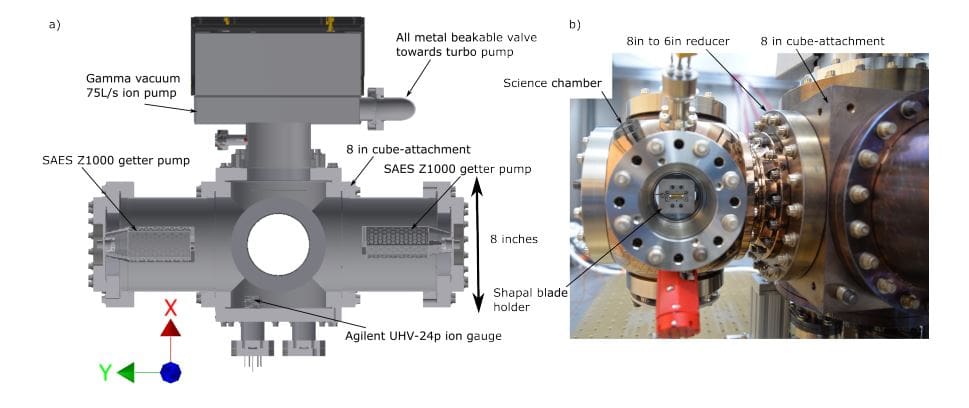
Scientists engineered a room-temperature extreme high vacuum (XHV) system to support long-duration operation of a trapped-ion processor. Recognizing that background gas collisions limit processor performance and can even eject ions, the team optimized chamber geometry, pumping configurations, and conductance pathways using Monte Carlo-based molecular-flow simulations with MolFlow+. High-temperature heat treatment of vacuum components, guided by material science principles, minimized outgassing. The system achieved a final chamber pressure at the limit of measurement, and direct measurements of collision-induced reordering in trapped ions confirmed a low local pressure, demonstrating exceptional performance.
Room-Temperature Vacuum System Enables Extended Ion Trapping
Scientists engineered a room-temperature extreme high vacuum (XHV) system specifically designed to support the extended operation of a trapped-ion processor. The team optimized chamber geometry, pumping configurations, and conductance pathways to maximize effective pumping speed at the ion’s location, recognizing that collisions with background gases limit processor performance. High-temperature heat treatment of stainless steel components, guided by material science principles, successfully reduced outgassing to an exceptionally low level. Measurements revealed a final chamber pressure at the limit of measurement, and direct measurements of collision-induced reordering in trapped ions confirmed a low local pressure, demonstrating exceptional performance.
Room-Temperature Vacuum for Scalable Ion Traps
Scientists developed a room-temperature extreme high vacuum (XHV) system designed to support the extended operation of trapped-ion processors. They focused on maximizing pumping speed at the location of the trapped ions through careful optimization of chamber geometry and pumping configurations, recognizing that collisions with background gases limit processor scalability. They achieved a substantial reduction in outgassing from internal components by employing targeted heat treatment based on established principles of material science. The resulting system demonstrates a significant improvement over typical room-temperature ion trap systems, reaching pressures at the limit of current measurement techniques, and direct measurements of collision rates within trapped ions validated the system’s performance.
👉 More information
🗞 A Room-Temperature Extreme High Vacuum System for Trapped-Ion Quantum Information Processing
🧠 ArXiv: https://arxiv.org/abs/2512.11794

