The seemingly inevitable increase in disorder, known as quantum noise, typically renders the dynamics of open quantum systems irreversible, hindering the reliable processing of quantum information. Einar Gabbassov from the University of Waterloo and Perimeter Institute for Theoretical Physics, alongside colleagues, now demonstrates that this irreversibility does not necessarily hold when observing individual quantum trajectories. The team develops reverse diffusion equations that accurately describe how to undo the effects of common types of quantum noise, including time-dependent depolarizing noise, effectively reversing the flow of information loss. This achievement bridges a critical gap between classical and quantum physics, establishing a theoretical foundation for new approaches to quantum gate design, precise quantum state characterisation, and potentially, entirely new paradigms for quantum computation.
Monitored quantum trajectories form the basis of this research. Scientists have developed quantum reverse diffusion stochastic differential equations, alongside corresponding stochastic master equations, which describe the exact and approximate reverse dynamics for continuously monitored quantum channels. These equations account for various types of noise, including time-dependent depolarizing noise, and bridge the gap between highly nonlinear classical reverse diffusion, prominent in generative modelling, and linear quantum mechanics. Consequently, the research establishes a theoretical framework for diffusion-driven quantum gates, quantum tomography via forward and reverse cycles, and potential paradigms for quantum error correction based on reverse diffusion.
Real-Time Quantum Error Reversal Algorithm
This work addresses the challenge of implementing Inverse Time Evolution (ITE), a crucial process for correcting errors and simulating quantum systems. Traditional methods for ITE often require extensive pre-characterization, significant post-processing, and numerous measurements, making them resource-intensive and sometimes unreliable. The authors aimed to develop an online, near-deterministic, and resource-efficient method for ITE, capable of operating in real-time during computation with a high probability of success. The core of the algorithm involves a combination of unitary block encoding, quantum teleportation, resource states, and post-selection.
The desired inverse operation is represented as a unitary transformation, and quantum teleportation transfers the system’s state to a new qubit, effectively applying the inverse operation. This process relies on specially prepared entangled states, known as resource states, and a post-selection step that verifies successful teleportation. The algorithm works by repeatedly attempting teleportation until a successful outcome is achieved, ensuring a near-deterministic result. Key innovations include the algorithm’s near-deterministic nature, achieved through repeated attempts, and careful management of resource states to minimize overhead.
The number of resource states required grows logarithmically with the desired accuracy. Furthermore, the algorithm can be generalized to handle multi-qubit errors and is designed to improve the performance of quantum error correction codes and enable more efficient quantum simulation. Resource analysis demonstrates that the algorithm requires a logarithmic number of resource states, quantum gates, and measurements, making it a promising candidate for scalable quantum computation.
Reversing Quantum Noise Through Individual Monitoring
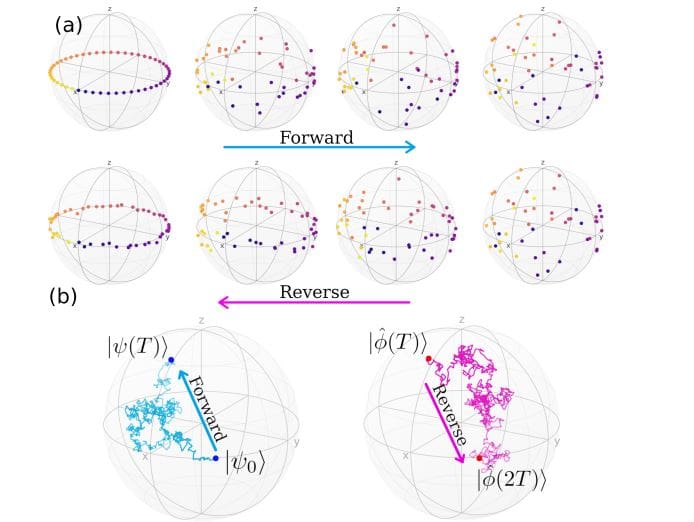
Scientists have demonstrated that quantum systems, when individually monitored, do not necessarily succumb to irreversible dynamics. This research establishes a theoretical framework for reversing the effects of noise on quantum states, revealing that apparent irreversibility arises from considering ensemble averages rather than individual trajectories. Researchers derived quantum reverse stochastic differential equations, alongside corresponding stochastic master equations, which describe how to precisely undo the effects of measurement-induced Pauli noise, including time-dependent depolarizing and Pauli error channels. The team showed that a quantum state undergoing continuous perturbation from random rotations or weak measurements can be recovered to its initial configuration using a subsequent reverse process, even while the original noise effects remain active.
This reverse process is achieved through a carefully constructed stochastic differential equation that incorporates a specific stochastic drift, actively steering the quantum state back towards its starting point or onto a desired manifold of states. Crucially, this reversal doesn’t rely on complex machine learning algorithms, but rather emerges as a natural quantum phenomenon within continuously monitored noisy systems with measurement-based feedback. Experiments reveal that the reverse process precisely mirrors the forward process in time, meaning the statistical distribution of the reversed state matches the time-reversed distribution of the original state. For a single Pauli error channel, the team derived equations describing the dynamics of the reverse process, demonstrating that the initial state, after undergoing the forward process, can be exactly recovered. Measurements confirm that normalizing the reversed state converges exactly to the initial state, offering a powerful tool for understanding and controlling quantum dynamics in noisy environments.
Reversing Diffusion for Quantum State Generation
This research establishes a theoretical framework demonstrating that irreversibility is not a fundamental constraint at the level of individual quantum trajectories in open systems, challenging conventional understanding of quantum dynamics. Scientists developed reverse diffusion stochastic differential equations and corresponding master equations, accurately describing the reverse dynamics of continuously monitored quantum channels, including those experiencing time-dependent noise. These equations bridge a gap between classical and quantum reverse diffusion, suggesting that diffusive effects can be reversed and harnessed to generate quantum states, opening new avenues for quantum generative modelling grounded in fundamental principles of measurement and feedback. The team’s work extends beyond theoretical advancement, providing a foundation for exploring diffusion-based quantum gates and novel approaches to quantum tomography via forward-reverse cycles. While the research successfully models information-dissipative reverse dynamics, the authors acknowledge the challenge of achieving robust in situ online implementation, identifying this as a critical next step to unlock practical applications.
👉 More information
🗞 Reversing Quantum Noise: Quantum Reverse Diffusion for Pauli Channels
🧠 ArXiv: https://arxiv.org/abs/2511.15919