Loop Quantum Gravity seeks to reconcile general relativity with quantum mechanics, offering a complete picture of the universe by quantising the very fabric of spacetime, but performing the necessary calculations presents formidable challenges. Ben Priestley, working independently, advances this field by translating complex spin network calculations into the finite-dimensional ZX-calculus, a graphical language originally developed for quantum computing. This approach builds upon earlier work and delivers the first accurate numerical results within the canonical formulation of Loop Quantum Gravity, allowing the underlying graphs to evolve throughout the calculation without sacrificing clarity. By deriving the forms for fundamental Loop Quantum Gravity objects within this new framework, Priestley demonstrates a high-level, intuitive language that retains the flexibility needed to handle changing graph structures, and proposes the Penrose Spin Calculus as a definitive language for canonical Loop Quantum Gravity. This achievement offers a powerful new tool for exploring the quantum nature of spacetime and promises to accelerate progress in this challenging area of theoretical physics.
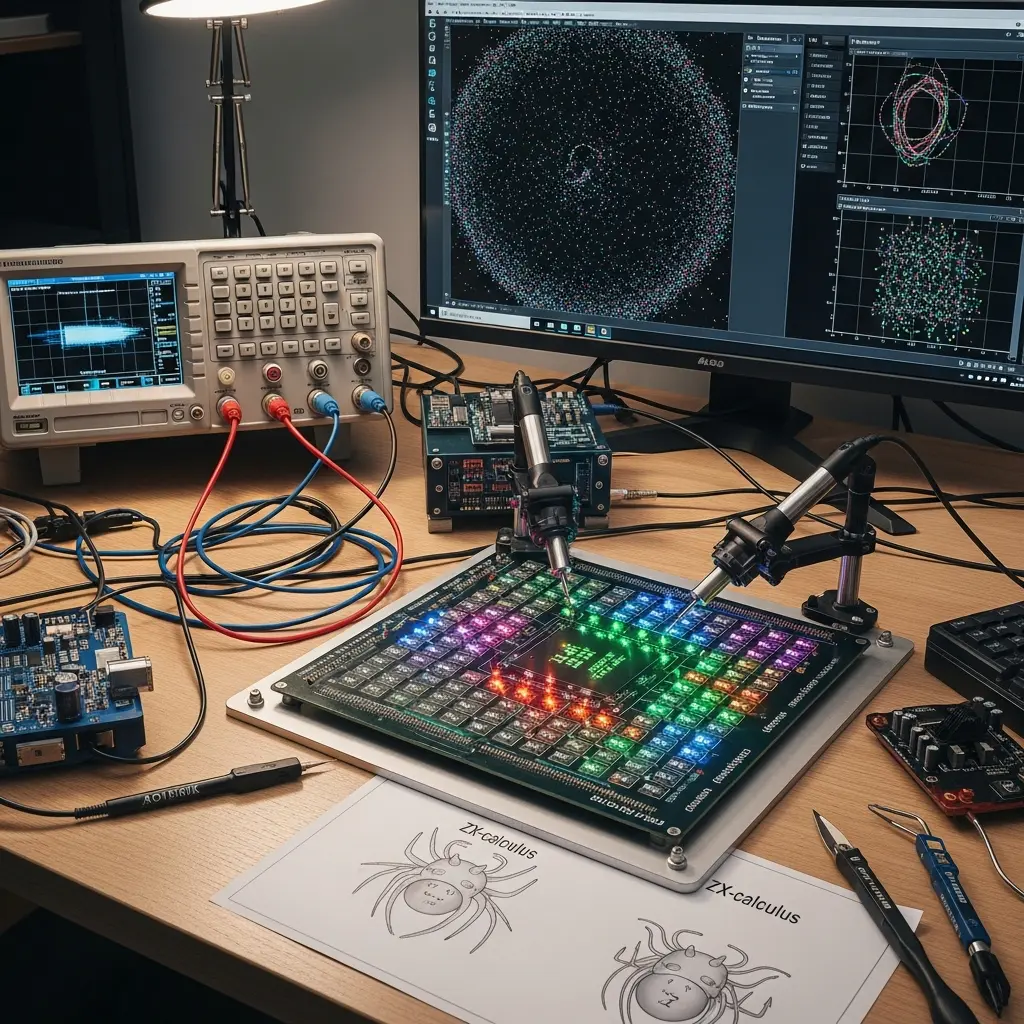
This research addresses these computational challenges, focusing on the application of finite-dimensional ZX-calculus as a tool for simplifying and performing these calculations. The approach involves representing the fundamental operators of LQG within the ZX-calculus framework, allowing for graphical manipulation and simplification of complex expressions. The research focuses on establishing the mathematical completeness and minimality of the calculus, ensuring it can represent all possible quantum computations with the fewest possible rules. Investigations into variations like SZX-Calculus and qudit ZX-Calculus expand the scope of the system, allowing it to handle more complex quantum systems beyond simple qubits. The study delves into the underlying mathematical structures, including category theory and algebra, to solidify the theoretical basis of ZX-Calculus.
Entanglement, a core quantum phenomenon, plays a crucial role in understanding the capabilities of ZX-Calculus, particularly in relation to holographic entanglement and spin network states. The research also explores connections to recoupling theory, a mathematical technique used within loop quantum gravity. This work builds upon existing knowledge of stabilizer fragments and Clifford+T quantum computation, leveraging these concepts to enhance the power and versatility of the ZX-calculus. The investigation into qudits, generalisations of qubits, expands the applicability of the calculus to more complex quantum systems.
The study also examines the relationship between ZX-Calculus and other mathematical frameworks, such as Hopf algebras and spin algebras, further solidifying its theoretical foundations. Researchers are exploring the potential of ZX-Calculus in areas like quantum machine learning and quantum error correction, demonstrating its broader applicability beyond fundamental physics. Researchers successfully translated the mathematical language of spin networks, fundamental to canonical LQG, into the finite-dimensional ZX-calculus, a graphical system originally developed for quantum computation. This translation allows for a new approach to calculations, enabling the representation of spin network operations using ZX-diagrams and facilitating a more intuitive and flexible method for manipulating these complex structures. The team demonstrated this approach by deriving the ZX-calculus forms for key LQG objects and proving the correctness of a crucial operation known as “loop removal”.
The achievement overcomes a major obstacle in canonical LQG, where calculations are notoriously difficult, and builds upon recent progress made in the covariant formulation of the theory. The authors acknowledge a primary limitation lies in the inherent complexity of representing infinite-dimensional structures within a finite-dimensional framework, requiring careful consideration of approximations and potential loss of information. Future work will focus on exploring the full potential of this new framework, including the development of automated tools for performing calculations and investigating the application of these techniques to more complex physical scenarios. This research establishes a promising new direction for tackling the computational challenges within loop quantum gravity and furthering our understanding of quantum spacetime.
👉 More information
🗞 Finite-Dimensional ZX-Calculus for Loop Quantum Gravity
🧠 ArXiv: https://arxiv.org/abs/2511.15966