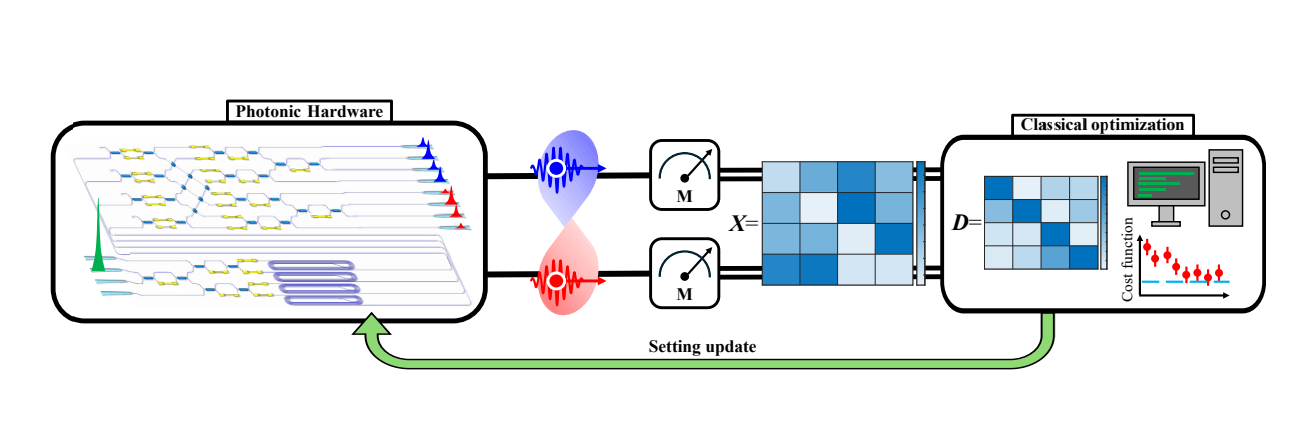
The travelling salesman problem, a classic challenge in computer science, presents a significant hurdle for even the most powerful conventional computers. Alessio Baldazzi, Stefano Azzini, and Lorenzo Pavesi, all from the University of Trento, now demonstrate a resource-efficient approach to tackling this notoriously difficult problem using the principles of quantum computation. Their method encodes potential routes between cities using entangled quantum bits, allowing the solution to emerge directly from the correlations within this quantum state. This research represents a crucial step towards practical quantum algorithms, as the team successfully implements their solution for problems involving four cities on a room-temperature silicon photonics circuit, paving the way for scalable quantum computation with integrated photonic technology.
Integrated Photonic Quantum Computing for Scalability
Research focuses on developing a scalable, integrated photonic quantum computer, utilizing photons as qubits and implementing quantum circuits on a chip rather than with bulky optical components. This work centers on the hardware required to achieve quantum advantage, solving problems intractable for classical computers. Key building blocks include multi-mode interference and Mach-Zehnder interferometers, used to manipulate photon phase and optical paths, alongside beam splitters and polarization control for creating entangled photons. Photonic qubits offer advantages in maintaining quantum information and ease of transmission, with silicon photonics as a prominent material platform.
Essential components include single-photon sources and detectors for generating and measuring quantum states, alongside nonlinear optics for creating entanglement and performing quantum gates. Researchers aim to create universal gate sets capable of implementing any quantum algorithm, with a focus on entangling gates like CNOT, Fredkin, and Toffoli. Circuit mapping, translating algorithms into circuits for the hardware, and post-selection, a technique to increase success probability, are also being investigated. While the primary focus is hardware, potential applications in quantum machine learning and quantum simulation are also explored. This research paints a picture of a rapidly evolving field focused on building practical, scalable quantum computers using integrated photonics.
Entangled Qubits Solve Travelling Salesman Problem
Scientists have developed a novel variational quantum algorithm to solve the computationally challenging travelling salesman problem, a cornerstone of combinatorial optimization. The method encodes potential routes between cities by preparing two maximally entangled quantum registers, requiring 2⌈log2 N⌉ qubits for a problem involving N cities. The solution, the shortest route, is then extracted from the correlation matrix of these registers. To demonstrate this approach, the team implemented the algorithm for a four-city problem using a reconfigurable room-temperature silicon photonic circuit. This circuit incorporates integrated photon-pair sources to initialize maximally entangled, path-encoded single-photon states, forming the foundation of the quantum registers.
The silicon-on-insulator photonic integrated circuit leverages established technology to manipulate photon states and create entanglement, crucial for implementing the variational quantum algorithm. The experimental setup utilizes integrated photon-pair sources to generate entangled photons, which are then manipulated using Mach-Zehnder interferometers within the silicon photonic circuit. These interferometers precisely control the path encoding of the photons, establishing the correlations that represent the possible routes between cities. By measuring the correlations within the entangled states, the algorithm effectively evaluates the cost function associated with each potential route, ultimately identifying the shortest path.
Quantum Solution for the Travelling Salesman Problem
Scientists have achieved a novel solution to the travelling salesman problem by leveraging the principles of quantum mechanics. The work centers on preparing two maximally entangled registers, where the correlations within these registers directly represent different possible routes between cities. For a four-city problem, this encoding requires four qubits, and the solution, the shortest route, is found by analyzing the correlation matrix of the two registers. Experiments implemented this approach using a reconfigurable silicon photonic circuit with integrated photon-pair sources, successfully initializing maximally entangled states of single photons. The quantum algorithm operates by converging on a cost function that identifies the optimal route, with the hardware trained to prepare the corresponding quantum state. The research also explores connections to existing quantum algorithms for the travelling salesman problem, such as those based on quadratic unconstrained binary optimization and quantum approximate optimization algorithms.
Photonic Entanglement Solves Travelling Salesman Problem
This research presents a novel approach to solving the travelling salesman problem. Scientists successfully demonstrated a method based on preparing and manipulating maximally entangled states of light within a silicon photonic integrated circuit, encoding potential routes between cities as correlations within these entangled states. This achievement marks a new application of photonic technology to practical combinatorial problems. The demonstrated method offers advantages over existing quantum approaches, notably a reduced requirement for qubits and quantum gates, achieving qubit scaling of O(N log2 N).
While acknowledging that the performance of the classical optimization routine used to refine the solution impacts convergence, the team highlights the potential for parallelization and reduced computational demands compared to other quantum and classical algorithms. Future work could explore alternative optimization strategies to improve convergence and robustness. Nevertheless, this research provides a promising new direction for quantum-enhanced solutions to complex logistical problems, leveraging the unique capabilities of integrated photonics.
🗞 Resource-efficient variational quantum solver for the travelling salesman problem and its silicon photonics implementation
🧠 ArXiv: https://arxiv.org/abs/2511.02696