

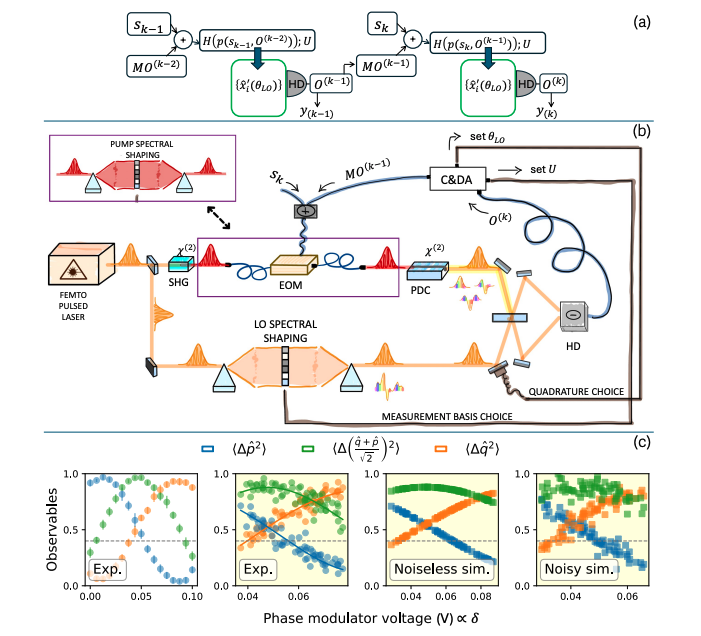
Researchers have developed an optical quantum reservoir computing platform utilising multimode squeezed states for continuous-variable quantum machine learning. The system achieves real-time and long-term memory through feedback and spatial multiplexing, successfully performing nonlinear temporal tasks like parity checking and chaotic forecasting, validated by a digital twin.
The pursuit of quantum machine learning seeks to harness quantum mechanical phenomena to enhance computational capabilities, particularly for tasks involving complex temporal data. A new study details the construction and validation of a continuous-variable quantum reservoir computer – a type of quantum neural network – capable of controlled memory and real-time processing. Researchers from Laboratoire Kastler Brossel (Sorbonne Université, ENS-Université PSL, CNRS, Collège de France) and the Instituto de Física Interdisciplinar y Sistemas Complejos (IFISC, UIB–CSIC) demonstrate this architecture using squeezed states of light, enabling both short- and long-term memory through feedback and spatial multiplexing. The work, detailed in their article “Experimental memory control in continuous variable optical quantum reservoir computing”, is led by Iris Paparelle, Johan Henaff, Émilie Gillet, and Valentina Parigi, alongside Jorge García-Beni, Gian Luca Giorgi, Miguel C. Soriano, and Roberta Zambrini.
Quantum reservoir computing (QRC) presents a novel approach to online, quantum-enhanced machine learning, specifically designed for tasks involving time-dependent data. Recent research details the construction and validation of a functional optical QRC platform, utilising deterministically generated multimode squeezed states to achieve controlled ‘fading memory’ – a critical attribute for processing sequential data streams. This leverages quantum entanglement to potentially surpass the limitations of classical machine learning algorithms.
The platform operates within a continuous-variable (CV) framework
The platform operates within a continuous-variable (CV) framework. CV quantum computing encodes information in the amplitude and phase of electromagnetic fields, offering compatibility with established optical technologies and simplifying implementation. Researchers employed both spectral and temporal multiplexing – techniques to increase data capacity – to maximise the information stored and processed within the quantum reservoir. This design aims to maintain robust performance even with noisy or incomplete data.
Data is encoded by programmably shaping the phase of the ‘pump’ beam in an optical parametric process, allowing precise control over the quantum state of the reservoir. Information retrieval is achieved through mode-selective homodyne detection, a measurement technique that extracts processed data with high fidelity.
Real-time memory is implemented via feedback utilising electro-optic phase modulation, dynamically adjusting the quantum state to store and recall information on demand. Simultaneously, long-term dependencies are captured through spatial multiplexing of modes, enabling the system to retain information over extended periods.
The platform’s performance was validated through successful execution of nonlinear temporal tasks, including parity checking and chaotic signal forecasting. Crucially, these results were corroborated by a high-fidelity ‘Digital Twin’ – a virtual replica of the physical system – confirming the accuracy and reliability of the implementation.
The research demonstrates that utilising the entangled structure
The research demonstrates that utilising the entangled structure of multimode squeezed states significantly enhances both the expressivity and memory capacity of the quantum reservoir, exceeding the capabilities of classical reservoir computing. This improvement arises from the ability of quantum entanglement to create a richer state space, allowing for more efficient information representation and processing.
🗞 Experimental memory control in continuous variable optical quantum reservoir computing
🧠 DOI: https://doi.org/10.48550/arXiv.2506.07279


