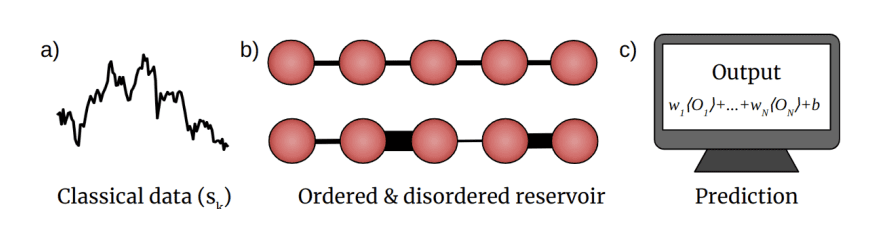
Researchers have made a breakthrough in understanding how complex systems can store and recall information. The study explores the concept of “memory capacity” in quantum systems, which refers to their ability to remember past inputs.
The team analyzed three dynamical phases: Mott-Insulator, quantum chaos, and superfluidity. They found that the system’s memory capacity decays as the delay between inputs increases, but this decay can be slowed down by increasing a parameter called J/U. In particular, the quantum chaotic regime showed better memory capacity than the superfluidity regime.
The researchers also introduced disorder into the system to see how it affected memory capacity and found that it did not play a significant role. This study has implications for our understanding of complex systems and could lead to breakthroughs in fields such as artificial intelligence and data storage.
The authors are exploring the concept of Short-Term Memory (STM) capacity in a quantum system, specifically a one-dimensional chain of atoms or particles. They’re investigating how well this system can recall past inputs, which is crucial for information processing and storage.
To evaluate the STM capacity, they inject an input sk into the system at each step k, and the target output is the previous input delayed by τ time steps (ybk = sk-τ). They then calculate a correlation metric C between the actual output yk and the target output ybk, which ranges from 0 (no memory) to 1 (perfect recall).
The results show how the STM capacity decays as the delay increases across different dynamical phases: Mott-Insulator, quantum chaos, and superfluidity. As expected, the Mott-Insulator phase has no memory capacity due to the lack of information spreading. However, in the quantum chaos regime, the system can recall previous inputs for longer times, achieving a memory capacity of around 0.8 at τ = 9. Interestingly, the superfluidity regime performs slightly worse than the quantum chaos regime.
To investigate this difference further, they plot the maximum delay with an STM capacity greater than 0.8 in. This reveals a peak in memory capability within the quantum chaotic regime relative to the superfluidity regime. They also compare homogeneous and heterogeneous chains (with disorder introduced in the coupling term) and find that disorder doesn’t play a significant role, with heterogeneous chains even displaying less capacity than homogeneous ones.
The authors then explore the system’s ability to remember nonlinear functions of an input sk, defined as ybk = s^d k-τ. They compare the linear and cubic cases (d = 3). Notably, they find that the memory capacity decreases with nonlinearity, but disparities emerge between the superfluidity and quantum chaos regimes. The chaotic regime outperforms the superfluidity regime for large delays, especially for nonlinear tasks.
In summary, this research demonstrates the potential of a quantum system to exhibit short-term memory capabilities, particularly in the quantum chaos regime. These findings have implications for the development of quantum information processing and storage technologies.
External Link: Click Here For More