Quantum computing promises to revolutionise machine learning, and a new hybrid approach brings that potential closer to reality. Wenduan Xu, alongside colleagues, demonstrates a novel recurrent neural network architecture that seamlessly integrates the power of quantum and classical computation. This research introduces a system where the core memory functions are handled by a parametrised quantum circuit, offering an exponentially large capacity for storing information, while a classical neural network provides essential control and nonlinearity. The team’s model achieves competitive performance on a range of challenging sequence tasks, including sentiment analysis and language modelling, representing a significant step towards building more powerful and efficient machine learning systems grounded in the principles of quantum mechanics.
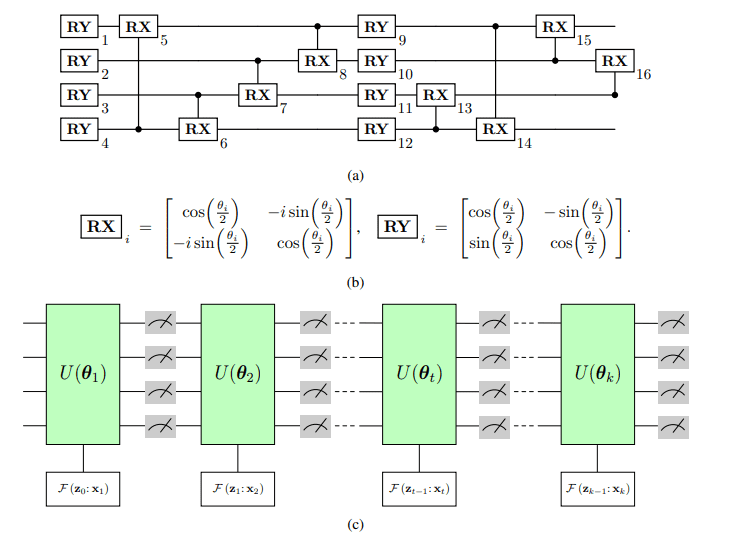
Hidden-state evolution occurs with norm preservation and without external constraints. At each timestep, mid-circuit readouts combine with the input embedding and process through a feedforward network, which introduces explicit classical nonlinearity. The outputs then parametrize the quantum circuit, which updates the hidden state via unitary dynamics. The quantum recurrent neural network is compact and physically consistent, unifying unitary recurrence as a high-capacity memory, partial observation via mid-circuit measurements, and nonlinear classical control for input-conditioned parametrization. The team evaluates the model in simulation with up to 14 qubits on sentiment analysis, MNIST, permuted MNIST, copying memory, and language modelling.
Quantum Circuit Expressibility and Neural Networks
Research in quantum machine learning focuses heavily on the expressive power of quantum circuits, investigating how effectively they can represent complex functions. Quantum neural networks are a major theme, with scientists developing various architectures and approaches to leverage quantum mechanics for machine learning tasks. Quantum recurrent neural networks represent a significant sub-area, with researchers focusing on rapid training techniques and applications in low-resource language text classification. Theoretical foundations and analysis are crucial, with scientists focusing on expressibility and the overall behavior of quantum neural networks.
Quantum neural architecture search is another active area, with scientists developing methods to automatically design robust quantum circuits. Related work in classical deep learning provides context and comparison for these quantum approaches. Key trends reveal a strong focus on quantum recurrent neural networks, suggesting their potential for processing sequential data. Hybrid approaches, combining quantum and classical techniques, are gaining traction.
Quantum Recurrent Neural Networks Demonstrate Competitive Performance
Scientists have developed a novel hybrid quantum-classical recurrent neural network where the core recurrent processing is entirely realized as a parametrized quantum circuit. This circuit operates on an exponentially large Hilbert space, enabling a high-capacity memory that persists across computational steps. A classical feedforward network steers the quantum computation, introducing essential nonlinearity through mid-circuit readouts. Experiments demonstrate the QRNN’s effectiveness across six realistic sequence-modeling tasks, achieving competitive performance with established models like LSTM and scaled Cayley orthogonal scoRNN.
Measurements confirm that the unitary quantum recurrent core maintains more stable gradients during training than traditional LSTMs, addressing a key challenge in recurrent network design. The architecture utilizes a quantum circuit with only one- and two-qubit gates, ensuring a hardware-aware design. Results show that incorporating nonlinear control mechanisms significantly improves performance, outperforming linear counterparts. This combination allows the QRNN to retain information and influence subsequent computation effectively, demonstrating a novel approach to recurrent processing.
Hybrid Quantum Recurrent Neural Network Achieves Competitive Performance
Scientists have developed a novel hybrid quantum-classical recurrent neural network where the recurrent core is a parametrized quantum circuit controlled by a classical feedforward network. The team successfully implemented a system with unitary dynamics, which inherently preserves norms and promotes stable gradient propagation during learning. This architecture unifies several important features, including unitary recurrence for high-capacity memory, partial observation through mid-circuit measurements, and nonlinear classical control for task-specific adaptation. Evaluations across a range of sequence tasks demonstrate that this QRNN achieves competitive performance against strong classical baselines. Notably, the QRNN exhibits improved gradient propagation compared to long short-term memory networks, suggesting enhanced stability during training. The researchers acknowledge that current quantum hardware presents limitations and anticipate that advancements in quantum simulation tools and hardware capabilities will facilitate more faithful implementations of this architecture.
👉 More information
🗞 Hybrid Quantum-Classical Recurrent Neural Networks
🧠 ArXiv: https://arxiv.org/abs/2510.25557