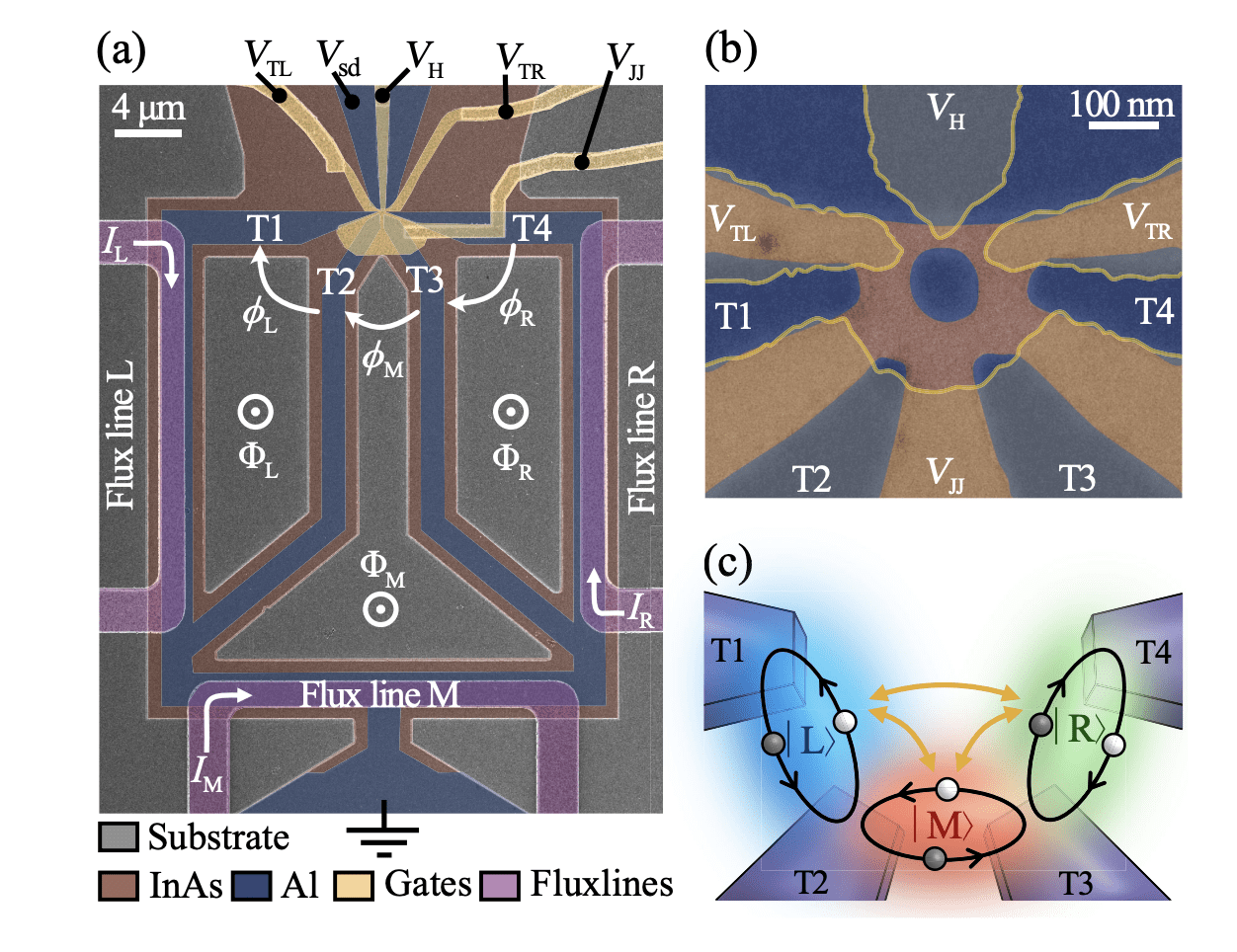
Hybrid multiterminal Josephson junctions are expected to harbour a novel class of Andreev bound states, including topologically nontrivial states in four-terminal devices. In these systems, topological phases emerge when Andreev bound states depend on at least three superconducting phase differences, resulting in a three-dimensional energy spectrum. This dependence signifies a departure from conventional Josephson junctions, opening possibilities for manipulating quantum information. Understanding the emergence and properties of these topologically protected states is crucial for advancing superconducting quantum electronics and exploring novel quantum phenomena, driving research into characterising the conditions under which these states appear and investigating their potential applications in quantum computing and other advanced technologies.
Four-Terminal Junctions and Andreev Band Structures
This work details research into multi-terminal Josephson junctions, specifically a four-terminal device combining superconductivity and semiconducting materials. The research aims to understand the arrangement of energy levels within these junctions and explore the possibility of creating topological Andreev band structures, a promising area for building robust quantum computers. The core of the investigation involves understanding how electrons behave at the interface between the semiconductor and the superconductor, leading to the formation of Andreev bound states. The team utilizes Josephson junctions, devices where two superconductors are separated by a weak link, allowing supercurrent to flow without voltage.
Andreev reflection plays a key role, a process where electrons from the semiconductor enter the superconductor as holes, creating these bound states. The goal is to create topological states, quantum states protected by the system’s structure, offering robustness against disturbances. Microwave spectroscopy is employed to probe the energy levels within the junction, while epitaxial growth and flip-chip technology are used to fabricate the nanoscale devices. The significance of this work lies in its potential to create more stable and efficient electronic devices, and ultimately, to build robust quantum bits (qubits) for quantum computing. The team’s work focuses on creating and characterizing a novel nanoscale device with the potential to advance quantum computing and topological electronics.
Hybridized Andreev States and Flux Control
Researchers have created a novel four-terminal superconducting device that mimics a three-dimensional band structure, representing a significant step towards realizing topologically protected states for future quantum technologies. The device exhibits behavior analogous to a triatomic molecule, with three distinct energy levels, bonding, nonbonding, and antibonding, that interact and split in energy. This interaction, observed through detailed measurements of the device’s electrical properties, confirms the hybridization of these three Andreev bound states. The team discovered that manipulating the magnetic flux within the device leads to the formation of an “M-shaped” energy dispersion near zero energy, a splitting of energy bands significantly stronger than previously observed in similar devices.
Simulations accurately reproduce these complex energy spectra, validating the interpretation of a tri-Andreev molecule delocalized across the four superconducting terminals. Further analysis reveals anisotropic energy splitting, with larger splittings observed along specific crystallographic directions, reflecting the directional dependence of the molecular state interactions. Importantly, the researchers identified zero-energy crossings within the device’s complex energy spectrum, a crucial characteristic for the formation of Weyl nodes, which are predicted to provide topological protection to quantum information. These crossings appear in pairs related by time-reversal symmetry, and the team successfully simulated the device’s Andreev band structure, matching their experimental results and confirming the potential for realizing topologically protected states. This breakthrough delivers a promising platform for developing robust quantum devices less susceptible to environmental noise, paving the way for advancements in quantum computing and other quantum technologies.
Weyl Nodes Emerge in Josephson Junction Spectrum
This research demonstrates the creation of a four-terminal Josephson junction that mimics the behaviour of a three-dimensional band structure, representing a step towards realizing topologically protected states for quantum devices. By carefully controlling the device’s parameters, the team observed evidence of Andreev bands and, crucially, conditions under which Weyl nodes, points of topological transition, emerge within the energy spectrum. These nodes signify an inversion between positive and negative energy bands, a key characteristic of topological materials and a potential source of stability for quantum information. The study successfully implemented a method for independent flux control, allowing systematic investigation of the device’s energy spectrum using tunneling spectroscopy.
While current spectroscopic resolution limited the ability to fully resolve energy gaps near the Weyl nodes, the results suggest that enhancing the superconducting gap or improving device tunability could facilitate clearer detection. Future research directions include employing advanced spectroscopic techniques, such as nonlocal spectroscopy or microwave spectroscopy, to achieve higher resolution and directly observe the gap closing and reopening expected at the Weyl nodes. Furthermore, integration with circuit QED architectures offers a promising avenue for exploring topological Andreev band structures in a more comprehensive manner.
👉 More information
🗞 Exploring the Energy Spectrum of a Four-Terminal Josephson Junction: Toward Topological Andreev Band Structures
🧠 DOI: http://link.aps.org/doi/10.1103/qd3y-f912