

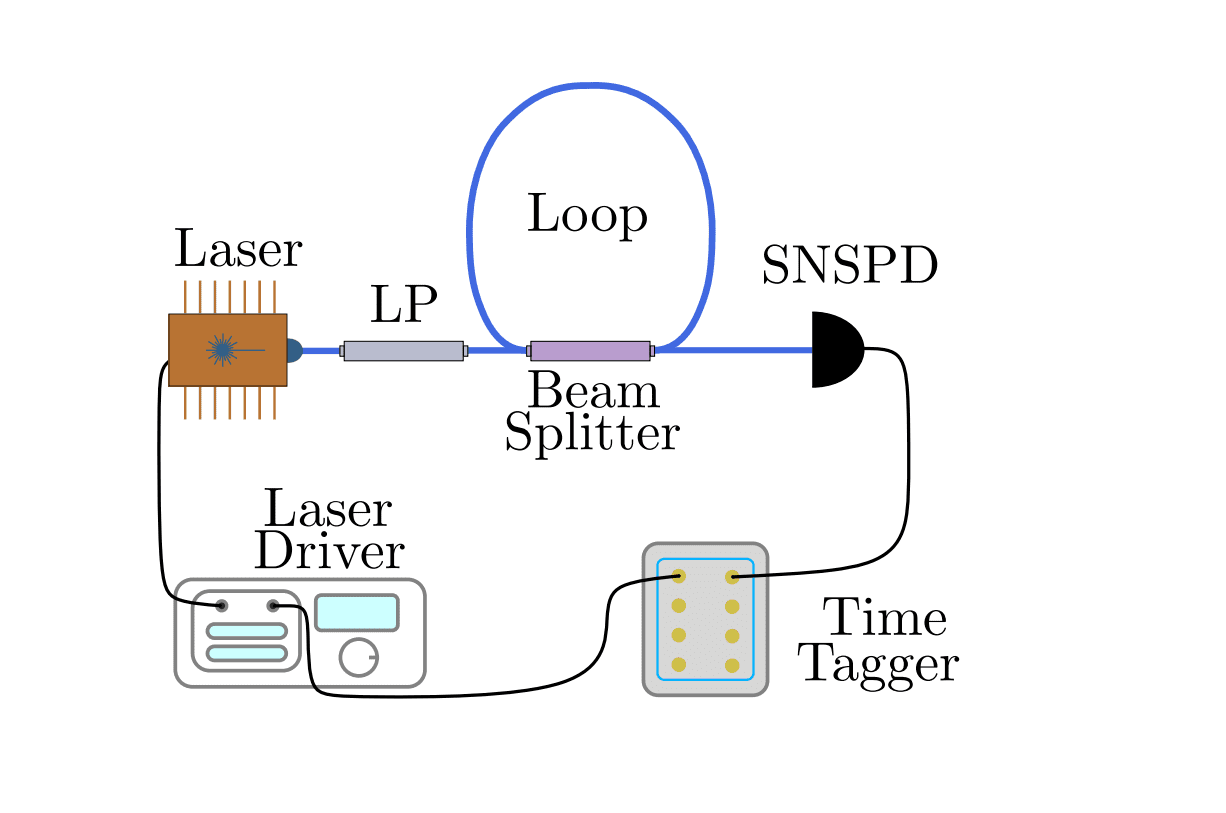
True random number generation is fundamental to secure communication and rigorous scientific modelling, yet building practical devices that consistently deliver genuine randomness remains a significant challenge. Rodrigo Piera, Gianluca De Santis, and Agustín Sanchez, working at the Quantum Research Centre within the Technology Innovation Institute, alongside Yury Kurochkin and James A. Grieve, now present a novel system that addresses these concerns. Their research introduces a compact device, built from simple optical components, which not only generates random numbers but also continuously verifies its own operation through an internal consistency check. Crucially, the system simultaneously produces a publicly available random sequence, allowing independent confirmation of randomness quality without compromising the security of a separate, private sequence, demonstrating a pathway to robust and verifiable randomness with minimal complexity.
The design addresses the critical need for trust and reliability in QRNGs, making them suitable for demanding applications like cryptography and scientific simulations. The team details the design, theoretical basis, and experimental considerations of this innovative QRNG. The foundation of the system lies in harnessing the inherent randomness of quantum mechanics to generate truly unpredictable numbers. A crucial feature is the QRNG’s ability to self-test, continuously monitoring its operation and detecting any deviations that might indicate a compromise or malfunction through monitoring detection ratios.
The system generates two separate sequences of random numbers, one for secure use and another for public release, allowing external parties to verify the quality of the randomness without compromising security. This combination of self-testing and public verification creates a layered approach to trust, allowing the device to autonomously assess its integrity and enabling independent confirmation of its output quality. The QRNG utilizes a loop-based optical setup, categorizing detection events based on the number of loops completed, forming the basis for the two verification sequences. While not fully device-independent, the design incorporates elements that reduce reliance on assumptions about the internal workings of the components.
The research acknowledges the potential impact of noise sources, such as dark counts, and suggests these could be detected through the self-testing mechanism. This design aims to overcome the challenge of establishing trust in the device by providing verifiable randomness, enhancing security, and making the QRNG more resistant to attacks and malfunctions. In summary, this paper presents a promising approach to building more secure and trustworthy QRNGs, addressing a critical need in the field and potentially paving the way for wider adoption of QRNGs in critical applications.
Looping Beam Splitters Generate Verified Random Numbers
This study pioneers a new system for generating truly random numbers based on a looped beam splitter architecture, utilizing only passive optical components. Researchers engineered a setup where a single photon traverses a loop containing beam splitters, creating a probabilistic path that forms the basis of randomness. This design inherently incorporates a self-testing mechanism, continuously validating the system’s correct operation and ensuring ongoing reliability without external intervention. To achieve this, scientists meticulously controlled the optical path, ensuring minimal loss and maximizing the probability of photon detection at each stage of the loop.
The detection rates at each beam splitter were precisely monitored, and any deviation from expected values would indicate a potential malfunction. The team demonstrated that excess dark counts, a common source of error, would manifest as a predictable anomaly in the monitored detection ratios, allowing for immediate identification and correction. Quantitative analysis focused on how varying noise levels influence the rate ratios and the overall entropy, providing a detailed understanding of the system’s robustness. This innovative approach demonstrates that robust, self-testing, and publicly verifiable randomness can be achieved with minimal complexity, without compromising security.
Self-Testing Quantum Random Number Generation Demonstrated
This research presents a new quantum random number generator (QRNG) designed for robustness and verifiable security, achieving a high level of performance through a simplified architecture. The system utilizes a looped beam splitter, employing only passive components to generate genuinely random numbers based on fundamental quantum processes. A key achievement is the development of an intrinsic self-testing mechanism, continuously validating correct operation by monitoring the stability of detection probability ratios. This ensures the entropy source remains secure and stable over time, a critical requirement for cryptographic applications.
Experiments demonstrate the generation of two independent random sequences with identical entropy, yet completely separate, allowing for public verification without compromising security. Precise measurements of the beam splitter reflectivity and loop loss were used to predict detection probabilities, which closely matched experimental results, confirming the expected exponential dependence of photon detection. Analysis of detection rate ratios across consecutive intervals revealed consistent stability, validating the model’s prediction of a constant relationship between successive loop detections. The generated sequences exceed the minimum recommended size for statistical testing, ensuring reliable evaluation.
Applying the NIST entropy assessment tool, the team confirmed that both sequences possess nearly identical statistical behavior, validating the model’s prediction of shared entropy characteristics. This dual-sequence approach, combined with the self-testing feature, delivers a robust and verifiable QRNG, minimizing potential failure points and enhancing long-term reliability. The system’s simplicity and stability represent a significant advancement in the field, offering a practical solution for secure random number generation.
Self-Testing Quantum Random Number Generation
This research presents a new quantum random number generator that addresses key challenges in robustness and verifiability. The team successfully demonstrates a system based on a looped beam splitter architecture, utilizing only passive components to generate genuinely random numbers. Crucially, the device incorporates an intrinsic self-testing mechanism, continuously monitoring internal statistics to ensure correct operation and detect potential failures caused by environmental factors or component degradation. The innovation extends to the simultaneous generation of two independent random sequences, one for secure applications and a second for public verification. Tests confirm that these sequences possess equivalent statistical properties, enabling external confirmation of randomness quality without compromising the security of the private sequence. This dual-sequence approach, combined with the self-testing feature, significantly strengthens the reliability and transparency of quantum randomness generation.
👉 More information
🗞 Quantum Random Number Generator with Internal Consistency Check and Public Verification
🧠 ArXiv: https://arxiv.org/abs/2510.26415

