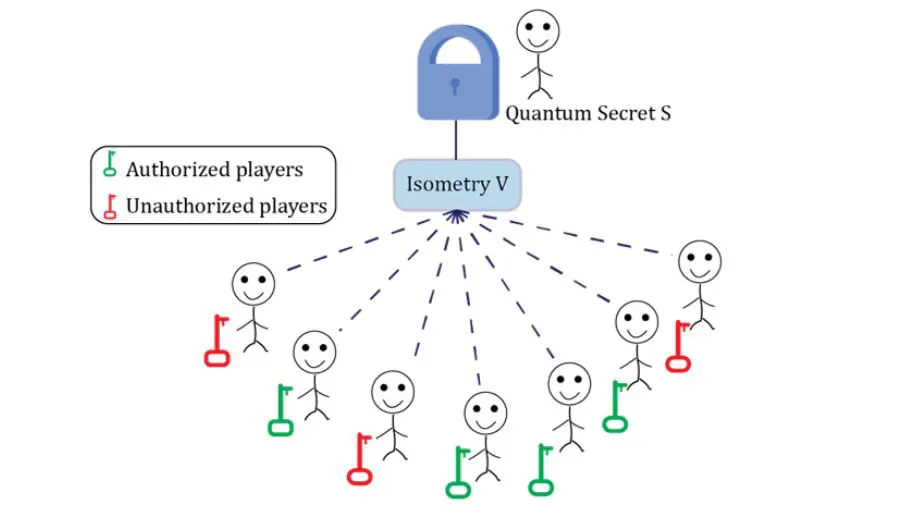
Information scrambling, a process where data disperses throughout a complex system, increasingly informs research into chaotic systems, benchmarking protocols, and even models of black holes. Kiran Adhikari from the Technical University of Munich, along with co-authors, now demonstrates a surprising connection between information scrambling and a cornerstone of cryptography, secret sharing. Their work reveals that a specific scrambling technique, known as Haar scrambling, is fundamentally equivalent to a type of secret sharing called ramp secret sharing, where access requires a gradually increasing number of participants. This discovery not only allows for the creation of versatile ramp secret-sharing schemes by controlling initial conditions, but also establishes a pathway for efficient implementation and suggests potential applications in network security and offers new insights into the behaviour of complex physical systems.
Quantum Secret Sharing and Information Scrambling
This body of work represents a comprehensive exploration of quantum information, scrambling, complexity, and networking, detailing connections between these vital areas. Researchers investigated quantum secret sharing, where a secret is distributed among multiple parties so that no single party, or small group, can reveal it, but a sufficient number can. This work encompasses both classical and quantum approaches, including ramp secret sharing, a specific type where a threshold number of parties is required for reconstruction. A central theme is quantum scrambling, describing how information spreads and becomes delocalized within a quantum system, often linked to quantum chaos.
Scientists utilized out-of-time-ordered correlations to measure how a system’s response to operators at different times correlates, with high correlations indicating strong scrambling. This research explores connections to the information loss paradox in black holes and investigates the Hayden-Preskill protocol, alongside the use of random unitary operators to simulate the process. Researchers also delved into quantum complexity and Krylov subspace methods, powerful techniques for approximating solutions to equations and analyzing quantum systems. Krylov complexity, a measure of the complexity of quantum states, was used to characterize states and develop new algorithms, exploring potential links to the complexity of black hole interiors.
The research extends to quantum networks, envisioning a future quantum internet for secure communication and distributed computing, and investigates quantum key distribution, repeaters, and state transfer. Underlying these investigations are fundamental mathematical concepts, including Haar measure, unitary designs, entanglement measures, and Rényi entropy. Researchers also utilize matrix product states and tensor networks to efficiently represent quantum states. Recent advances include learning efficient decoders for chaotic quantum scramblers, exploring connections between black hole complexity, unscrambling, and stabilizer thermal machines, and developing quantum state-aware query complexity.
Information Scrambling and Secret Sharing Equivalence
Researchers have established a fundamental connection between information scrambling and quantum secret sharing, demonstrating their equivalence through rigorous analysis. Scientists investigated these protocols using quantum information theoretic tools, including Rényi mutual information and the operator trace norm, to quantify the similarity between quantum states and establish a quantifiable distance between ideal and noisy states. The team employed fidelity and the Fuchs-van de Graaf inequalities to define criteria for distinguishing or indistinguishing states, utilizing the decoupling inequality, a powerful concept with broad applications in quantum error correction and many-body physics, to analyze scenarios where a quantum system is purified with a reference system, encoded, and interacted with an environment, ultimately allowing for recovery of the original message. The study extended these concepts to quantum secret sharing schemes, cryptographic protocols used to distribute a secret among multiple parties. Scientists rigorously defined access structures, specifying which combinations of parties are authorized to reconstruct the secret, and formulated a quantum secret sharing scheme utilizing purification with a reference system, demonstrating its direct connection to the principles of information scrambling.
Haar Scrambling Enables Ramp Secret Sharing
Scientists have demonstrated a fundamental equivalence between Haar scrambling and quantum ramp secret sharing, revealing that the process of information dispersal in complex quantum systems can be directly utilized to create a specific type of quantum secret sharing scheme. Unlike traditional threshold schemes, ramp secret sharing allows for partial information leakage, meaning subsets of parties may gain limited knowledge of the shared secret without fully reconstructing it. Researchers proved that the resulting secret sharing scheme is inherently a ramp scheme due to the inherent randomness present within Haar scrambling. By manipulating the purity of the initial quantum states, scientists demonstrated the ability to generate all possible configurations of ramp secret sharing schemes, offering a versatile approach to quantum information security.
Importantly, the protocol developed can be efficiently implemented in polynomial time through the approximation of the scrambling unitary using t-design circuits, making it practical for near-term quantum devices. This breakthrough reveals a deep connection between information scrambling and cryptography, suggesting that scrambling unitaries can serve as effective encoders for quantum error correction codes. The team’s findings have implications for enhancing security in distributed quantum networks and developing cryptographic protocols suitable for the Noisy Intermediate-Scale Quantum (NISQ) era, providing new insights into fundamental physics domains, such as many-body quantum systems and the behavior of quantum black holes.
🗞 Quantum ramp secret sharing from Haar scrambling
🧠 ArXiv: https://arxiv.org/abs/2512.00970