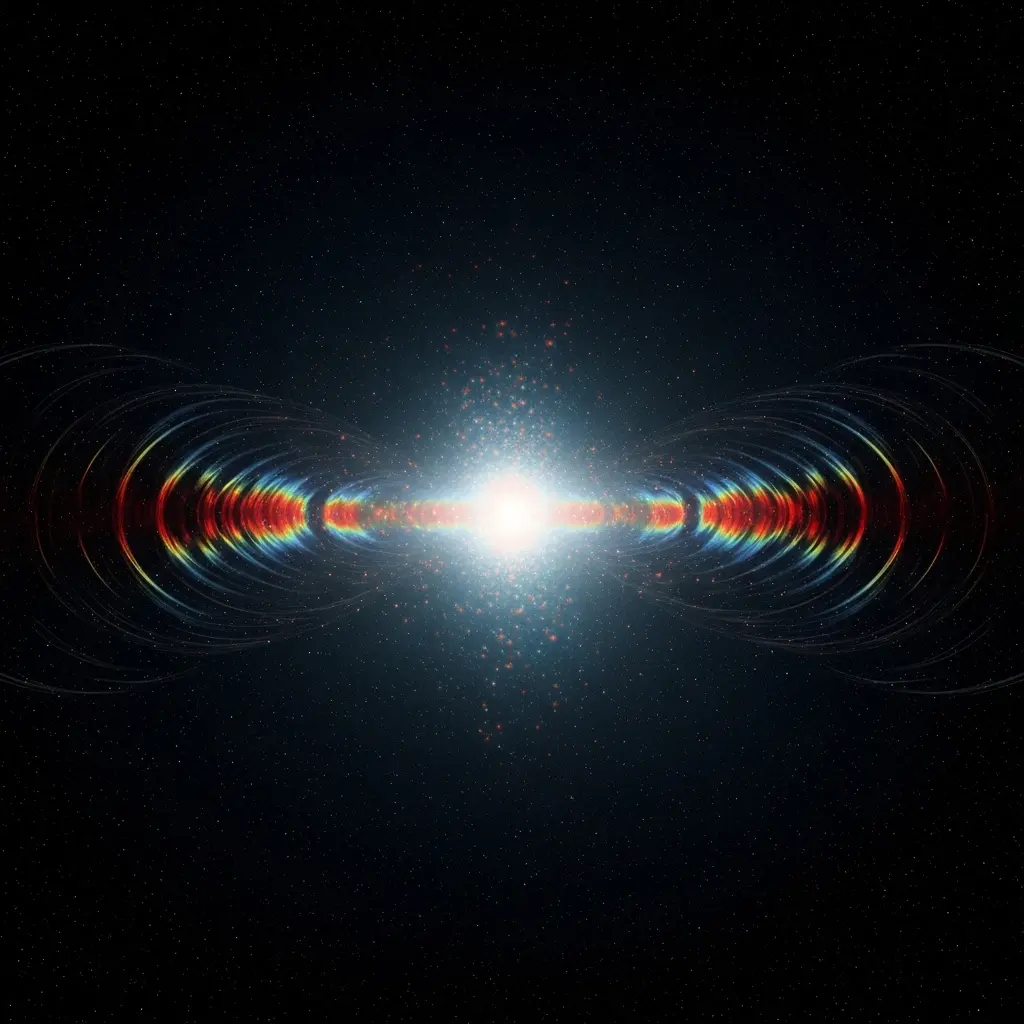
Researchers are tackling the enduring mystery of the very early universe with a novel approach to bouncing cosmology. Sandro D. P. Vitenti (Universidade Estadual de Londrina), Nelson Pinto-Neto (COSMO, Centro Brasileiro de Pesquisas Físicas) and Patrick Peter (GRεCO, Institut d’Astrophysique de Paris, CNRS & Sorbonne Université), alongside Luiz Felipe Demétrio, present a theoretical model demonstrating how a universe might avoid an initial singularity through a period of contraction and subsequent expansion, offering a compelling alternative to the widely accepted theory of inflation. Their significant contribution lies in incorporating both matter and radiation into the contracting phase, a more realistic scenario which naturally generates the observed ‘red tilt’ in the spectrum of cosmological perturbations that has previously proved difficult to achieve. This work establishes that even a simple two-component bounce model, utilising only ordinary matter and radiation, can seamlessly connect to our standard expanding universe with initial conditions consistent with current observations.
Calculations were performed using a canonical quantization of gravity approach, building upon previous work establishing Hamiltonian constraints up to second order in perturbation theory. The team’s model incorporates quantum corrections to the scale factor evolution, accounting for both the radiation equation of state (wr = 1/3) and the late-time matter equation of state (w). The research establishes a framework that seamlessly connects the contracting, bouncing, and expanding phases of the universe, aligning with observational knowledge of cosmological parameters. By applying the coupled adiabatic vacuum prescription, the scientists were able to define an appropriate vacuum state for the two-fluid system and calculate the power spectra and correlations of the perturbations. This work opens avenues for further investigation into quantum gravity effects at the bounce and provides a compelling alternative to inflationary models, offering a new perspective on the origins of the universe and its large-scale structure.
Radiation-induced red tilt in bouncing cosmologies
To accurately model this, the team meticulously defined vacuum initial conditions, acknowledging the coupling between perturbations of matter and radiation via a specific interaction term. The research harnessed a series of previously published works calculating the Hamiltonian constraint up to second order in perturbation theory, adapting it for homogeneous and isotropic backgrounds with various matter fields. Scientists developed a proper definition of quantum trajectories in configuration space, demonstrating that many solutions are free of singularities, replaced by a bounce, and converge to the classical limit at large scales. Perturbations were then shown to obey the same equations as in semi-classical theory, but with classical background trajectories replaced by these quantum trajectories.
The system delivers a framework where the matter content near the bounce can be approximated by a single perfect fluid with a constant equation of state, wb, equal to 1/3 for radiation domination. This approach enables a detailed description of a model consistent with observational cosmological parameters, extending back to account for the contracting and bouncing phases. The study pioneered the application of a coupled adiabatic vacuum prescription to define an appropriate vacuum state for the two-fluid system, circumventing the difficulties of defining vacuum states in coupled perturbation scenarios.
Radiation induces red tilt in bouncing cosmology
This red tilt is crucial, as it aligns with observed spectra, overcoming a significant challenge in earlier bouncing cosmology frameworks. The team employed a Dirac quantization approach, setting the lapse function to a³wr, which led to a time-dependent Schrödinger equation governing the wave function Ψ(a, τ). Transforming the variable ‘a’ to ‘q’ resulted in a time-reversed free particle Schrödinger equation, allowing for the derivation of a full time-dependent wave function Ψ(a, τ) expressed as Ψ(a, τ) = 8τb/π τ 2 + τ 2b 1/4 exp −4τb a3(1−wr) 9(1 −wr)2 (τ 2 + τ 2b) eiS, where S(a, τ) represents the phase. This solution explicitly replaces the singularity with a bounce at τ = 0, establishing a minimal scale factor ab.
Tests prove that the Hubble parameter, calculated in terms of fluid time τ, is H(t) ≡1 a da dt = 2τa−3wr 3 (τ 2 + τ 2b) (1 −wr), and when expressed in terms of the scale factor, reads H = ±2 3 (1 −wr) τb 1 a3wr b rab a 3(1+wr) − ab a 6. Restricting attention to radiation, which dominates during the bounce phase, the researchers derived a corrected Friedmann equation, phenomenologically equivalent to adding a “quantum matter” term with negative energy density ρq ∝a−6. Data shows this leads to a modified equation: H² = 8πGn³(ρ − ρq), where ρ = Ωbρcritx³(1+wr), with Ωb representing the energy density fraction compared to the critical density ρcrit. Results demonstrate that Ωb =4a−6wr 0x−3(1−wr) b 9H² 0 (1 −wr)² τ²b, and Ωq =4a−6wr 0x−6(1−wr) b 9H² 0 (1 −wr)² τ²b = Ωb x³(1−wr) b. The team established that for wr 1, the quantum component becomes negligible at large scale factors, recovering classical evolution. Implementing this bouncing scenario requires only one free parameter, as the fluid density and Hubble constant H₀ are potentially determined by observational data obtained long after the bounce occurred, representing a significant advancement in cosmological modelling.
Radiation induces red tilt in bouncing cosmology models
The findings are significant because they offer a pathway to reconcile bouncing cosmologies with observational data, specifically the red tilt observed in the cosmic microwave background. The authors acknowledge limitations stemming from the small amplitude of the predicted power spectrum, requiring a decrease in a free parameter (cw) to match CMB observations, though this introduces numerical instability at extremely low values. Future research could explore the stability of the model with smaller cw values or investigate the impact of alternative initial conditions. Researchers found that the late-time integrals are dominated by the endpoint at xb, exhibiting negligible sensitivity to the transition time.
The estimates derived are sufficient to compute super-SHS approximations, and the large-scale power spectrum of ζ can be estimated using a specific formula. However, achieving a power spectrum amplitude comparable to CMB observations would necessitate a reduction in the cw parameter to approximately 10−10, a value that currently leads to numerical instability. Despite this, the study confirms that even at the bounce scale, physical lengths remain significantly larger than the Planck length, preventing perturbations from becoming trans-Planckian.
👉 More information
🗞 Two Fluid Quantum Bouncing Cosmology I: Theoretical Model
🧠 ArXiv: https://arxiv.org/abs/2601.15542