The pursuit of more stable and reliable qubits represents a significant challenge in the development of quantum computing, and researchers are now exploring novel approaches using magnetic textures called skyrmions. Doru Sticlet, Romulus Tetean, and Coriolan Tiusan, from the National Institute for R and D of Isotopic and Molecular Technologies and Babes-Bolyai University, investigate how these skyrmionic states, stabilized by the Dzyaloshinskii-Moriya interaction within two-dimensional magnetic materials, can function as qubits and support quantum logic gates. Their work demonstrates the potential to create qubits with tunable properties and coherent control, while also revealing a critical trade-off between qubit stability and the performance of quantum operations, a key consideration for building practical quantum technologies. By modelling the behaviour of these skyrmionic qubits under various conditions, the team establishes a framework for understanding and mitigating decoherence, bringing this promising qubit platform closer to realisation.
Skyrmions Demonstrate Robust Qubit Potential
Skyrmions, nanoscale magnetic textures, offer potential as qubits for quantum computing due to their inherent stability and resistance to disturbances. Their small size allows for highly dense qubit systems, and they can be manipulated using electric currents, magnetic fields, or mechanical strain, potentially with lower energy consumption than other qubit technologies. Researchers are exploring ways to encode quantum information using skyrmion properties like their direction or location. Quantum computing relies on qubits, and faces challenges like maintaining qubit coherence and scaling up the number of qubits.
Skyrmions offer a potential advantage in coherence due to their inherent stability, and their small size aids scalability. Overcoming decoherence and implementing error correction are crucial for building practical quantum computers. Scientists are investigating methods to manipulate skyrmions using electric currents, magnetic fields, and mechanical strain. Confining skyrmions within nanostructures allows for precise control of their behavior. These skyrmions typically arise in materials with specific magnetic properties, and researchers are exploring materials like ferrimagnetic compounds and van der Waals structures to enhance skyrmion stability and manipulation.
The potential applications of skyrmionic qubits are vast, ranging from simulating complex quantum systems and implementing secure quantum communication to building brain-inspired computing systems. Combining skyrmionic qubits with other qubit technologies could leverage the strengths of each approach. This research draws on concepts from magnetism, materials science, and quantum information theory, presenting a compelling case for skyrmions as a promising platform for future quantum computers.
Skyrmionic Qubits, Triangular Lattice Model Developed
Scientists developed a computational model to explore skyrmionic qubits, moving beyond traditional bit-based processing by harnessing quantum phenomena like superposition and entanglement. The study focuses on a triangular interacting spin lattice, incorporating interactions between spins, magnetic anisotropy, and external magnetic fields. Researchers simplified the model for efficient computation while still capturing the essential physics of skyrmionic qubit behavior. The team employed exact diagonalization, a numerical method to solve complex quantum problems, using the open-source Python package QuSpin to solve the Schrödinger equation for a 2D spin lattice.
This method enabled the diagonalization of the Hamiltonian for a 19-spin lattice, a significant computational undertaking. Researchers measured properties like spin polarization to characterize the system’s quantum state, not only for the lowest energy state but also for all excited levels. The study focused on a triangular lattice configuration, recognizing that its inherent geometric frustration, combined with specific magnetic interactions, stabilizes non-collinear spin configurations like helical and skyrmionic states, introducing additional quantum fluctuations. This meticulous approach allows for a detailed understanding of skyrmionic qubit behavior and their potential for quantum computing applications.
Skyrmion Qubits Demonstrate Logic Gate Operation
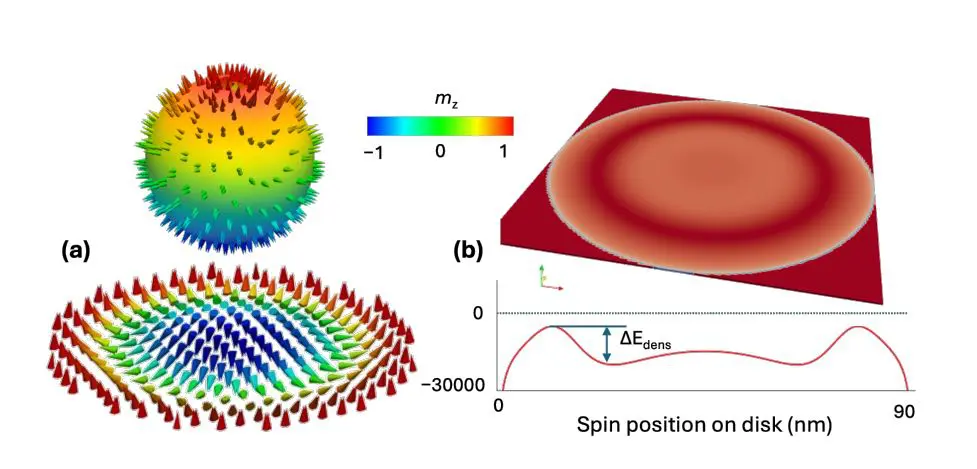
This work presents a novel approach to qubit realization using skyrmionic states stabilized by the Dzyaloshinskii-Moriya interaction within two-dimensional spin lattices. Researchers developed a computational model based on exact diagonalization to explore the behavior of these quantum systems, focusing on both periodic and open boundary conditions. Simulations reveal that a skyrmionic phase emerges under specific parameter settings, while open boundaries favor the formation of classically-protected skyrmions, both of which can be implemented as qubits. The team implemented logic gates, Pauli X, Y, Z, and Hadamard, on both types of skyrmions, then analyzed energy density and entanglement entropy to assess qubit performance.
Results demonstrate that skyrmions experience decoherence driven by the Dzyaloshinskii-Moriya interaction, reducing gate fidelity, whereas the classically-protected skyrmions maintain greater stability. Detailed quantum simulations, incorporating drive effects and decoherence mechanisms, confirm tunable energy levels and coherent Bloch-sphere manipulation, indicating the potential of these skyrmionic states for qubit implementation. Further analysis of qubit dynamics reveals that the Dzyaloshinskii-Moriya interaction, while essential for stabilizing skyrmions, simultaneously induces decoherence during gate operations. Time evolution analysis of entanglement entropy during qubit manipulation shows that topologically protected, classical skyrmionic qubits exhibit slower growth of entanglement entropy and reduced decay in gate fidelity. Calculations demonstrate that for open boundary conditions, the resulting energy level diagram possesses clear anharmonicity, making these states well-suited for qubit implementation. This work establishes a foundation for designing advanced skyrmionic quantum materials that balance skyrmion formation, topological protection, and minimized decoherence.
Skyrmionic Qubits Demonstrate Quantum Gate Operations
This research demonstrates the potential of skyrmionic states as qubits, fundamental units of quantum computation, by establishing a framework for their realization within two-dimensional spin lattices. Scientists successfully modeled these states, stabilized by the Dzyaloshinskii-Moriya interaction, and explored their behaviour under various conditions using detailed simulations. The work reveals that these skyrmionic qubits exhibit tunable energy levels and can be coherently manipulated, suggesting they are promising candidates for building quantum technologies. The team implemented logic gates, Pauli X, Y, Z, and Hadamard, on both skyrmionic and classical-like skyrmion types, demonstrating the feasibility of performing quantum operations.
Analysis of energy density and entanglement entropy revealed a key challenge: the Dzyaloshinskii-Moriya interaction, while essential for stabilizing the skyrmions, also contributes to decoherence and reduces gate fidelity. Simulations confirm that classical-like skyrmions offer improved stability compared to their quantum counterparts. Researchers acknowledge that the Dzyaloshinskii-Moriya interaction presents a dual role, simultaneously enabling qubit stabilization and introducing decoherence during gate operations. Future work will focus on mitigating the decoherence effects of the Dzyaloshinskii-Moriya interaction to enhance gate fidelity. The current findings provide a foundational understanding of skyrmionic qubits and pave the way for exploring advanced materials and techniques to overcome existing limitations.
🗞 Skyrmionic qubits stabilized by Dzyaloshinskii-Moriya interaction as platforms for qubits and quantum gates
🧠 ArXiv: https://arxiv.org/abs/2511.12250