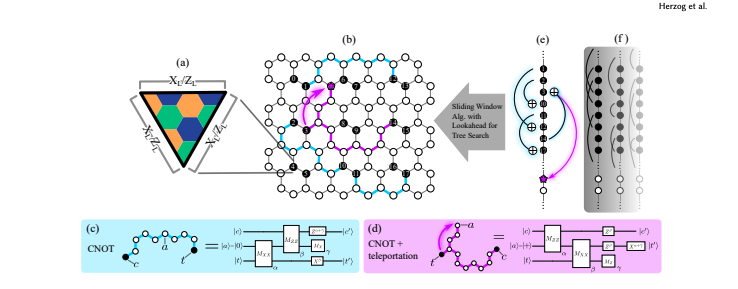
Quantum computation relies on protecting fragile quantum information from errors, and lattice surgery stands out as a promising technique for achieving this with two-dimensional error correcting codes, particularly suited to current superconducting hardware. Laura S. Herzog, Lucas Berent, Aleksander Kubica, and Robert Wille, from institutions including Technical University Munich and Yale University, present a new approach to lattice surgery compilation that dramatically improves efficiency. Their work introduces the concept of ‘movable’ logical qubits, utilising teleportation to allow these qubits to change position during computation, a departure from traditional methods where qubits remain fixed. Numerical simulations demonstrate that this technique substantially reduces the complexity of quantum circuits, offering significant advantages not only for architectures with physically movable qubits, but also for widely used superconducting systems, and the team has made their implementation openly available.
Lattice Surgery Optimizes Surface Code Quantum Computation
Research focuses on building fault-tolerant quantum computers using the surface code and a technique called lattice surgery. Lattice surgery physically rearranges qubits within a surface code architecture to perform complex quantum operations, offering a pathway to reliable computation despite inherent noise. Scientists are actively developing optimizations to make this approach practical, addressing challenges like minimizing qubit requirements and adapting to imperfections in hardware. Key areas of investigation include reducing resource usage, handling defects in qubit arrangements, and efficiently mapping quantum algorithms onto the lattice surgery framework.
Techniques like LUCI, which simplifies hardware needs by utilizing initialization and measurement, and dropouts, which manage qubit failures, are being explored. The ZX-calculus, a graphical language for quantum circuits, provides a powerful tool for designing and optimizing lattice surgery sequences. Related approaches, such as color codes and LDPC codes, are also under investigation, alongside space-time optimization techniques to minimize overall computational resources. This research highlights the importance of efficient compilation and defect tolerance in realizing practical fault-tolerant quantum computation.
Dynamic Lattice Surgery via Logical Qubit Teleportation
Scientists have developed a novel compilation scheme for lattice surgery that leverages the movement of logical qubits during computation. This approach departs from traditional methods by utilizing teleportation to dynamically reposition qubits during gate operations, offering greater flexibility in circuit design and potentially reducing computational overhead. Focusing on the color code, the team engineered a system where logical qubits are not fixed in static locations, allowing for more parallel gate execution. Researchers implemented CNOT gates using measurement-based lattice surgery, incorporating logical qubit teleportation as an integral part of the process. They constructed a routing graph representing the quantum hardware, distinguishing between data and ancilla patches, and visualized the impact of standard and teleportation-enhanced gates on circuit depth. Numerical simulations on a two-dimensional color code architecture demonstrate that optimizations based on movable logical qubits are applicable to superconducting quantum hardware, moving beyond the traditional place-and-route paradigm.
Movable Logical Qubits Reduce Circuit Complexity
Scientists have achieved a breakthrough in quantum computation by developing a new compilation technique for lattice surgery that leverages movable logical qubits via teleportation. This work focuses on the color code and introduces a method that dynamically adjusts the positions of logical qubits during computation to reduce circuit depth. The team demonstrates that this approach moves beyond the traditional “place-and-route” paradigm, where logical qubits remain fixed throughout the process. Experiments reveal that utilizing movable logical qubits substantially reduces the number of routed circuit layers compared to standard compilation techniques.
This advancement exploits the flexibility of measurement-based CNOT implementations, allowing logical qubits to be teleported without increasing the number of lattice surgery operations, enabling more gates to be executed in parallel. Researchers developed a heuristic compilation routine that strategically moves logical data qubits via teleportation during CNOT operations. Simulations demonstrate that this approach identifies regimes where teleportation-based movements significantly reduce routed layers, and is applicable to superconducting quantum hardware with static physical qubits, delivering a new level of flexibility in quantum circuit design.
Logical Qubit Movement Simplifies Quantum Circuits
This work presents a new approach to compiling quantum circuits for lattice surgery, a leading technique for fault-tolerant quantum computation. Researchers successfully demonstrated that allowing logical qubits to move during computation, via teleportation, can significantly reduce the complexity of the required circuits. This contrasts with traditional methods that fix qubit positions throughout the process. Numerical simulations confirm that this technique lowers circuit depth compared to standard compilation approaches, and is applicable to current superconducting quantum hardware. The team developed a software implementation to explore this concept, identifying conditions where substantial reductions in circuit complexity can be achieved by balancing layout density and logical circuit design. This represents the first step beyond the conventional “place-and-route” paradigm for quantum hardware with static physical qubits. Future research will focus on extending the software to evaluate performance on specific quantum algorithms and adapting it to handle defects in quantum systems.
🗞 Exploiting Movable Logical Qubits for Lattice Surgery Compilation
🧠 ArXiv: https://arxiv.org/abs/2512.04169