

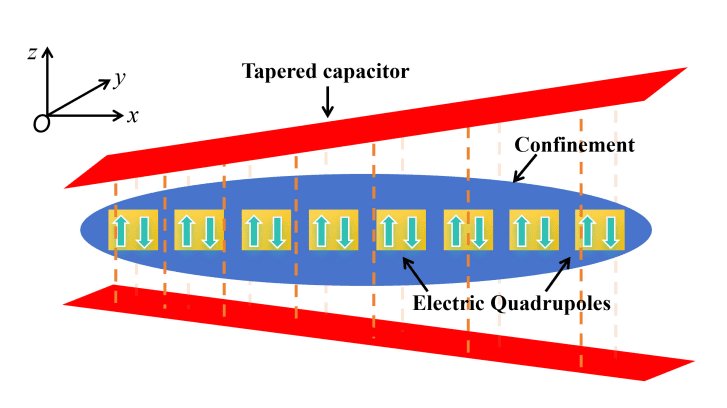
Recent research investigates the fascinating world of quantum droplets, novel states of matter arising from interactions within many-body systems, and expands understanding beyond previously studied dipolar systems. Wei-qi Xia, Xiao-ting Zheng, and Xiao-wei Chen, all from Dongguan University of Technology, alongside Gui-hua Chen, explore the formation and behaviour of these droplets within a quasi-two-dimensional quadrupolar Bose-Einstein condensate. Their work reveals that these droplets exhibit unique properties, including flat-topped density profiles and tunable elliptical shapes, influenced by the strength of quadrupolar interactions and the number of particles they contain. Crucially, the team demonstrates a rich variety of collision dynamics, ranging from merging and scattering to repulsion and even topologically protected tunneling, offering a comprehensive picture of how higher-order interactions govern droplet stability and paving the way for potential applications in areas like anisotropic fluid simulation and topological excitation studies.
This work investigates the static and dynamical properties of quadrupolar quantum droplets within quasi-two-dimensional condensates, building on previous studies of dipolar and spin-1/2 systems. By combining analytical calculations with numerical simulations enhanced with a Lee-Huang-Yang correction, the researchers model the system to examine droplet formation, stability, and collective excitations, revealing the influence of quasi-2D confinement and quadrupolar interactions. The team demonstrates that droplet size and binding energy strongly depend on the strength of interactions and the degree of confinement, providing a pathway for experimental control and manipulation. Furthermore, the study predicts unique collective modes, characterised by both breathing and dipole oscillations, which differ significantly from those observed in other types of quantum droplets. These findings contribute to a deeper understanding of quantum droplet physics and open new avenues for exploring many-body phenomena in ultracold atomic gases.
Ultracold Molecules Form Self-Bound Quantum Droplets
Quantum droplets are self-bound, ultradilute quantum systems formed through a balance of attractive forces and quantum fluctuations, representing a novel state of matter distinct from traditional Bose-Einstein condensates. Research details their properties, dynamics, and creation, often involving solving relevant equations and exploring key parameters like dipolar interactions and the Lee-Huang-Yang correction, crucial for stabilizing droplets against collapse. Ultracold molecules, such as rubidium-cesium and sodium-potassium, are frequently used as building blocks for quantum droplets due to their strong dipolar interactions. Experimental techniques include tuning interactions with Feshbach resonances, shielding molecules from collisions, evaporative cooling, and optical trapping.
Researchers emphasize the importance of molecular properties like the electric quadrupole moment and rotational states, which influence interactions and droplet properties. Investigations explore droplet collisions, including elastic and inelastic behaviours, alongside vortex dynamics and droplet stability in external fields. Research details the creation of anisotropic droplets, their confinement to two dimensions, and the interplay between vortices and quantum droplets, highlighting the potential of these systems for new quantum technologies. Future research will likely focus on creating more complex droplet structures, exploring their use for quantum information processing, and developing more accurate theoretical models.
Quadrupolar Droplets Exhibit Incompressible, Elliptical Behaviour
This work presents a comprehensive investigation into the properties of quantum droplets formed within a two-component quadrupolar Bose-Einstein condensate. Researchers successfully predicted and demonstrated the existence of these droplets, revealing flat-topped density profiles and a linear relationship between droplet area and particle number, confirmed through both analytical calculations and numerical simulations. The study establishes that these droplets exhibit incompressible behaviour, with peak density and chemical potential saturating as particle number increases. Notably, vortex droplets display elliptical shapes due to the directional nature of quadrupolar interactions, with the degree of elongation tunable by adjusting particle number and interaction strength. Simulations of droplet collisions revealed behaviours ranging from merging and scattering to penetration, influenced by impact velocity and droplet topology. These findings advance understanding of anisotropic quantum fluids and topological excitations, potentially paving the way for controlled manipulation of these systems in ultracold atomic experiments.
👉 More information
🗞 Static and dynamical properties of quadrupolar quantum droplets in quasi-2D condensates
🧠 ArXiv: https://arxiv.org/abs/2510.13059

