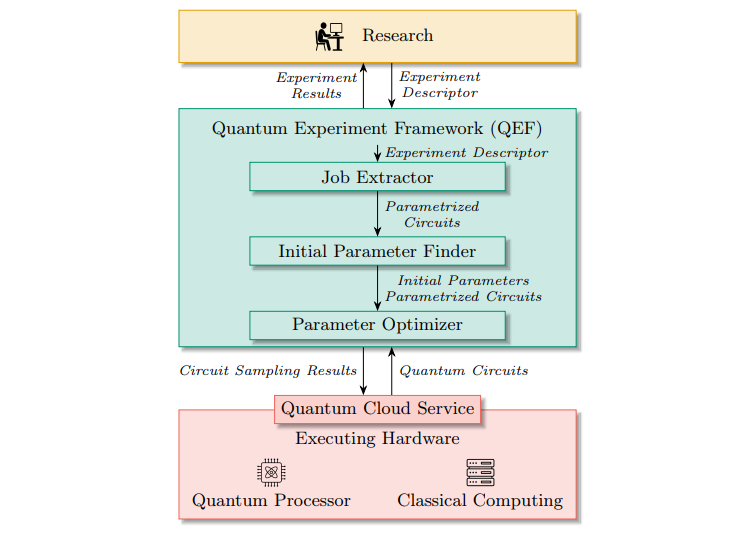
The increasing availability of noisy intermediate-scale quantum devices presents exciting opportunities for practical experimentation, but current tools often lack the systematic approach needed for robust research. Vincent Gierisch and Wolfgang Mauerer, from the Technical University of Applied Science Regensburg, along with their colleagues, address this challenge by introducing the Experiment Framework, or QEF. This lightweight framework prioritises iterative exploration and hypothesis-driven study of quantum algorithms, moving beyond simple evaluation of fixed approaches. QEF captures all essential experimental details in a concise specification, enabling rigorous, reproducible, and scalable parameter sweeps, and ultimately lowering the barriers to empirical research on both current and future quantum systems.
Automated Framework Accelerates Quantum Algorithm Experimentation
Scientists have developed the Quantum Experiment Framework (QEF), a new system designed to streamline and enhance the study of quantum algorithms. This work delivers a practical solution for researchers seeking to conduct systematic, hypothesis-driven experiments on both current and future quantum devices. The framework captures all essential aspects of software and algorithm experiments through a concise specification, which expands into a comprehensive set of variants for controlled, large-scale parameter sweeps, enabling rigorous evaluation and precise reproducibility of results. QEF automatically partitions large studies into asynchronous jobs, distributing them efficiently across available hardware, including cloud resources.
This capability allows researchers to conduct extensive parameter sweeps without the manual overhead typically associated with such investigations. Furthermore, the framework supports built-in parameter reuse between experimental runs, accelerating convergence when exploring related sequences of experiments. All results and metadata are logged in a tidy data format, providing researchers with immediate access to metrics collected at every iteration of a hybrid quantum-classical experiment. The system’s architecture facilitates end-to-end experiment creation, batching, and result consolidation, distinguishing it from other frameworks that focus on individual components or workflow stages.
Unlike systems tightly coupled to specific cloud platforms, QEF remains adaptable and does not require ad-hoc scripting for experiment execution. By enabling simultaneous testing of numerous algorithm variants, QEF isolates the impact of individual factors and returns results in a readily analyzable format, offering a significant advantage over tools designed to test only one algorithm at a time. This approach supports application-level benchmarking, comparing the performance of quantum algorithms without focusing on low-level hardware metrics.
Framework Enables Scalable Quantum Experimentation
The Quantum Experiment Framework, or QEF, represents a significant advance in the methodology of quantum research by enabling reproducible and scalable experiments applicable to both current noisy intermediate-scale quantum (NISQ) devices and future fault-tolerant systems. Researchers developed QEF to address the need for a lightweight, flexible alternative to existing vendor-specific tools, focusing on systematic hypothesis-driven studies of quantum algorithms. The framework manages experiment orchestration, parallel execution, and automated data collection, streamlining the research process and facilitating rigorous analysis. A key achievement of this work lies in the framework’s design, informed by a comprehensive review of current empirical quantum studies, which revealed a tendency to focus on limited parameters and metrics. QEF directly addresses this limitation by supporting common use cases while also allowing for custom extensions, promoting more thorough investigations. By prioritising tidy data, reproducibility, and ease of use, the team replaced ad-hoc scripting with a coherent framework that accelerates experimentation and fosters comparable, community-driven evidence in quantum computing research.
Standardized Reproducible Quantum Experiment Framework Design
Scientists have introduced the Quantum Experiment Framework (QEF), a new system designed to support systematic, hypothesis-driven study of quantum algorithms. This framework prioritises iterative, exploratory analysis of evolving experimental strategies rather than exhaustive evaluation of fixed algorithms using predefined quality metrics. QEF captures all essential aspects of quantum software and algorithm experiments through a concise specification, which expands into a Cartesian grid of variants for controlled, large-scale parameter sweeps. QEF improves reproducibility through careful experiment tracking, standardized data formats, and the ability to re-run experiments with the same parameters.
The framework also supports scalability through parallel execution of experiments, allowing researchers to explore a wide range of parameters and configurations. QEF employs the tidy data principle, ensuring data is organised in a consistent and analysis-friendly format, simplifying data processing and analysis. The framework’s modular architecture allows researchers to easily extend and customise it with new components and features. Key components include an initialisation handler that prepares quantum circuits for the target hardware, an allround optimiser that manages parameter optimisation within hybrid quantum-classical loops, a quantum processing unit that evaluates the circuits, and a post-processing module that handles asynchronous job dispatch, data retrieval, and organisation. This system enables researchers to generate large parameter sweeps, log results in a structured format, and perform exploratory data analysis using standard statistical software.
🗞 QEF: Reproducible and Exploratory Quantum Software Experiments
🧠 ArXiv: https://arxiv.org/abs/2511.04563