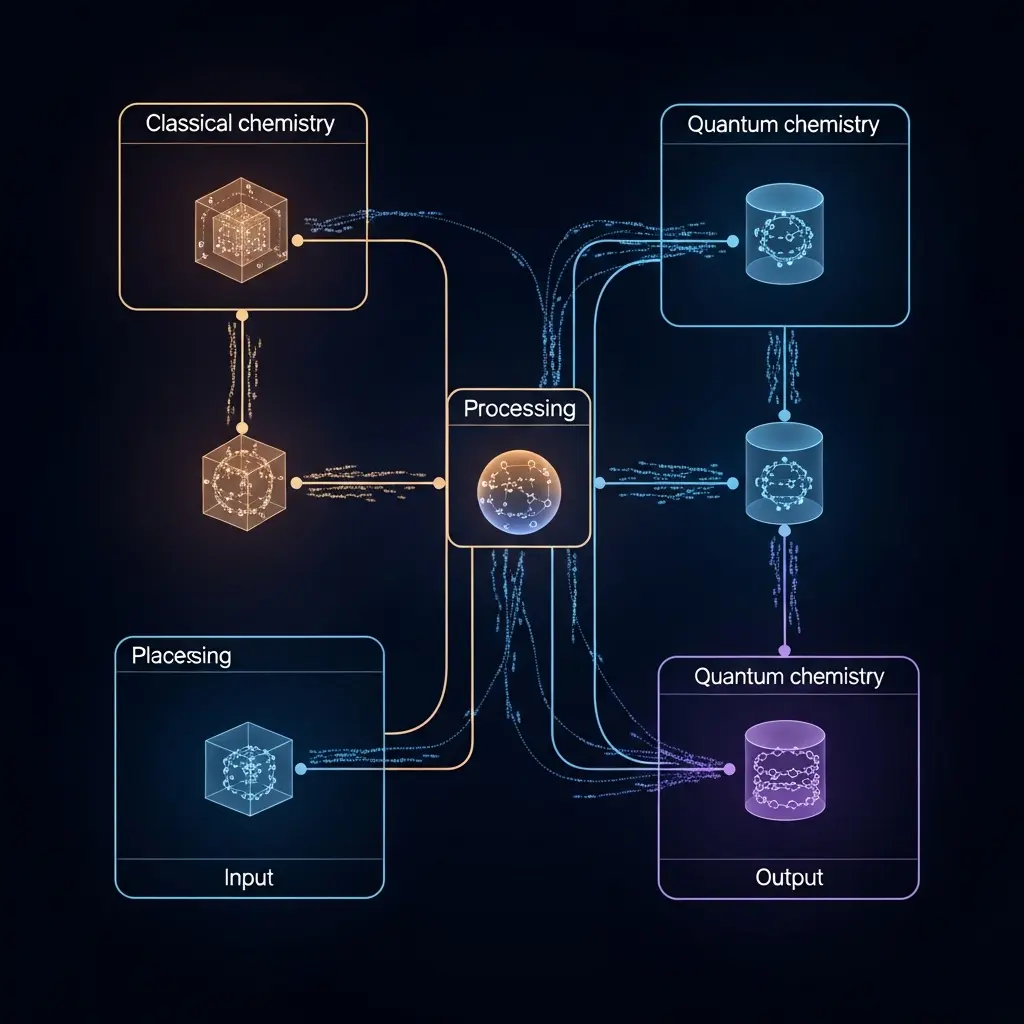
Scientists are tackling a critical bottleneck in quantum chemistry: the disjointed link between complex calculations and their implementation on quantum hardware. Nathan A. Baker, Brian Bilodeau, and Chi Chen, alongside colleagues from various institutions, introduce QDK/Chemistry, a modular toolkit designed to bridge this gap. This innovative software separates data handling from computational methods, allowing researchers to build adaptable workflows from readily interchangeable parts. By integrating with existing open-source chemistry packages and offering native implementations of key algorithms, QDK/Chemistry promises to significantly accelerate reproducible quantum chemistry research and unlock the potential of near-term quantum computers for real-world chemical problems.
This innovative software separates data handling from computational methods, allowing researchers to build adaptable workflows from readily interchangeable parts.
Modular Toolkit Bridges Quantum Chemistry and Computation
This toolkit facilitates molecular geometry handling, self-consistent field calculations, and orbital localization, all crucial steps in preparing accurate inputs for quantum simulations. Furthermore, the work incorporates advanced techniques for active space selection and multi-configuration wavefunction generation, enabling researchers to focus on the most relevant aspects of molecular correlation physics while respecting the limitations of current quantum hardware. Experiments show that QDK/Chemistry’s modularity significantly reduces the effort required to compare different computational approaches. By decoupling data formats and algorithmic implementations, the toolkit allows scientists to easily swap components, such as different active space selectors, qubit mappings, or state preparation strategies, without rewriting extensive pipeline code.
This capability is particularly valuable in a rapidly evolving field where algorithms and hardware are constantly being refined. The team’s innovative approach tackles the challenges of data incompatibility, reproducibility, and methodological variation that plague traditional ad hoc scripting methods, paving the way for more efficient and reliable quantum chemistry research. This breakthrough reveals a powerful solution to the fragmented landscape of quantum chemistry software. QDK/Chemistry’s multi-language support and extensible plugin system ensure adaptability and longevity, allowing it to evolve alongside advancements in both quantum algorithms and hardware. The toolkit’s capabilities extend to qubit Hamiltonian construction, state preparation, statistical energy estimation, and quantum phase estimation, providing a comprehensive suite of tools for tackling complex chemical problems. Ultimately, the research opens exciting possibilities for simulating strongly correlated electronic systems, accelerating materials discovery, and designing novel molecules with tailored properties, all powered by the synergy of classical and quantum computation.
Modular Quantum Chemistry Workflows with QDK/Chemistry enable rapid
QDK/Chemistry provides native implementations of key algorithms within the quantum-classical pipeline, but crucially, it also integrates with widely used open-source quantum chemistry packages and frameworks via a plugin system. This innovative approach allows users to combine methods from diverse sources without the need to modify core workflow logic, significantly reducing development time and potential errors. The study pioneered a system where molecular geometry handling, self-consistent field calculations, orbital localization, active space selection, and multi-configuration wavefunction construction are all seamlessly integrated within a unified framework. Experiments employ a robust classical electronic structure module, beginning with precise molecular geometry handling to define the system under investigation.
Following this, the team implemented self-consistent field calculations to determine the electronic structure, subsequently applying orbital localization techniques to simplify the wavefunction and facilitate active space selection. This active space selection process focuses on identifying the most crucial orbitals for capturing essential correlation physics, while remaining mindful of the limitations imposed by quantum hardware. The system delivers multi-configuration wavefunctions, providing a comprehensive description of the electronic state. Furthermore, the toolkit constructs quantum circuits by first building a qubit Hamiltonian, then implementing state preparation routines and statistical energy estimation techniques. Quantum phase estimation is also incorporated, allowing for accurate determination of ground state energies. This approach enables the execution of complex quantum chemistry simulations, and the modular design facilitates reproducible quantum chemistry experiments by ensuring consistency across multiple workflow stages, from initial structure input to final observable estimates.
Modular QDK/Chemistry streamlines workflow component exchange
This separation allows for easy substitution of methods without disrupting the overall workflow, a significant advancement in computational efficiency. The team measured the impact of this separation by observing how easily different algorithms could be integrated into a single workflow. Results confirm that data classes, representing intermediate quantities as immutable objects, simplify provenance tracking, the output of a calculation depends solely on its inputs and configuration. Algorithm classes, functioning as stateless transformations, consume data and produce new data, ensuring a predictable dataflow model where changes to one stage do not affect others.
Measurements reveal that this immutability also facilitates checkpointing and reproducibility, allowing calculations to be archived and resumed from specific points, crucial for complex simulations. Tests prove the effectiveness of factory-based instantiation for algorithm substitution, allowing users to switch implementations without rewriting pipeline code. The architecture features factory registries that maintain available implementations for each algorithm type, enabling discoverability and seamless integration of new methods, whether developed internally or contributed by the community. Scientists recorded that this approach supports diverse user goals, from developing novel algorithms to benchmarking existing methods against specific problems.
The system’s uniform interfaces ensure that plugin-provided algorithms are indistinguishable from native implementations, simplifying the user experience and promoting code reuse. Furthermore, the work introduces a plugin system that extends the toolkit’s capabilities by integrating with existing chemistry packages and quantum computing frameworks. This extensibility is not merely an add-on but a foundational design choice, mirroring trends in modern computational chemistry software. Measurements confirm that plugins interact with the core through public interfaces, ensuring independent development, testing, and maintenance. The breakthrough delivers a coordination layer for heterogeneous computational environments, allowing QDK/Chemistry to serve as a central hub for diverse methods and algorithms.
QDKChemistry streamlines quantum chemistry workflows
This innovative toolkit not only implements targeted algorithms within the classical pipeline but also integrates with existing open-source chemistry packages via a plugin system. This integration enables users to combine diverse methods without altering core workflow logic, fostering greater flexibility and efficiency. The authors highlight that solving complex chemistry problems necessitates a series of interconnected workflows, demanding consistent data handling and methodological tracking, features QDK/Chemistry aims to deliver. The authors acknowledge that the current implementation focuses on specific algorithms and may require further development to accommodate a wider range of quantum algorithms and hardware platforms. Future research directions could involve expanding the plugin system to support more chemistry packages and developing automated tools for optimising workflows for different quantum hardware architectures. This work represents a crucial step towards reproducible and scalable quantum chemistry experiments, potentially accelerating the development of new materials and technologies.
👉 More information
🗞 QDK/Chemistry: A Modular Toolkit for Quantum Chemistry Applications
🧠 ArXiv: https://arxiv.org/abs/2601.15253