
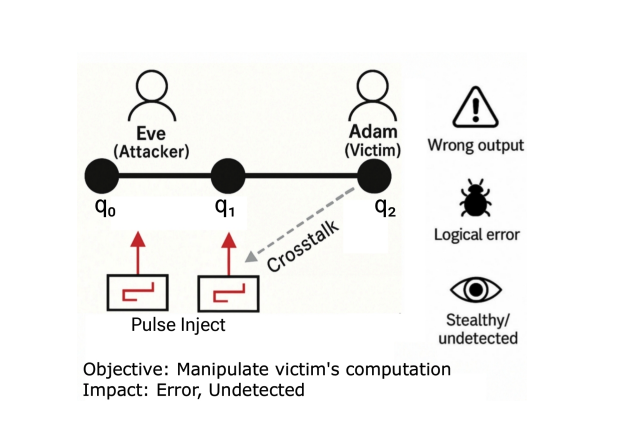
The increasing complexity of quantum computers introduces new security vulnerabilities, and researchers now demonstrate a significant threat from hardware crosstalk in multi-tenant superconducting systems. Syed Emad Uddin Shubha and Tasnuva Farheen, both from the Division of Computer Science at Louisiana State University, alongside their colleagues, present the first complete framework that links physical attacks at the pulse level to specific, understandable errors in quantum logic. This work reveals a fundamentally asymmetric attack mechanism where one qubit drives the initial error, and a second refines its impact on coherence, potentially reducing the accuracy of quantum computations to random chance. By reconstructing the complete error channel and modelling it as a logical circuit, the team not only demonstrates the feasibility of these “stealthy” attacks under realistic conditions, but also proposes a detection strategy based on identifying unique attack signatures, paving the way for improved security in future cloud-based quantum platforms.
Crosstalk Vulnerabilities in Superconducting Qubits
Scientists have developed a rigorous framework to understand and mitigate security risks posed by crosstalk in superconducting quantum computers, particularly as systems move towards shared, multi-tenant architectures. This research highlights the need to address security concerns at the fundamental, physical level of quantum hardware. The team introduced a channel-theoretic framework connecting adversarial control signals to resulting errors in quantum computations, using detailed simulations, quantum process tomography, and a new method to extract simplified logical circuit models representing the attack. A key discovery is an asymmetric attack mechanism where the impact of the attack differs depending on which qubit the attacker controls, proving robust to variations in hardware parameters.
The team proposes a two-tiered mitigation strategy based on detecting anomalies using simple quantum circuits and containing attacks by resetting the state of affected qubits. This involves simulating qubit interactions, precisely measuring the quantum state of qubits with quantum process tomography, and translating complex physical interactions into simplified logical circuit models. Results show the attack’s impact is significantly different depending on which qubit the attacker controls, with direct control over the targeted qubit being far more damaging. Canary circuits effectively detect anomalies in certain scenarios, and state reset successfully contains the attack by limiting its impact. This research underscores the importance of considering security at the physical layer of quantum hardware and emphasizes the need for robust hardware resistant to crosstalk attacks, paving the way for future work validating the framework on real hardware and refining mitigation strategies.
Crosstalk Characterisation and Error Channel Reconstruction
Scientists have developed a novel framework to map physical attacks exploiting hardware crosstalk to interpretable logical error channels in multi-tenant superconducting quantum computers, addressing a critical security vulnerability. The team integrated density-matrix simulation, quantum process tomography, and a newly developed circuit extraction method to reconstruct the complete induced error channel, revealing the underlying mechanisms of these attacks. The methodology begins with characterising crosstalk using quantum process tomography, precisely measuring the quantum state of qubits to identify unintended interactions. Scientists then employed density-matrix simulation to model the physical behaviour of qubits under adversarial control pulses, accurately capturing the effects of crosstalk.
A key innovation is an isometry-based circuit extraction method, which translates complex physical interactions into a simplified, logical circuit model representing the induced error. This approach reveals a fundamentally asymmetric attack mechanism where one adversarial qubit functions as a ‘driver’ to set the induced logical rotation, while a second qubit acts as a ‘catalyst’ to refine the attack’s coherence. Experiments conducted on a linear three-qubit system demonstrate the effectiveness of this framework, showing that such attacks can significantly disrupt diverse quantum protocols, while remaining effective even under realistic variations in hardware parameters. Furthermore, scientists proposed a protocol-level detection strategy based on observable attack signatures, providing a foundation for defense-in-depth strategies in cloud-based quantum computing platforms.
Crosstalk Exploits Reveal Quantum Computer Vulnerability
Scientists have demonstrated a novel framework for characterising and exploiting hardware crosstalk in multi-tenant superconducting quantum computers, revealing a significant security vulnerability. The team developed an end-to-end system that maps physical pulse-level attacks to interpretable logical error channels, successfully reconstructing the complete induced error channel and modelling it as an effective logical circuit. The team discovered a fundamentally asymmetric attack mechanism, identifying one adversarial qubit as a “driver” that sets the induced logical rotation and a second, acting as a “catalyst”, that refines the attack’s coherence. This allows for precise control over the induced errors on a victim qubit, even under realistic variations in hardware parameters.
Measurements confirm that the attacks remain effective and stealthy, mimicking device calibration drift or random noise, making detection challenging. The research shows that an attacker with control over two qubits can induce unintended quantum operations on a neighbouring victim qubit without direct access, representing a potent security vector. Furthermore, scientists proposed and validated a protocol-level detection strategy based on observable attack signatures, demonstrating that stealthy attacks can be exposed through targeted monitoring. This provides a foundation for developing defense-in-depth strategies for cloud-based quantum platforms, establishing a clear link between physical attacks and interpretable logical models.
Hardware Crosstalk Reveals Asymmetric Qubit Attacks
This research presents a comprehensive framework for understanding and mitigating security threats posed by hardware crosstalk in multi-tenant superconducting quantum computers. The team successfully mapped physical, pulse-level attacks to interpretable logical error channels, a crucial step in assessing and addressing vulnerabilities. By combining Hamiltonian-level simulation, quantum process tomography, and a novel circuit extraction method, they established a systematic pipeline applicable to various hardware configurations and attack types. The findings reveal a previously unrecognised asymmetric attack mechanism, where one qubit acts as a driver to initiate errors and a second, the catalyst, refines their coherence. Demonstrations on a three-qubit system show these attacks can significantly disrupt quantum protocols, reducing accuracy to the level of random guessing, while remaining difficult to detect under realistic hardware conditions. Importantly, the researchers also propose a protocol-level detection strategy, demonstrating that stealthy attacks can be exposed through targeted monitoring.
👉 More information
🗞 Pulse-to-Circuit Characterization of Stealthy Crosstalk Attack on Multi-Tenant Superconducting Quantum Hardware
🧠 ArXiv: https://arxiv.org/abs/2509.11407