Understanding the behaviour of open quantum systems, those interacting with their surroundings, remains a significant challenge in modern physics and technology, often hampered by immense computational demands. Chong Chen and Ren-Bao Liu, both from The Chinese University of Hong Kong’s Department of Physics, now demonstrate a pathway to overcome this limitation, proving that accurately describing the dynamics of these systems requires computational effort that scales much more favourably than previously thought. Their work establishes a theorem showing the number of necessary calculations increases at most linearly with time and polynomially with the size of the surrounding environment, opening the door to efficient algorithms for simulating small open quantum systems like qubits or atoms. By developing a novel tensor network approach, they further reveal that calculations can proceed with a bond dimension increasing linearly with time, offering a practical method for tackling a wide range of problems in areas such as environmental learning and noisy information processing.
Quantum Dynamics and Environmental Interactions
This collection of research focuses on the field of open quantum systems, exploring how quantum systems interact with their surroundings and lose quantum coherence. Understanding these interactions is crucial for developing quantum technologies and accurately modelling complex physical processes. Researchers are particularly interested in the influence of spin baths and nuclear spin noise, which commonly cause decoherence in electron spins within materials like quantum dots. Tensor networks, a powerful class of numerical techniques, are prominently featured as a means of efficiently representing and simulating quantum many-body systems.
Specific types of tensor networks, such as matrix product states and projected entangled pair states, are used to model both one- and two-dimensional quantum systems. The collection also highlights the importance of developing accurate models of the environment and accurately capturing its influence on the system’s behaviour. The research reveals a growing interest in understanding and mitigating decoherence in solid-state qubits, which are promising candidates for building quantum computers. Researchers are also focused on developing methods that can scale to larger system sizes and longer simulation times, addressing a major challenge in the field. Furthermore, some studies explore non-Markovian dynamics, where the environment retains a memory of its past interactions with the system, adding another layer of complexity to the modelling process.
Efficiently Modelling Open Quantum System Dynamics
Researchers have developed a new theoretical framework and computational approach to model open quantum systems, systems that interact with their environment. They established a theorem demonstrating that the computational complexity of describing these systems grows at most linearly with evolution time and polynomially with the size of the environment. This breakthrough enables the efficient simulation of previously intractable problems involving small open quantum systems, such as qubits or atoms. The team’s method utilizes tensor networks, a mathematical tool for efficiently encoding quantum states, to represent both the system and its environment.
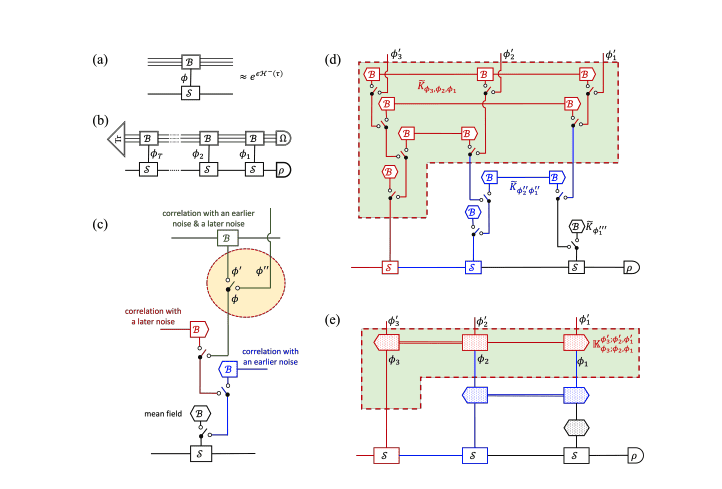
A key innovation is a tensor contraction procedure that ensures the complexity of the network increases linearly with time, rather than exponentially. To validate their approach, researchers applied it to two well-studied models: a spin interacting with a Gaussian bath and a central spin coupled to numerous environmental spins. The results demonstrate the ability to accurately calculate the system’s quantum state by tracing out the environmental degrees of freedom. This new tool offers a powerful means of understanding and controlling the dynamics of open quantum systems in noisy environments, with important implications for quantum computing and information processing. The research provides a pathway towards simulating more complex quantum systems and developing more robust quantum technologies.
Linear Scaling for Open Quantum System Dynamics
Researchers have established a groundbreaking theorem demonstrating that calculating the dynamics of open quantum systems, systems interacting with their environment, is computationally tractable. This challenges previous expectations of exponential complexity and opens new avenues for research in areas like quantum computing and materials science. The team proves that the number of calculations needed to describe an open quantum system grows at most linearly with simulation time and polynomially with the size of the surrounding environment. This discovery allows for the development of efficient algorithms to model open quantum systems, even those with a large number of interacting components.
Previously, the computational demand increased so rapidly with system size that simulating even moderately complex systems was impractical. The researchers achieved this breakthrough by recognizing that full knowledge of the environment’s dynamics is unnecessary; only its correlation functions, describing how different parts of the environment relate to each other, are required to accurately predict the system’s evolution. To demonstrate the theorem’s practical application, the team developed a novel tensor network algorithm and successfully applied it to two widely studied open quantum system problems: a spin interacting with a Gaussian bath and a central spin coupled to numerous environmental spins. Numerical results confirm the algorithm’s efficiency, showing that the computational demand increases linearly with time, regardless of the strength of the interaction or the size of the environment. This confirms the theoretical prediction and validates the approach as a viable method for simulating complex open quantum systems.
Polynomial Complexity for Open Quantum Systems
This research demonstrates that solving the dynamics of an open quantum system, a system interacting with its environment, is not inherently computationally difficult, despite previous assumptions. The team proved a ‘polynomial complexity theorem’, meaning the number of calculations needed to describe the system’s evolution increases at most linearly with time and at a manageable rate with the size of the environment. This challenges the idea that such problems are limited by an exponential increase in computational demand. The researchers further developed a tensor network algorithm that efficiently simulates these open quantum systems, showing that the computational complexity grows only as a polynomial function of both time and environment size.
They validated their theorems and algorithm by successfully modelling two common scenarios: a spin interacting with a Gaussian bath and a central spin coupled to many environmental spins. This work offers new approaches to understanding dynamics in complex systems, learning about environments, and optimising information processing in noisy conditions. The authors acknowledge that determining the noise correlations within the environment remains a challenge, although they highlight that many open quantum system problems can be formulated without explicitly calculating these correlations. They also note that their theorems apply regardless of the specific method used to solve the problem. Future research could focus on finding explicit algorithms to take advantage of the guaranteed polynomial complexity, and applying these methods to evaluate local observables in complex many-body systems.
👉 More information
🗞 Polynomial complexity of open quantum system problems
🧠 ArXiv: https://arxiv.org/abs/2509.00424