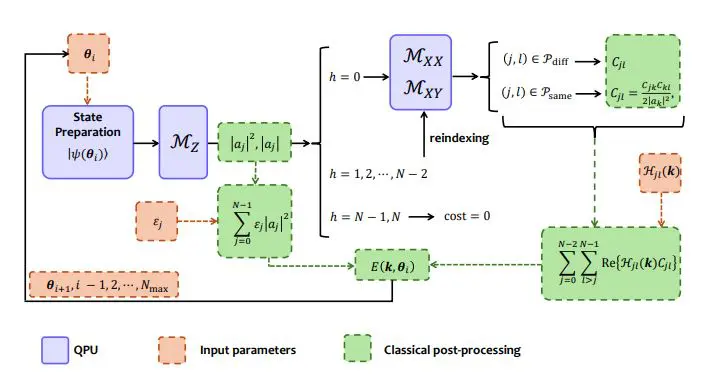
Determining the electronic structure of materials relies heavily on accurate and efficient measurement protocols, yet the number of required measurements often increases dramatically with the complexity of the system. Michal Krejčí, Lucie Krejčí, Ijaz Ahamed Mohammad, Martin Plesch, and Martin Friák, from institutions including the Czech Academy of Sciences and the Slovak Academy of Sciences, now present a novel measurement protocol that significantly reduces this burden. Their approach, designed for calculating band structures in crystalline materials, achieves a remarkable feat by requiring only three distinct measurement settings, regardless of the number of qubits involved. This breakthrough circumvents a major bottleneck in quantum computation, as most existing protocols scale with qubit number, and the team demonstrates its effectiveness using models of cuprate and graphene materials, paving the way for more complex simulations and potentially unlocking quantum advantage in materials science.
Reducing Measurement Overhead in Variational Algorithms
Scientists have achieved a significant breakthrough in quantum computing by developing a new measurement protocol that dramatically reduces the computational resources needed for certain types of calculations. This advancement addresses a key limitation of variational quantum algorithms, where the number of measurements typically increases with the complexity of the problem, hindering scalability. The research team successfully demonstrated this protocol within the Variational Quantum Deflation algorithm, achieving a fixed number of measurement settings, just three, regardless of the number of qubits used. The core of this achievement lies in exploiting the symmetries present in tight-binding Hamiltonians, a common framework for describing the electronic structure of materials.
By carefully grouping quantum operators, scientists were able to measure multiple properties simultaneously, significantly reducing the overall measurement burden. This was successfully tested on models of crystalline materials, including a two-dimensional copper oxide lattice and bilayer graphene, accurately reproducing known energy spectra. The team validated their approach by comparing results to exact diagonalization, a computationally intensive classical method, confirming the accuracy of the new protocol even with limited data. Further testing on systems ranging from three to fourteen qubits demonstrated that the precision of the measurements did not diminish as the system size increased, confirming its scalability.
This constant measurement count represents a crucial step towards making variational quantum algorithms practical for near-term quantum computers. While current classical simulations remain more efficient for these specific materials models, this research highlights a fundamental advancement for quantum computing. By demonstrating that measurement overhead need not scale with system size, scientists have opened new avenues for exploring more complex quantum systems. Future work will focus on extending this constant-measurement protocol to strongly correlated materials, paving the way for more efficient quantum simulations and materials discovery.
👉 More information
🗞 Minimum measurements quantum protocol for band structure calculation
🧠 ArXiv: https://arxiv.org/abs/2511.04389