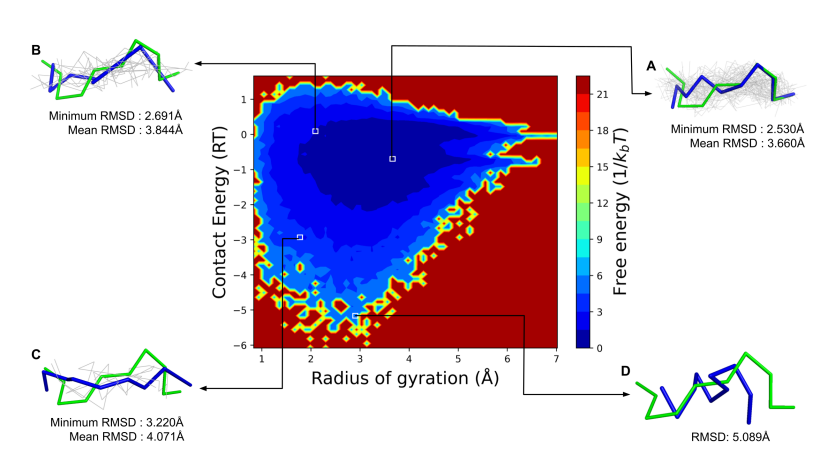
Protein folding, the process by which a chain of amino acids attains its functional three-dimensional shape, remains a fundamental challenge in biology, with misfolding linked to debilitating diseases like Alzheimer’s and cystic fibrosis. Ashwini Kannan, Jaya Vasavi Pamidimukkala, and Avinash Dakshinamoorthy, from the Indian Institute of Technology Madras, alongside Soham Bopardikar from Northeastern University, Kalyan Dasgupta from IBM Research, and Sanjib Senapati from the Indian Institute of Technology Madras, have developed a new method to map the complex energy landscape governing this process. Their work introduces an efficient encoding optimisation algorithm that considers both hydrophobic interactions and all non-bonded forces, creating a more realistic model of protein conformation on a three-dimensional lattice. By employing a hybrid classical and quantum approach, utilising a Variational Eigensolver on advanced hardware, the team successfully predicts protein structures and demonstrates a promising pathway towards improved accuracy, particularly for proteins with limited similarity to known structures.
Predicting and understanding how a protein’s linear sequence of amino acids folds into its specific three-dimensional structure remains a central challenge in structural biology. This structure is critical, as a protein’s functionality is inherently linked to its final folded form, and misfolding can lead to severe diseases such as Alzheimer’s and cystic fibrosis, highlighting the biological and clinical importance of understanding protein folding mechanisms.
Quantum Algorithm for Protein Structure Prediction
Scientists are exploring the potential of quantum computing to predict protein structures, a notoriously difficult problem crucial for understanding protein function and designing new drugs. Researchers developed a variational quantum algorithm, combining quantum computations with classical optimisation loops, and used a simplified protein model represented as a chain of beads on a grid to reduce computational complexity. The algorithm encodes possible protein shapes into quantum states and minimises an energy function representing the stability of the conformation, based on a commonly used statistical potential in protein folding. A variational quantum eigensolver identifies the lowest energy state, representing the most stable conformation, and the algorithm was tested both through simulations on classical computers and on actual quantum hardware. Error mitigation techniques were employed to reduce the impact of noise on the quantum computations. While not yet competitive with classical methods, the results suggest quantum algorithms have the potential to outperform them as quantum hardware improves, and show promise for scalability, potentially allowing application to larger and more complex proteins.
Quantum Algorithm Predicts Protein Folding Structures
Scientists have achieved a breakthrough in predicting protein structures using a novel computational approach that combines classical and quantum computing techniques. Researchers developed a turn-based encoding optimisation algorithm designed to predict the folded structures of peptides and small proteins, implemented on a three-dimensional grid. The team constructed a mathematical representation of the protein’s energy, incorporating both hydrophobic interactions and all interactions between atoms, offering superior packing efficiency and a realistic representation of protein conformations. To identify the lowest-energy folded configurations, scientists utilised a hybrid quantum-classical algorithm, implemented on quantum hardware. Experiments demonstrate the ability to accurately predict protein structures, validated against experimental data, and show particular promise for sequences with limited similarity to known structures. This research delivers a significant advancement in computational protein folding, potentially accelerating the discovery of new therapies for diseases linked to protein misfolding.
Predicting Protein Structure With Quantum Computation
Researchers have developed a novel computational approach to predicting protein structures, addressing a long-standing challenge in biology. They created an optimisation algorithm that simulates the protein folding process, considering both hydrophobic interactions and all interactions between amino acids. By encoding the folding problem onto a three-dimensional grid, the team created a mathematical description of the system’s energy, which was then solved using both classical and quantum computational methods. The results demonstrate the potential of combining classical and quantum computing to predict protein structures, particularly for sequences that are dissimilar to known structures. Validation against experimental data showed promising agreement between predicted and observed structures, suggesting the algorithm effectively captures key aspects of the protein folding process and offers a valuable tool for structural prediction. Future research will likely focus on improving the accuracy and efficiency of the algorithm and exploring its potential for drug discovery and materials science.
🗞 Capturing Protein Free Energy Landscape using Efficient Quantum Encoding
🧠 ArXiv: https://arxiv.org/abs/2510.15316