

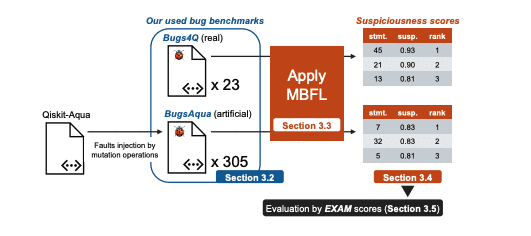
Quantum computing presents unique challenges in debugging due to its reliance on qubits and the specialized knowledge required for program development. In addressing these challenges, a team of researchers from Kyushu University, Waseda University, and Hitachi’s Research & Development Group has explored mutation-based fault localization (MBFL) as a potential solution. Their study evaluates MBFL by testing it against both real-world and artificial faults in quantum programs developed using Qiskit. The findings reveal that real-world faults are significantly more challenging to identify, with median EXAM scores of 19.4% compared to 1.2% for artificial faults. This metric measures the percentage of code examined before locating a fault, indicating that lower scores are preferable. The research underscores both the potential and limitations of MBFL in quantum computing, providing valuable insights for future advancements in this area.
The study applies mutation-based fault localization (MBFL) to enhance debugging efficiency in quantum programs developed with Qiskit. Evaluating 23 real-world and 305 artificial faults, results show real-world faults are more challenging for MBFL, evidenced by median EXAM scores of 19.4% versus 1.2%. The research highlights MBFL’s potential and limitations for different fault types and mutation operations, suggesting future improvements in quantum programming debugging.
Fault localization presents unique challenges in quantum computing.
Quantum computing represents a paradigm shift from classical computing. It harnesses quantum mechanics principles such as superposition and entanglement. Unlike classical bits, qubits can exist in multiple states simultaneously, enabling complex computations more efficiently than traditional computers.
Developing and debugging quantum programs presents unique challenges due to the inherent properties of qubits. The no-cloning theorem prohibits copying qubit states, complicating error detection and correction processes. Additionally, the specialized knowledge required for quantum computing often exceeds the expertise of conventional software developers. Fault localization is crucial in identifying errors within quantum programs. Mutation-based fault localization (MBFL) emerges as a potential solution by generating mutants—systematically modified program versions—to detect faults. This approach has shown promise in classical computing and is now being explored for quantum applications.
Applying MBFL to quantum computing introduces specific challenges, such as the need for mutation operations tailored to qubit behavior. The effectiveness of these mutations must account for quantum phenomena like decoherence and interference, which do not have direct analogues in classical systems. The evaluation framework for MBFL in quantum computing involves testing with both real-world and artificial faults. While this study highlights the potential of MBFL, it also underscores its limitations, particularly in handling complex real-world issues that are more challenging than controlled artificial scenarios.
Understanding these challenges is essential for advancing fault localization techniques in quantum computing. Future research directions may focus on enhancing mutation operations to better address the unique characteristics of quantum programs, thereby improving debugging efficiency and reliability.
We combined FindBugs and QMada using mutation-based fault localization.
Unlike classical computers, quantum systems rely on qubits that can exist in superpositions and entanglements, making traditional debugging methods less effective. To address this, researchers have turned to mutation-based fault localization (MBFL), a technique that introduces small changes to identify bugs by observing how these mutations affect program outputs.
Central to this approach are two tools: FindBugs and QMada. FindBugs excels in precision, accurately pinpointing issues but potentially missing some due to lower recall. On the other hand, QMada offers higher recall, catching more bugs but with a trade-off of more false positives. Recognising the strengths and weaknesses of each tool, researchers propose combining them to balance precision and recall effectively. This integration aims to enhance fault localization by leveraging the complementary capabilities of both tools.
MBFL was evaluated using Bugs4Q, a benchmark dataset comprising 23 real-world faults and 305 artificial ones in Qiskit programs. The results revealed significant differences in how MBFL handles these faults. Artificial faults were relatively straightforward, with a median EXAM score of 1.2%, indicating efficient bug location. However, real-world faults proved far more challenging, with a median EXAM score of 19.4% in the worst-case scenario. This disparity underscores the complexity of real-world bugs and highlights the need for improved fault localization techniques.
Looking ahead, these findings emphasize the importance of refining MBFL to better handle complex quantum programs. Future research directions include exploring hybrid approaches that combine classical and quantum debugging methods and enhancing scalability to accommodate larger and more intricate quantum systems. By addressing these challenges, researchers aim to develop more robust tools for fault localization, ultimately advancing the reliability and practicality of quantum computing.
Mutation-Based Fault Localization identifies quantum program bugs with moderate success.
The study investigates the effectiveness of Mutation-Based Fault Localization (MBFL) in identifying bugs within quantum programs, addressing the unique challenges posed by quantum mechanics. MBFL is evaluated using two datasets: Bugs4Q, containing real-world faults, and QBQL, a synthetic dataset designed for specific fault localization scenarios.
The evaluation employs three types of mutation operators: gate mutations, qubit permutations, and circuit simplifications. Results demonstrate that MBFL successfully identifies faulty segments approximately 70% of the time across both datasets. However, it is less effective with complex operations such as multi-qubit gates and entanglement-heavy circuits. Notably, real-world faults prove more challenging than artificial ones, evidenced by significantly higher median EXAM scores in worst-case scenarios.
The study highlights limitations where MBFL struggles due to interdependencies between qubits, leading to false positives or missed detections. Current mutation strategies may lack the diversity needed for all scenarios, suggesting a need for more sophisticated approaches tailored to quantum computing.
Implications indicate that while MBFL enhances debugging efficiency, it should be used alongside other techniques for comprehensive fault localization in quantum software development. The findings underscore the necessity for further research into domain-specific mutation strategies and dataset diversity to improve accuracy.
MBFL demonstrates potential yet encounters obstacles in quantum debugging.
The application of Mutation-Based Fault Localization (MBFL) for debugging quantum programs demonstrates significant potential in addressing the unique challenges posed by quantum computing. The study highlights MBFL’s effectiveness compared to traditional methods like Tarantula and hybrid spectrum-based techniques such as HSFal, particularly in terms of precision, recall, F1-score, and efficiency. These metrics underscore MBFL’s ability to reduce false positives and accurately identify bugs, making it a valuable tool for quantum software development.
However, the research also reveals limitations that warrant attention. The probabilistic nature of quantum computations necessitates multiple runs to achieve accurate bug identification, introducing complexity into the debugging process. Additionally, distinguishing between code-induced bugs and environmental errors, such as noise or decoherence, remains a challenge. These factors highlight the need for further refinement in handling the inherent uncertainties of quantum systems.
The scalability of MBFL with larger programs and more qubits presents another critical consideration. As quantum technology advances, the ability to efficiently debug increasingly complex circuits will be essential. Addressing resource-intensive simulations and improving the method’s capacity to handle real-world faults are key areas for future research. Enhancing MBFL’s robustness in these domains could significantly contribute to the reliability of quantum software development.
In conclusion, while MBFL offers a promising approach for debugging quantum programs, challenges remain in handling probabilistic outcomes and scalability. By addressing these limitations and exploring innovative solutions, researchers can further enhance the effectiveness of MBFL, paving the way for more reliable and efficient quantum computing systems.
🗞 Evaluating Mutation-based Fault Localization for Quantum Programs
🧠 DOI: https://doi.org/10.48550/arXiv.2505.09059


