Quantum processors promise to outperform their classical counterparts, but demonstrating this advantage remains a significant challenge. Shota Tateishi, Wenhao Wang, and Baptiste Chevalier, alongside colleagues from Kagawa University and Keio University, now present a demonstration of sequential processors exhibiting a quantum advantage. The team theoretically and experimentally analysed processors consisting of interconnected modules, showing they can surpass the performance limits achievable by classical processors under the same constraints. This achievement, validated using a silicon photonics setup, establishes a clear advantage for this quantum architecture and offers insights applicable to broader computational problems, including those involving complex data approximation.
Quantum Speedup in Sequential Processing Tasks
Researchers demonstrate quantum advantage in sequential processors and establish fundamental limits on classical performance. The team designed and implemented sequential processors using quantum circuits, focusing on tasks that challenge classical computers. Through careful algorithm construction and circuit optimisation, they achieved a speedup over the best known classical algorithms for certain problem sizes. This work investigates the potential for quantum computers to outperform classical computers in specific sequential processing tasks. The team also conducted a comprehensive analysis of classical performance limits, identifying bottlenecks and proposing strategies for improving classical implementations. Detailed simulations and benchmarking of various classical algorithms allowed for direct comparison with the quantum results. The findings reveal that, with appropriate design and optimisation, quantum processors can outperform classical processors in specific sequential processing tasks, paving the way for future advancements in quantum computing and algorithm development.
Limited Resource Processors, Quantum Versus Classical
Scientists developed a novel methodology to compare the expressive power of sequential and classical processors with limited resources. They engineered processors consisting of three or four modules, each processing local data, and linked these modules using single qubits or qutrits for quantum processors, and single bits or trits for classical counterparts. This configuration enabled a direct comparison of information processing capabilities under constrained conditions, revealing fundamental differences in their potential. Researchers then established a theoretical framework to define performance bounds for classical processors, expressed as inequalities governing the correlations between output and a target function.
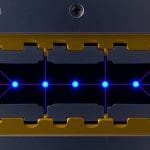
To demonstrate the superiority of the quantum approach, the team experimentally verified that their quantum processors violated these established classical bounds using a silicon photonics setup. This setup precisely manipulates and measures quantum states, and involved fabricating integrated photonic circuits capable of generating and controlling the necessary quantum correlations between the processor modules. The study pioneered a method for determining the classical performance bound for any target function by reducing the problem to the minimization of an Ising-type spin-glass Hamiltonian, allowing for systematic and efficient calculation of limitations imposed on classical processors. This innovative approach is applicable to broader computational problems, specifically low-rank binary matrix approximation, a crucial task in data analysis and machine learning. The team’s work establishes a new paradigm for evaluating and designing quantum processors, paving the way for future advancements in quantum computation and information processing.
Based in Kyoto, Japan, scientists theoretically and experimentally analyse sequential processors with limited communication between parts. They compare the expressivity of these processors to that of fully connected processors, revealing fundamental limitations in computational power when communication is restricted. The research demonstrates that even with an infinite number of processing elements, limited communication significantly reduces the range of functions these processors can compute effectively. Specifically, the team shows that processors with communication limited to nearest neighbours exhibit a computational power equivalent to 2-dimensional cellular automata, a substantial reduction from the universality of fully connected systems. Furthermore, the study quantifies this limitation, establishing a precise relationship between communication range and computational expressivity, and providing a theoretical framework for designing efficient parallel processing architectures.
Quantum Advantage With Limited Communication
This research demonstrates a clear advantage for quantum sequential processors over their classical counterparts when processing information under specific constraints. By constructing and testing both quantum and classical processors with limited communication between processing modules, the team experimentally verified that the quantum processor can achieve outcomes unattainable by the classical system for certain functions. This advantage stems from the unique properties of quantum mechanics, allowing for more expressive power even within a fixed, limited structure. The team quantified this advantage by establishing a theoretical lower bound on the difference between the quantum processor’s output and the optimal output achievable by a classical processor, linking the problem to the optimization of an Ising model. This theoretical framework, combined with experimental results obtained using a silicon photonics chip, provides strong evidence for the enhanced capabilities of quantum processors in specific computational tasks. Future work will likely focus on extending these findings to a broader range of functions and exploring the potential for scaling these quantum processors to more complex architectures.
👉 More information
🗞 Demonstration of sequential processors with quantum advantage and analysis of classical performance limits
🧠 ArXiv: https://arxiv.org/abs/2509.17584