

Jiaxuan Zhang and colleagues from the University of Science and Technology of China, along with collaborators, have experimentally demonstrated a universal set of logical gates on a superconducting quantum processor, “Wukong.” Published November 14, 2025, in npj Quantum Information, the team implemented a transversal CNOT gate alongside arbitrary single-qubit rotations on distance-2 surface codes. This achievement represents a critical step towards fault-tolerant quantum computation, enabling the fault-tolerant preparation of logical Bell states and observation of a CHSH inequality violation, confirming entanglement between logical qubits. Logical gate fidelities were comprehensively evaluated using logical Pauli transfer matrices, validating the viability of surface code error correction on superconducting platforms.
Fault-Tolerant Quantum Computing and Logical Qubits
Recent research has demonstrated a complete, universal set of logical gates on a superconducting quantum processor, a crucial step towards fault-tolerant quantum computing. Researchers at the University of Science and Technology of China successfully implemented arbitrary single-qubit rotations and a CNOT gate using distance-2 surface codes on the “Wukong” processor. This achievement fills a critical gap, as previous superconducting demonstrations lacked two-qubit logical operations necessary for universal computation.
The key to this advancement was a tailored encoding circuit that, while simplifying the surface code implementation, allowed for transversal CNOT gates. Single-qubit rotations were achieved through gate teleportation utilizing ancilla logical states. Notably, the team bypassed real-time stabilizer measurements—typically used for error detection—opting for post-selection and reconstruction of stabilizers from final measurement results. This approach represents a pragmatic trade-off for demonstrating logical gate functionality.
Characterization using Logical Pauli Transfer Matrices (LPTMs) confirmed gate fidelities, and the creation of entangled Bell states—verified via CHSH inequality violation—demonstrated successful entanglement between logical qubits. This work moves beyond simply storing quantum information in logical qubits, demonstrating the ability to process it, paving the way for more complex, error-corrected quantum algorithms on superconducting platforms.
Quantum Error Correction and Noise Suppression
Recent research demonstrates a crucial step towards practical quantum computing: a universal set of logical gates implemented on a superconducting processor. Researchers at Wukong achieved this using a distance-2 surface code, encoding two logical qubits within an 8-physical qubit region. Critically, they implemented a transversal CNOT gate – inherently fault-tolerant – alongside single-qubit rotations achieved via gate teleportation and ancilla logical states. This addresses a significant gap in superconducting quantum error correction demonstrations.
The team characterized these logical gates using Logical Pauli Transfer Matrices (LPTMs), enabling fidelity evaluation. This fidelity assessment is vital for understanding the effectiveness of error correction. Further validating the system, they prepared logical Bell states and confirmed entanglement by observing a violation of the CHSH inequality. This demonstrates that quantum information is being reliably preserved and manipulated at the logical qubit level, a key requirement for scalable quantum computation.
This work uniquely addresses limitations of prior demonstrations. Unlike previous attempts, this research implements a complete universal gate set and utilizes logical ancilla states—essential for true fault tolerance. While the experiment currently relies on post-selection for error detection (omitting real-time stabilizer measurements), it establishes a clear pathway toward building more robust and complex quantum algorithms on superconducting hardware, overcoming a major hurdle in quantum computing development.
Universal Gate Sets for FTQC
Researchers have demonstrated a universal set of logical gates—including arbitrary single-qubit rotations and a CNOT gate—on a distance-2 surface code using the Wukong superconducting quantum processor. This is a significant step towards fault-tolerant quantum computing (FTQC) as it overcomes the previous limitation of lacking two-qubit logical operations in superconducting systems. The implementation utilizes a tailored encoding circuit, simplifying the surface code to remove ancilla qubits needed for typical stabilizer measurements, relying instead on post-selection for error detection.
The key to achieving universality involved a transversal CNOT gate – directly operating on the encoded logical qubits – coupled with gate teleportation for single-qubit rotations. While transversal gates are ideal for FTQC, a theorem dictates no code can simultaneously be both universal and fully transversal. This work bypasses this limitation by utilizing ancilla logical states – a critical distinction from prior work that used physical ancilla – and strategically implementing gate teleportation to complete the universal gate set.
Gate fidelity was rigorously characterized using Logical Pauli Transfer Matrices (LPTMs) on a complete state set, confirming the functionality of the logical gates. Furthermore, the researchers successfully prepared logical Bell states and verified entanglement through a violation of the CHSH inequality. This demonstration validates the effectiveness of the approach and marks a crucial advancement in realizing practical, fault-tolerant quantum computation with superconducting qubits and surface code error correction.
Surface Code Encoding for Quantum Information
Recent research demonstrates a complete, universal set of logical gates within an error-detecting surface code using superconducting qubits. Researchers at Wukong successfully implemented both a transversal CNOT gate and arbitrary single-qubit rotations – a first for this encoding scheme. This was achieved using a distance-2 surface code, encoding two logical qubits within a 2×4 qubit region. Crucially, this advancement bypasses the need for traditional stabilizer measurements during gate operations, simplifying the circuit while still enabling error detection post-operation.
The team utilized a clever design, removing ancilla qubits typically needed for stabilizer measurements to streamline the transversal CNOT implementation. Single-qubit rotations were accomplished through gate teleportation, leveraging an ancilla logical state – a key component for true fault-tolerance. Characterization using Logical Pauli Transfer Matrices (LPTMs) rigorously assessed gate fidelity across a complete state set, confirming performance and validating the approach to building robust quantum computation.
Demonstrating entangled logical states via the preparation of Bell states and verification of CHSH inequality violation further solidifies this work’s significance. This experiment moves beyond simply storing quantum information in logical qubits – it showcases the ability to process that information with high fidelity. This is a critical step toward realizing practical, fault-tolerant quantum computers capable of tackling complex problems beyond the reach of classical machines.
Experimental Implementation of Logical CNOT Gate
Researchers have demonstrated a complete, universal set of logical gates on a superconducting quantum processor (“Wukong”) using a distance-2 surface code. This is a significant step toward fault-tolerant quantum computing (FTQC). The team successfully implemented a transversal CNOT gate – acting on logical qubits – alongside arbitrary single-qubit rotations. Crucially, this work addresses a gap in existing research, as prior superconducting demonstrations lacked two-qubit logical operations forming a complete universal set.
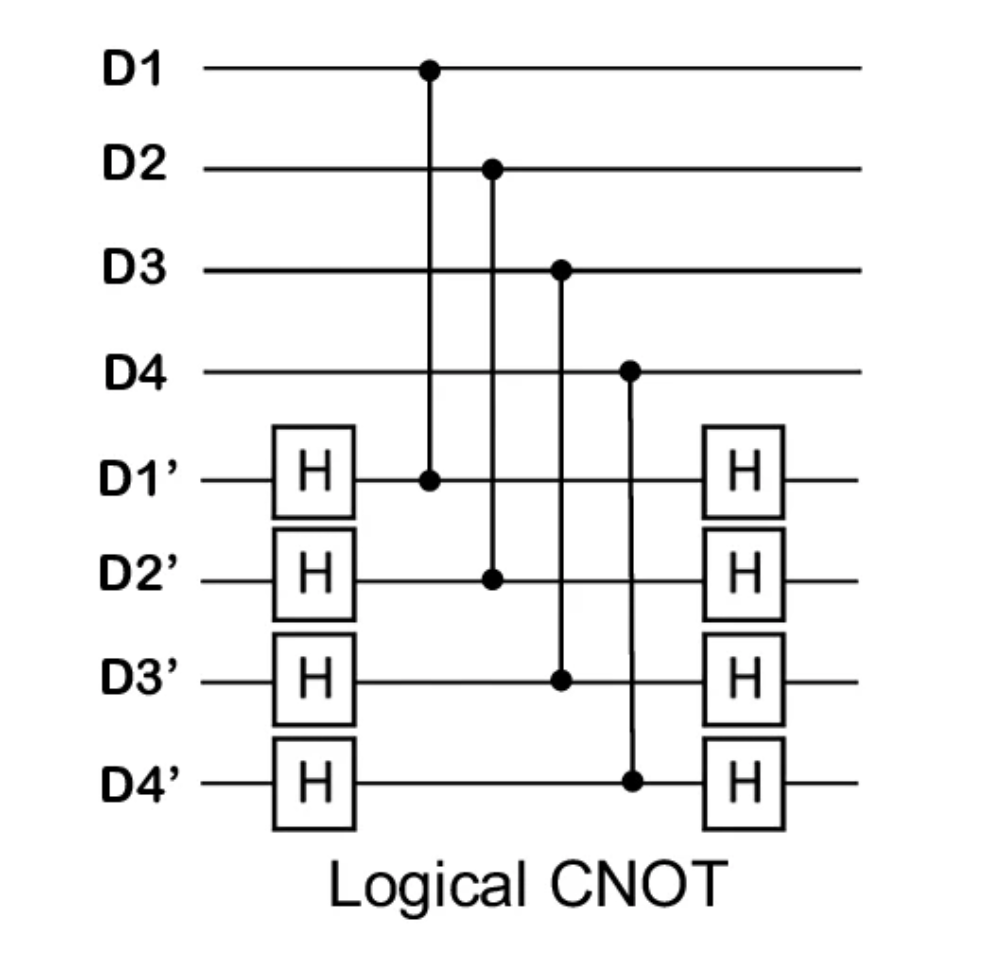
The experimental setup encoded two logical qubits within an 8-qubit region of the processor. The CNOT gate was achieved by applying four physical CNOTs, while single-qubit rotations utilized gate teleportation via ancilla logical states. A key design choice involved simplifying the encoding by removing qubits normally used for stabilizer measurements, relying instead on post-selection for error detection—a viable approach within the fault-tolerant framework.
Gate performance was rigorously characterized using Logical Pauli Transfer Matrices (LPTMs), allowing for fidelity evaluation. Furthermore, the researchers prepared logical Bell states and confirmed entanglement through a violation of the CHSH inequality. This validation demonstrates not only the functionality of the gates, but also the successful creation and manipulation of entangled logical qubits—essential for complex quantum algorithms within a fault-tolerant architecture.
Transversal Gate Operations and Limitations
Transversal gate operations offer a pathway to fault-tolerant quantum computing by limiting interactions between physical qubits within logical blocks. This approach inherently provides some error protection, simplifying error correction protocols. However, a fundamental theorem dictates that no quantum code can simultaneously achieve both transversal implementation and a universal gate set. This means compromises are necessary – often requiring indirect gate implementation via techniques like gate teleportation, which introduces ancilla qubits and added complexity.
Researchers recently demonstrated a universal logical gate set – including arbitrary single-qubit rotations and a CNOT gate – using a distance-2 surface code on the Wukong superconducting processor. This was achieved through a tailored encoding circuit that removed ancilla qubits typically used for stabilizer measurements, implementing the CNOT gate transversally. Single-qubit gates were realized via gate teleportation using an ancilla logical state – a crucial distinction from prior work using only physical ancilla.
The fidelity of these logical gates was assessed using Logical Pauli Transfer Matrices (LPTMs), and logical Bell states were successfully prepared, verifying entanglement. While this implementation currently relies on post-selection for error detection instead of real-time stabilizer measurement, it represents a significant step toward practical fault-tolerant quantum computation on superconducting platforms. The achievement fills a critical gap in current literature by demonstrating a complete universal gate set within the surface code framework.
Gate Teleportation for Single-Qubit Rotations
Researchers recently demonstrated a complete, universal set of logical gates – essential for fault-tolerant quantum computing – using a distance-2 surface code on the superconducting processor, Wukong. This included a transversal CNOT gate and arbitrary single-qubit rotations. Achieving single-qubit rotations required a technique called gate teleportation, utilizing ancilla logical states and a logical CNOT, overcoming limitations of purely transversal gate sets. This marks a significant step toward practical, error-corrected quantum computation with superconducting qubits.
Gate teleportation allowed the team to implement single-qubit rotations despite the surface code’s challenges with transversal universality. They prepared ancilla logical states—meaning the ancilla qubits themselves were protected by the error-correcting code—and combined these with a logical CNOT and measurements. This method bypasses the need for direct transversal implementation of rotations like the S or T gate, which are otherwise difficult within the surface code framework.
The fidelity of these logical gates was thoroughly characterized using Logical Pauli Transfer Matrices (LPTMs). Furthermore, the researchers successfully prepared entangled logical Bell states and verified entanglement via a violation of the CHSH inequality. This confirms the functionality of the implemented logical gates and demonstrates the ability to perform complex quantum operations while actively suppressing errors – a crucial milestone for scaling up quantum computing.
Wukong Superconducting Quantum Processor
Researchers have demonstrated a universal set of logical gates on the “Wukong” superconducting quantum processor, a crucial step towards fault-tolerant quantum computing. This achievement centers around implementing a distance-2 surface code, encoding two logical qubits within an 8-qubit region of the processor. Critically, they successfully performed a transversal CNOT gate—a key building block—along with arbitrary single-qubit rotations, filling a gap in previous superconducting quantum experiments. This builds towards reliable quantum calculations.
The team achieved single-qubit rotations not through direct implementation, but via “gate teleportation” utilizing an ancilla logical state and the transversal CNOT. This approach overcomes limitations inherent in surface codes, where direct universal gate sets are difficult to realize. Characterization using Logical Pauli Transfer Matrices (LPTMs) evaluated gate fidelities, providing quantifiable metrics for performance. The experiment intentionally simplified error detection to focus on logical gate operation.
Confirmation of entanglement between these logical qubits was achieved by preparing Bell states and verifying a violation of the CHSH inequality. This demonstrates the ability to create and manipulate quantum information protected by the surface code, a major milestone. The “Wukong” processor’s success highlights the potential of superconducting systems for realizing practical, fault-tolerant quantum computers capable of complex calculations.
Encoding and Layout of Logical Qubits
Researchers recently demonstrated a universal set of logical gates using a distance-2 surface code on the superconducting processor “Wukong.” Encoding two logical qubits required an 8-qubit physical region (2×4 layout). Crucially, they implemented a transversal CNOT gate – performing four physical CNOTs – simplifying the architecture. While standard stabilizer measurements for error detection were bypassed for simplicity, the design allows post-selection error detection via reconstruction of stabilizers from final measurements, a key step toward practical fault tolerance.
Single-qubit rotations weren’t directly transversal. Instead, the team employed gate teleportation, utilizing an ancilla logical state alongside the transversal CNOT. This approach bypasses limitations inherent in surface codes where not all gates can be implemented directly via transversal operations. The design prioritizes a complete, universal gate set—arbitrary single-qubit rotations and CNOT—filling a significant gap in superconducting quantum computing demonstrations of error correction.
Gate fidelity was rigorously assessed using Logical Pauli Transfer Matrices (LPTMs) across a complete state set, providing a quantitative measure of performance. Furthermore, the researchers successfully prepared logical Bell states and confirmed entanglement by observing a violation of the CHSH inequality. These results validate the effectiveness of their encoding scheme and demonstrate a critical step towards achieving fault-tolerant quantum computation on superconducting platforms.
Error Detection via Post-Selection
Researchers recently demonstrated a universal set of logical gates—essential for fault-tolerant quantum computing—using a distance-2 surface code on the superconducting processor “Wukong.” This involved encoding two logical qubits within an 8-physical qubit region. Critically, the team implemented a transversal CNOT gate – a key building block – alongside arbitrary single-qubit rotations achieved via gate teleportation and ancilla logical states. This represents a significant step forward, filling a gap in existing superconducting quantum computing demonstrations.
A core innovation was simplifying the surface code encoding by removing ancilla qubits normally used for stabilizer measurements. Error detection, therefore, relied on post-selection – analyzing the final measurement results to identify errors after the computation. While foregoing real-time error correction, this approach still allows for fault-tolerant operation as single errors can be reconstructed from the terminal measurements. This allowed for demonstrating the creation of entangled logical Bell states, confirmed by violating the CHSH inequality.
Gate fidelity was thoroughly characterized using Logical Pauli Transfer Matrices (LPTMs), providing quantitative performance metrics. The successful demonstration of both two-qubit (CNOT) and single-qubit operations within the surface code establishes a foundational toolkit for building more complex, error-resilient quantum algorithms on superconducting platforms. This work moves the field closer to realizing practical, large-scale fault-tolerant quantum computation.
Characterizing Gate Fidelity with LPTMs
Researchers recently demonstrated a universal set of logical gates—including arbitrary single-qubit rotations and a CNOT gate—on a superconducting quantum processor using distance-2 surface codes. This was achieved by encoding two logical qubits within an 8-physical qubit region of the “Wukong” processor. A key innovation was implementing the CNOT gate transversally—directly at the physical qubit level—while strategically removing ancilla qubits normally used for stabilizer measurements, simplifying the circuit. This represents a significant step toward fault-tolerant quantum computation.
To rigorously assess performance, the team characterized all logical gates using Logical Pauli Transfer Matrices (LPTMs). These matrices allow for a complete evaluation of gate fidelity across all possible input states. The results, detailed in their publication, quantify the accuracy of each logical operation, providing crucial data for optimizing future designs. Specifically, LPTMs provide a framework to understand and minimize errors impacting the reliability of quantum computations.
Beyond individual gate fidelity, the researchers demonstrated the creation of entangled logical qubits—specifically, four Bell states—and verified entanglement via a violation of the CHSH inequality. This confirms that the error correction scheme effectively preserves quantum coherence at the logical level. Successfully creating and verifying entangled logical qubits is vital, as entanglement is a core resource for many quantum algorithms and applications, proving the viability of their approach.
Demonstrating Entanglement with Bell States
Researchers recently demonstrated a complete, universal set of logical gates—including single-qubit rotations and a CNOT gate—on a superconducting quantum processor named Wukong. Utilizing a distance-2 surface code, they encoded logical qubits across an 8-qubit region. Crucially, this work bypasses traditional stabilizer measurements during computation to simplify the circuit, relying instead on post-selection for error detection. This represents a significant step towards practical, fault-tolerant quantum computation.
The team achieved this by implementing the CNOT gate transversally—meaning each physical qubit interacts with at most one other—and utilizing gate teleportation for single-qubit rotations. This involved preparing ancilla logical states, a key improvement over previous work using only physical ancilla. Characterization via Logical Pauli Transfer Matrices (LPTMs) allowed for rigorous fidelity evaluation of each gate, confirming their functionality within the error-correcting framework.
Confirmation of entanglement was achieved by preparing Bell states—maximally entangled pairs of qubits—and verifying a violation of the CHSH inequality. This provides strong evidence that the logical qubits are genuinely entangled after undergoing the quantum operations and error correction. This demonstration validates the efficacy of the surface code in protecting entanglement – a critical resource for quantum algorithms – paving the way for more complex quantum computations.


