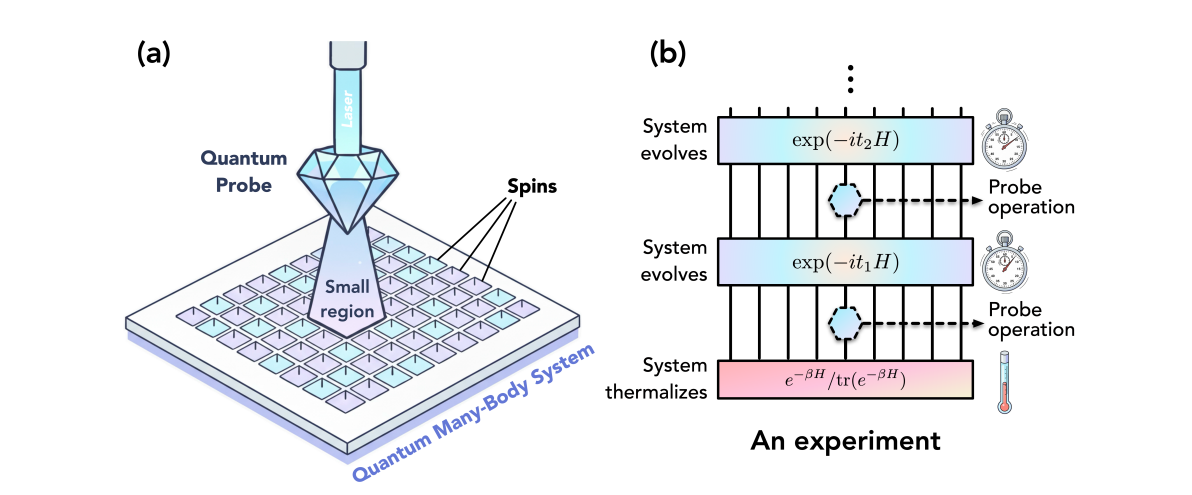
Characterising complex many-body systems presents a long-standing challenge across physics and materials science, but current methods often require complete control over the system, a limitation in many real-world scenarios. Sitan Chen from Harvard University, Jordan Cotler also from Harvard University, and Hsin-Yuan Huang from Caltech address this issue by introducing and formalising the problem of ‘probe tomography’, a technique for learning the parameters of a complex system using only a single, local probe accessing a small part of it. Their work establishes that a wide range of physically relevant Hamiltonians are identifiable from this limited data, utilising a novel combination of algebraic geometry and smoothed analysis, and importantly, they have developed the first efficient algorithm to achieve this. This algorithm learns Hamiltonian parameters to a high degree of accuracy, with a query complexity that scales favourably, demonstrating that robust Hamiltonian learning is possible even with severely restricted experimental access.
Existing methods often demand complete control over the entire system, a limitation in many real-world experiments. This work introduces a new protocol that circumvents this issue by using a small number of local, passive quantum probes, weakly coupled to the system of interest, and performing randomised measurements on these probes. By analysing the resulting correlations, the team demonstrates the ability to accurately estimate the parameters of the system Hamiltonian, even in the presence of experimental noise. This approach offers a pathway towards characterising complex quantum systems using experimentally feasible techniques, and it opens new avenues for exploring many-body physics in diverse platforms. The researchers show that the efficiency of the protocol scales favourably with system size, making it applicable to increasingly complex materials and devices.
Hamiltonian Identification via Quantum Measurements
Research across physics, computer science, and materials science focuses on determining the Hamiltonian of a quantum system through measurements. Many approaches exist, including techniques based on measurement data, time traces, and optimisation algorithms. Some studies concentrate on resource-efficient learning, achieving results with limited quantum resources, while others address the fundamental question of whether a Hamiltonian can be uniquely determined from a given set of measurements. Specific measurement strategies, such as using out-of-time-order correlators or short-time measurements, are also under investigation.
Researchers are also exploring how to apply these techniques to open quantum systems, those interacting with their environment, and increasingly, machine learning methods are being used to accelerate Hamiltonian learning. Quantum sensing and metrology play a crucial role, with diamond-based sensors, utilising nitrogen-vacancy centres, offering highly sensitive magnetic measurements. Squeezed states are also employed to reduce quantum noise and improve the sensitivity of interferometers, while entangled photons are used for precise clock synchronisation.
Limited Probes Identify Complex Hamiltonians Accurately
Scientists have developed a new approach to characterising many-body systems, addressing a fundamental problem in physics and materials science. This method, termed probe tomography, learns the parameters of a complex Hamiltonian using only local measurements from a small part of the system. This contrasts with existing techniques that typically require full control and measurement of all components, making the new method more practical for real-world applications where access is limited. The team demonstrated that, under certain conditions, these Hamiltonians are identifiable from the limited probe data, and they designed an algorithm that accurately reconstructs Hamiltonian parameters.
Specifically, the algorithm achieves accuracy with a query complexity that scales favourably, and classical processing time grows at a manageable rate, demonstrating efficient reconstruction even with constrained experimental access. They validated this approach by successfully reconstructing translation- and rotation-invariant nearest-neighbor Hamiltonians in one, two, and three dimensions, using only single-site probes. The authors acknowledge that their results rely on certain assumptions about the Hamiltonians being studied, and that the identifiability guarantees may not hold for all possible systems. Future work could explore the extension of this method to more complex Hamiltonians and the development of algorithms that are robust to noise and imperfections in the measurements. This research represents a significant step towards practical Hamiltonian learning, offering a pathway to characterise complex quantum systems with limited experimental resources.
Local probe settings provide access only to small, local measurements. This motivates the introduction and formalisation of quantum probe tomography, where the goal is to learn the parameters of a many-body Hamiltonian using only local access to a small subsystem of a many-body thermal state undergoing time evolution. The research addresses the identifiability problem, determining which Hamiltonians can be distinguished from probe data, through a new combination of tools from algebraic geometry and smoothed analysis. This approach proves that generic Hamiltonians in various physically natural families are identifiable up to simple, unavoidable structural symmetries.