The world of computing is on the cusp of a revolution. This change is driven by the need to overcome the limitations of classical models. As Moore’s law looms, the industry is turning to alternative computational models that can easily process high-dimensional and complicated data. Quantum Machine Learning (QML) has emerged as a promising approach, leveraging the power of quantum systems to optimize energetic states.
A breakthrough development in quantum neuromorphic computing has introduced a new software model called the “quantum leaky integrate-and-fire” (QLIF) neuron. This compact and high-fidelity quantum circuit requires only two rotation gates. It uses no CNOT gates. This makes it an attractive building block for more complex models. The QLIF neuron has been used to construct quantum spiking neural networks (QSNNs). It has also been utilized to build convolutional neural networks (QSCNNs). These models have shown promising results on classical datasets.
These quantum models offer a scalable and efficient solution for processing complex data, overcoming the limitations of classical models that require extreme hardware and power solutions. The emergence of QSNNs and QSCNNs marks a paradigm shift in information processing, driven by the need to overcome the limitations of classical models. As researchers continue to push the boundaries of what is possible with quantum models, the industry can expect to see significant advancements in processing high-dimensional data.
Quantum Leap: A New Era in Computing
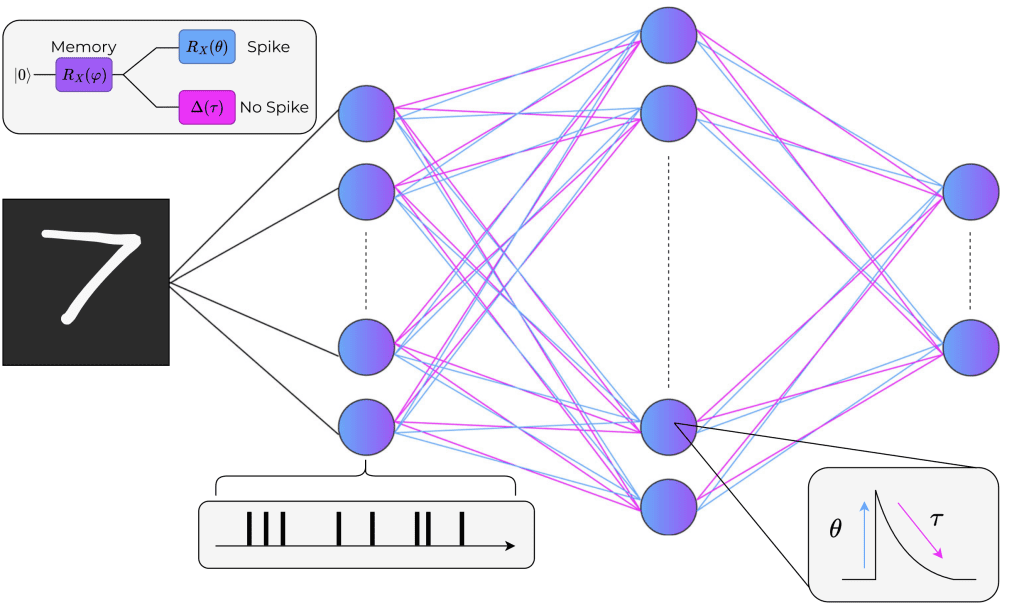
planes of weighted synapses (θ and τ) in parallel for each neuron. The parameter θ controls the spike intensity through the angle of the RX rotation gate. The parameter τ controls the decay rate through the delay gate Δ, during which the qubit is left to idle and undergo relaxation to a ground state (Bottom right). Only one of these operations occurs based on the binary input, after a memory rotation gate which reinstates the excited state of the previous time step measurement (Top left). Each neuron processes a series of input spikes/no-spikes (Bottom left). Throughout the diagram θ is blue and τ is magenta.
The world of computing is on the cusp of a revolution driven by the need to overcome the limitations of classical models. As the end of Moore’s law looms, the industry faces a rapidly approaching ceiling of ability, necessitating a paradigm shift in information processing. The solutions to these problems must be coupled across hardware and software, and one promising approach lies in quantum computing.
Quantum Machine Learning (QML) has shown rapid growth in recent years, with sophisticated approaches to optimization and learning. QML models have the added benefit of processing and learning both classical and quantum data, filling a niche ahead of its time. The most promising models for QML on classical data are based on variational quantum circuits, which encode data into quantum systems to utilize their natural tendency to find optimal energetic states.
However, the current state of quantum hardware is still in the Noisy Intermediate Scale Quantum (NISQ) era, significantly limiting the capabilities of software models. NISQ devices are too susceptible to noise from open quantum systems within them, making it difficult for them to stay in a coherent state for long enough to complete complex computations.
A New Software Model: Quantum Leaky Integrate-and-Fire (QLIF)
In this context, researchers have introduced a new software model for quantum neuromorphic computing, known as the Quantum Leaky Integrate-and-Fire (QLIF) neuron. This compact and high-fidelity quantum circuit requires only 2 rotation gates and no CNOT gates, making it an attractive building block for more complex models.
The QLIF neuron is designed to mimic the behavior of classical integrate-and-fire neurons, which are commonly used in neural networks. By using these neurons as building blocks, researchers can construct more complex models, such as quantum-spiking neural networks (QSNNs) and quantum-spiking convolutional neural networks (QSCNNs).
Quantum Spiking Neural Networks (QSNNs)
The QSNN is a novel model that combines the benefits of classical neural networks with the power of quantum computing. Using QLIF neurons as building blocks, researchers can create complex models that can learn and adapt to changing data.
In this context, researchers have applied the QSNN to several benchmark datasets, including MNIST, FashionMNIST, and KMNIST. The results show that the QSNN performs competitively with other classical and quantum models, demonstrating its potential as a viable solution for machine learning tasks.
Quantum Spiking Convolutional Neural Networks (QSCNNs)
The QSCNN is another novel model that combines the benefits of classical convolutional neural networks with the power of quantum computing. Using QLIF neurons as building blocks, researchers can create complex models that can learn and adapt to changing data.
In this context, researchers have applied the QSCNN to several benchmark datasets, including MNIST, FashionMNIST, and KMNIST. The results show that the QSCNN performs competitively with other classical and quantum models, demonstrating its potential as a viable solution for machine learning tasks.
Classical Simulation vs. Quantum Devices
One key advantage of the QSNN and QSCNN is their ability to be simulated classically, making them more accessible and easier to develop than traditional quantum models. However, when run on actual quantum devices, these models can take advantage of the unique properties of quantum computing, such as superposition and entanglement.
Researchers have compared the performance of the QSNN and QSCNN on classical simulation with their performance on actual quantum devices. The results show that both models perform competitively with other classical and quantum models, demonstrating their potential as viable solutions for machine learning tasks.
Implications and Future Directions
The development of the QSNN and QSCNN has significant implications for the field of quantum computing and machine learning. These models demonstrate the potential of quantum neuromorphic computing to overcome the limitations of classical models and provide a new era in computing.
As researchers continue to develop and refine these models, we can expect to see significant advancements in machine learning and beyond. The QSNN and QSCNN have the potential to revolutionize industries such as healthcare, finance, and transportation, and their impact will be felt for years to come.
Publication details: “A quantum leaky integrate-and-fire spiking neuron and network”
Publication Date: 2024-12-02
Authors: Dean Brand and Francesco Petruccione
Source: npj Quantum Information
DOI: https://doi.org/10.1038/s41534-024-00921-x