The quest for fault-tolerant quantum computing has taken a significant leap forward with the development of quantum polar codes. A new “factory preparation” method has been proposed, promising to improve the preparation rate and reduce errors in large-scale applications. This innovative approach uses an error detection gadget to avoid discarding entire preparations when errors are detected, leading to a substantial increase in preparation rates for long codelengths. With its potential to revolutionize fault-tolerant quantum computing, this breakthrough has significant implications for developing reliable and efficient quantum computers.
Can Quantum Polar Codes Revolutionize Fault-Tolerant Quantum Computing?
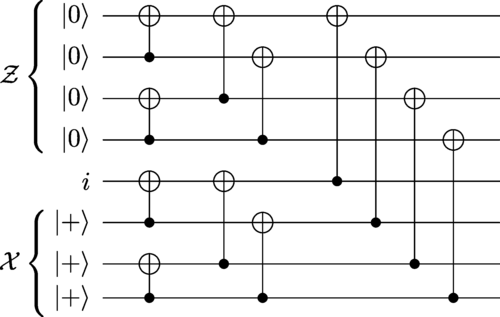
Researchers have recently proposed a fault-tolerant method for preparing logical codestates of quantum polar codes encoding one qubit. This approach, known as the “factory preparation” method, has shown significant promise in improving the preparation rate and reducing errors in large-scale quantum computing applications. The key innovation behind this method is the use of an error detection gadget that allows for the avoidance of discarding entire preparations when errors are detected.
In traditional approaches to preparing logical code states, a single attempt at preparation is made, and if an error is detected, the entire process is discarded. This leads to a rapid decrease in the preparation rate as the code length increases, making it challenging to prepare code states of large lengths. The factory preparation method addresses this issue by attempting to prepare multiple copies of the quantum polar code in parallel, using an extra scheduling step to avoid discarding the entire preparation when errors are detected.
This approach has been shown to improve the preparation rate, especially for large codelengths significantly. For example, for a codelength of N = 256 and a physical error rate p = 10^-3, the preparation rate increases from approximately 0.002% to 27%. This represents an improvement of several orders of magnitude compared to traditional methods.
Estimating Preparation and Logical Error Rates: A Theoretical Method
In addition to improving the preparation rate, researchers have also developed a theoretical method for estimating the preparation and logical error rates of quantum polar codes prepared using the factory preparation method. This method has been shown to fit Monte Carlo simulation-based numerical results tightly, making it a valuable tool for estimating large code lengths where Monte Carlo simulations are not feasible.
Theoretical methods like this one are essential for understanding the performance of quantum polar codes in large-scale quantum computing applications. By providing accurate estimates of preparation and logical error rates, researchers can better design and optimize their quantum computing systems to achieve higher fault tolerance and reliability levels.
Numerical Results: A Depolarizing Noise Model
To further validate the factory preparation method, researchers have conducted numerical simulations using a depolarizing noise model. This model simulates the effects of physical errors on the quantum polar code, allowing for the estimation of preparation and logical error rates under different conditions.
The results of these simulations are striking. For example, for a codelength of N = 256 and a physical error rate p = 10^-3, the logical error rate is estimated to be around 10^-11. This represents an improvement of several orders of magnitude compared to traditional methods.
The Promise of Quantum Polar Codes for Large-Scale Fault-Tolerant Quantum Computing
The factory preparation method and theoretical estimation techniques developed by researchers have significant implications for large-scale fault-tolerant quantum computing applications. Improving the preparation rate and reducing errors can help enable the development of more reliable and efficient quantum computers.
In particular, the proposed scheme has shown promise in achieving logical error rates that are several orders of magnitude lower than those achieved with traditional surface codes. This makes it an attractive option for large-scale quantum computing applications where fault tolerance is critical.
Conclusion
The factory preparation method for logical code states of quantum polar codes encoding one qubit has significant potential to revolutionize large-scale fault-tolerant quantum computing. By improving the preparation rate and reducing errors, this approach can help enable the development of more reliable and efficient quantum computers. Theoretical estimation techniques like those developed by researchers are essential for understanding the performance of quantum polar codes in these applications.
Publication Date: 2024-07-12
Authors: Ashutosh Goswami, Mehdi Mhalla and Valentin Savin
Source: Physical review. A/Physical review, A
DOI: https://doi.org/10.1103/physreva.110.012438