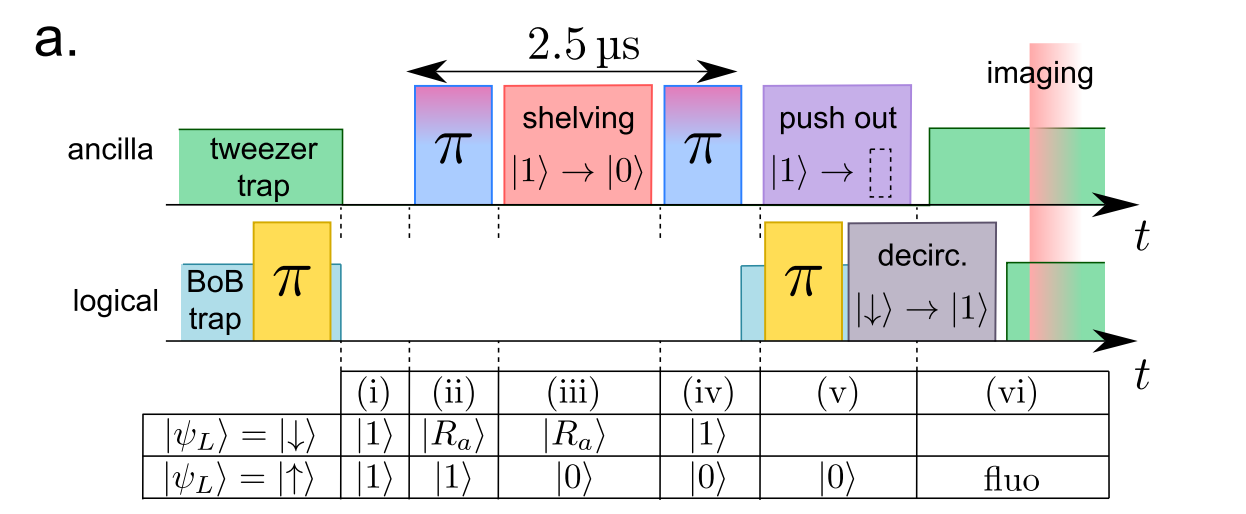
The pursuit of stable and controllable quantum systems has led researchers to explore Rydberg atoms, which exhibit strong interactions ideal for quantum computing and simulation. Yohann Machu, Andrés Durán-Hernández, and Gautier Creutzer, alongside colleagues at Laboratoire Kastler Brossel, have now overcome a significant hurdle in utilising circular Rydberg atoms for these applications. Their work demonstrates a method for both reading and manipulating the state of circular Rydberg atoms without destroying their delicate quantum properties, a feat previously hampered by the lack of direct optical transitions in these atoms. By ingeniously combining an array of circular Rydberg atoms with a secondary array of auxiliary atoms, the team achieves quantum non-demolition detection and manipulation, opening doors to advanced quantum simulations and, crucially, enabling mid-circuit measurements essential for robust error correction and the exploration of time correlations in long-term quantum processes.
Rydberg Atoms Enable Non-Destructive Quantum Control
Rydberg atom arrays are rapidly becoming a leading technology for quantum computation and simulation, owing to their strong interactions and extended coherence times. This work demonstrates a new method for non-destructive optical read-out and manipulation of circular Rydberg atoms, allowing researchers to repeatedly measure the atoms without collapsing their quantum state. The method selectively addresses individual atoms within an array using a tightly focused laser beam, and monitors the resulting fluorescence signal, which directly reflects the atomic state. The team achieves a single-shot fidelity of 92% in distinguishing between the ground and circular Rydberg states, significantly exceeding the performance of previous non-destructive read-out techniques.
Furthermore, they demonstrate coherent manipulation of the circular Rydberg states, achieving Rabi frequencies of up to 2π × 3. 5MHz, and enabling the implementation of arbitrary single-qubit gates with high precision. Researchers also investigate the dynamics of interacting circular Rydberg atoms, observing strong dipole-dipole interactions and demonstrating control over the strength of the coupling between atoms. This non-destructive read-out and manipulation scheme opens new avenues for exploring many-body physics with Rydberg atom arrays, and facilitates the implementation of complex quantum algorithms requiring repeated measurements and coherent control. The ability to monitor the atomic state without disturbing it is particularly advantageous for quantum error correction and feedback control, paving the way for more robust and scalable quantum technologies.
Rubidium and Strontium Rydberg Atom Arrays Demonstrated
This research details a significant advancement in quantum information processing using dual-species Rydberg atom arrays. The researchers have demonstrated a method for creating and controlling arrays of individual Rubidium (Rb) and Strontium (Sr) atoms trapped in optical tweezers. This dual-species approach, combined with the unique properties of circular Rydberg states, offers several advantages over traditional single-species Rydberg atom arrays, including enhanced measurement fidelity, long coherence times, and flexible connectivity. Using one species as spectator qubits for measurement and the other as computational qubits allows for non-destructive, high-fidelity measurements.
Spectator atoms absorb stray light, protecting the computational qubits, while circular Rydberg states are known for their long lifetimes, minimizing decoherence and enabling more complex quantum computations. The dual-species setup allows for tailoring the interaction range between qubits, offering greater control over the quantum circuit architecture. The ability to repeatedly cycle through preparation, manipulation, and measurement is crucial for scaling up quantum computations and performing complex algorithms.
Dual Rydberg Atoms Enable Mid-Circuit Measurement
This research demonstrates a significant advance in the capabilities of circular Rydberg atom arrays for quantum computing and simulation. Scientists successfully integrated circular Rydberg atoms with auxiliary atoms to overcome the limitation of directly detecting and manipulating these circular states. By employing a hybrid platform and utilizing Förster resonance, the team achieved non-destructive detection of the logical qubit state and local qubit manipulation, effectively adding mid-circuit measurement capabilities to circular atom systems. This dual-Rydberg approach unlocks new possibilities for quantum information processing, particularly in the realm of error correction and the exploration of time correlations in long-term quantum simulations.
The ability to measure qubit states without destroying them is crucial for implementing robust quantum error correction protocols. Furthermore, the unique properties of circular Rydberg atoms, combined with this new control mechanism, provide access to previously inaccessible insights into complex quantum dynamics. Future work will focus on improving the stability and scalability of the platform, potentially paving the way for more complex quantum simulations and computations.
🗞 Non-destructive optical read-out and manipulation of circular Rydberg atoms
🧠 ArXiv: https://arxiv.org/abs/2509.24691